High on its hilltop, the medieval city of Laon sets the tone: in the Aisne, history is carved into every stone. The battlefields of the Chemin des Dames, the Gothic abbeys of Soissons, the industrial utopia of the Familistere de Guise -- this northern French department spans the centuries with a depth that few territories can match. Add deep forests, quiet valleys and little-known Champagne vineyards, and you have one of the finest surprises in the north of France.
Laon: The Crowned Mountain
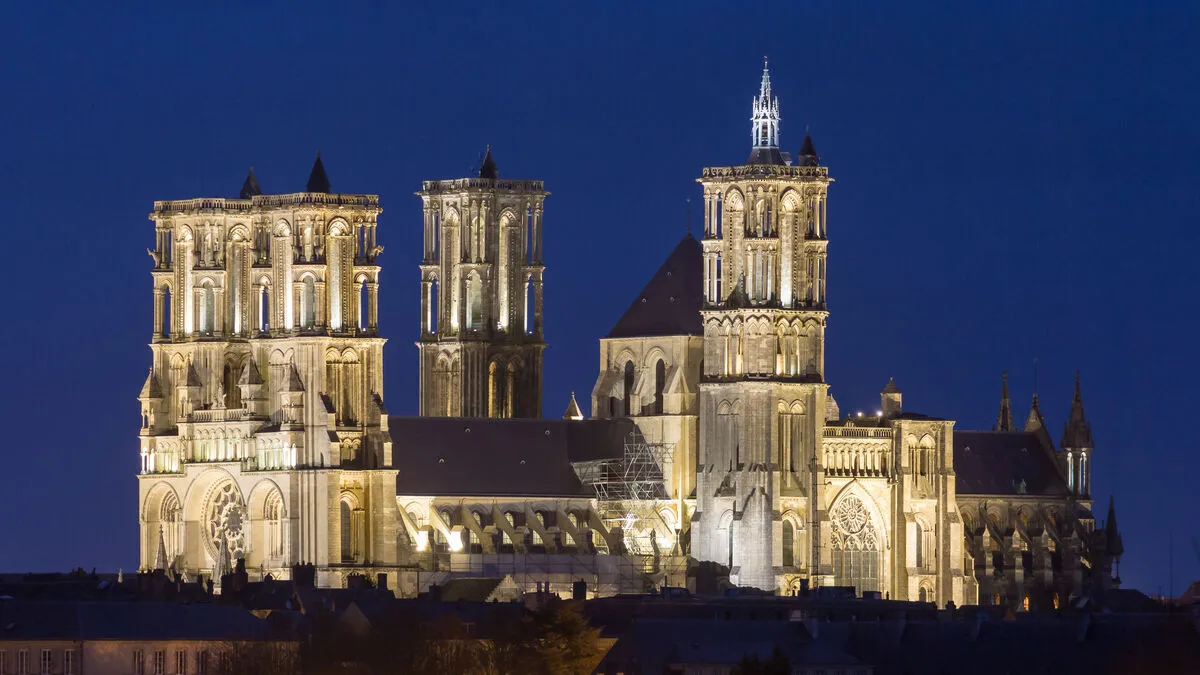
Laon is a revelation. The upper town sits atop a narrow, flat-topped ridge 181 metres above the surrounding plain, its skyline bristling with cathedral towers and ramparts. The effect, especially when seen from the approach roads, is breathtaking — a fortified city seemingly suspended in mid-air above the vast Picardy flatlands.
Notre-Dame Cathedral
Laon Cathedral, built between 1155 and 1235, is one of the earliest and purest examples of French Gothic architecture. Its west front, flanked by two immense towers, is considered one of the finest of any French cathedral. Look closely at the tops of the towers and you will spot sculpted oxen peering out — a charming tribute to the beasts that hauled building stone up the hill. Inside, the soaring nave bathes in a gentle luminosity. Climbing the tower (around 6 euros, booking recommended) rewards you with a staggering panorama — on a clear day, the view stretches more than 50 kilometres across the plain.
The Upper Town and the Poma
Laon's upper town is encircled by 7 kilometres of ramparts and preserves a remarkably intact medieval streetscape. Wander through lanes lined with houses spanning the 12th to the 18th centuries, discover the octagonal Templar Chapel (12th century), the former bishops' palace gardens, and the fortified gates. The Poma, a unique rubber-tyred automated cable car, whisks passengers from the lower town to the hilltop in 3 minutes for around 1.50 euros — a delightful curiosity in itself.
The Museum of Art and Archaeology (around 5 euros), housed in the former Templar commandery, holds an outstanding archaeological collection that includes Merovingian gold treasures and Greco-Roman artefacts from local excavations.
The Chemin des Dames: Landscape of Memory
The Chemin des Dames is a 30-kilometre limestone ridge running between the Aisne and Ailette valleys. Its graceful name — it was the route used by the daughters of Louis XV to reach the Château de la Bove — belies its grim significance. On 16 April 1917, a disastrous French offensive here resulted in catastrophic losses and triggered widespread mutinies. Today, the ridge is one of the Western Front's most moving memorial landscapes.
The Caverne du Dragon (Dragon's Lair) is the most powerful site. This underground quarry was occupied alternately — and sometimes simultaneously — by French and German troops, who lived just metres apart separated by thin walls of stone. The guided tour (environ 8 euros, 90 minutes, booking essential) descends into the galleries and brings the soldiers' claustrophobic existence vividly to life.
Along the ridge road (the D18), the Plateau de Californie offers immense views and a stark memorial, while the Cerny-en-Laonnois cemetery and memorial gather the graves of thousands of soldiers. Plan a half-day to drive the full length of the ridge and absorb the landscape with the contemplation it deserves.
Soissons: Cradle of France
Soissons was the first capital of the Frankish kingdom under Clovis, and the setting for the legendary episode of the Vase of Soissons. Despite heavy damage in both World Wars, the city retains remarkable treasures.
The Abbey of Saint-Jean-des-Vignes is Soissons' iconic landmark. Its soaring twin-spired Gothic façade — the church itself was demolished during the Revolution, but the façade survived — stands like a magnificent stage set in a landscaped park. The Cathedral of Saint-Gervais-et-Saint-Protais (12th–13th century), overshadowed by its famous neighbours in Reims and Laon, is a refined Gothic masterpiece whose south transept is particularly elegant.
The Soissons Museum (around 4 euros) houses exceptional finds, including Gallo-Roman wall paintings and Merovingian artefacts. History enthusiasts will also appreciate the crypt of the Abbey of Saint-Médard, one of the oldest Carolingian monuments in France.
The Familistère de Guise: A Utopia Made Real
The Familistère de Guise is one of the most extraordinary sites in France. Built from 1859 by industrialist Jean-Baptiste André Godin, manufacturer of cast-iron stoves, it was a "social palace" designed to provide workers with living conditions equal to those of the bourgeoisie: spacious, light-filled apartments, a school, a theatre, a swimming pool, gardens, a laundry, and cooperative shops.
The main building, the Social Palace, is a monumental complex of three wings arranged around courtyards covered with glass roofs. The architecture is stunning: stacked galleries flooded with zenithal light create a communal space of startling modernity. The visit (environ 9 euros, allow 2 to 3 hours) includes recreated apartments, the 400-seat theatre (a jewel), the gardens, and a permanent exhibition on this unique social experiment, which continued as a workers' cooperative until 1968.
Château-Thierry and the Champagne Vineyards
Château-Thierry is the gateway to the Aisne's Champagne vineyards. The birthplace of fabulist Jean de La Fontaine preserves a ruined medieval castle overlooking the Marne and a charming museum (environ 5 euros) in his childhood home, with illustrated editions and children's activities.
The real discovery, however, is the Marne Valley Champagne vineyard. Far from the grand houses of Reims and Épernay, small grower-producers here craft characterful champagnes, often based on Pinot Meunier, the signature grape of the valley. Tastings at these independent vignerons (environ 10 to 15 euros) are more intimate and often more enlightening than those at the big brands. The village of Crouttes-sur-Marne and the hillsides around Essômes-sur-Marne offer superb vineyard scenery.
The American Memorial on Cote 204, a hilltop above the town, commemorates the 1918 battles in which US troops halted the German advance. The panorama is outstanding.
The Forest of Saint-Gobain and Coucy-le-Château
Deep in the heart of the Aisne, the Forest of Saint-Gobain (9,000 hectares) is one of the finest beech woodlands in France, threaded with walking trails and scattered with ruins: abbeys, hermitages, and the original royal glassworks that gave birth to the multinational Saint-Gobain corporation.
On the forest's edge, Coucy-le-Château-Auffrique preserves the ruins of a feudal stronghold whose keep was once the largest in Europe — 31 metres in diameter and 54 metres tall, deliberately demolished by the German army in 1917. The surviving ramparts and towers still convey the fortress's extraordinary scale. Entry to the castle ruins is around 5 euros.
Practical Information
- When to visit: May to October for the best weather; the 11 November commemorations along the Chemin des Dames are particularly moving
- Getting around: a car is essential for exploring the département; Laon is reachable by regional train from Paris-Nord (1 hour 40 minutes)
- Budget: the Aisne is very affordable — expect 50 to 80 euros for a double room, 12 to 18 euros for a set lunch
- Suggested duration: 3 to 4 days for a thorough tour; a single day suffices for Laon and the Chemin des Dames
- Don't miss: the view from Laon Cathedral's towers, the Caverne du Dragon, the Familistère de Guise, and a grower champagne tasting in Château-Thierry
Explore on the map
Map →📚 Related collections
Related guides
 Regions
Ain: Bresse, Dombes and Pays de Gex
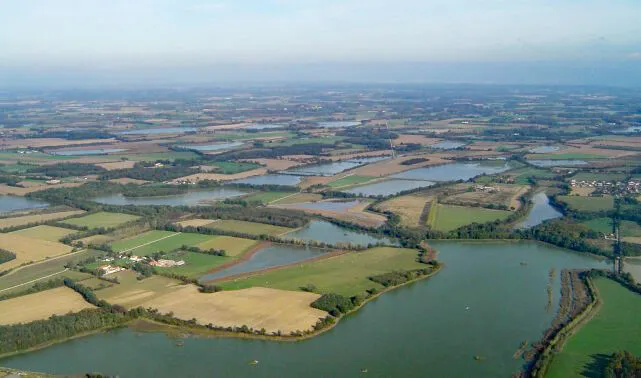
Discover the Ain: world-famous Bresse poultry, the thousand ponds of the Dombes, Pays de Gex facing Mont Blanc and the emerald gorges of Nantua. Complete guide.
 Regions
Allier: Vichy, Moulins and the Forest of Troncais
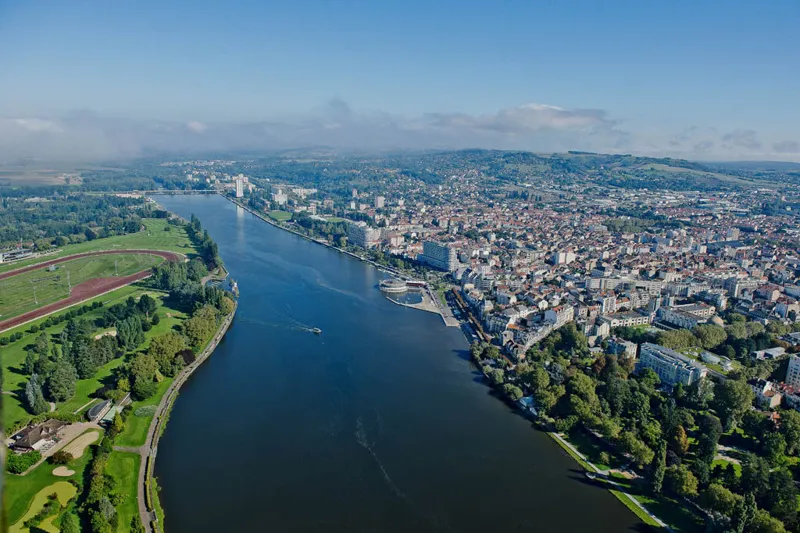
Discover the Allier: Vichy UNESCO spa town, Moulins ducal capital, the oak forest of Troncais and Bourbon-l'Archambault. Complete guide with practical tips.