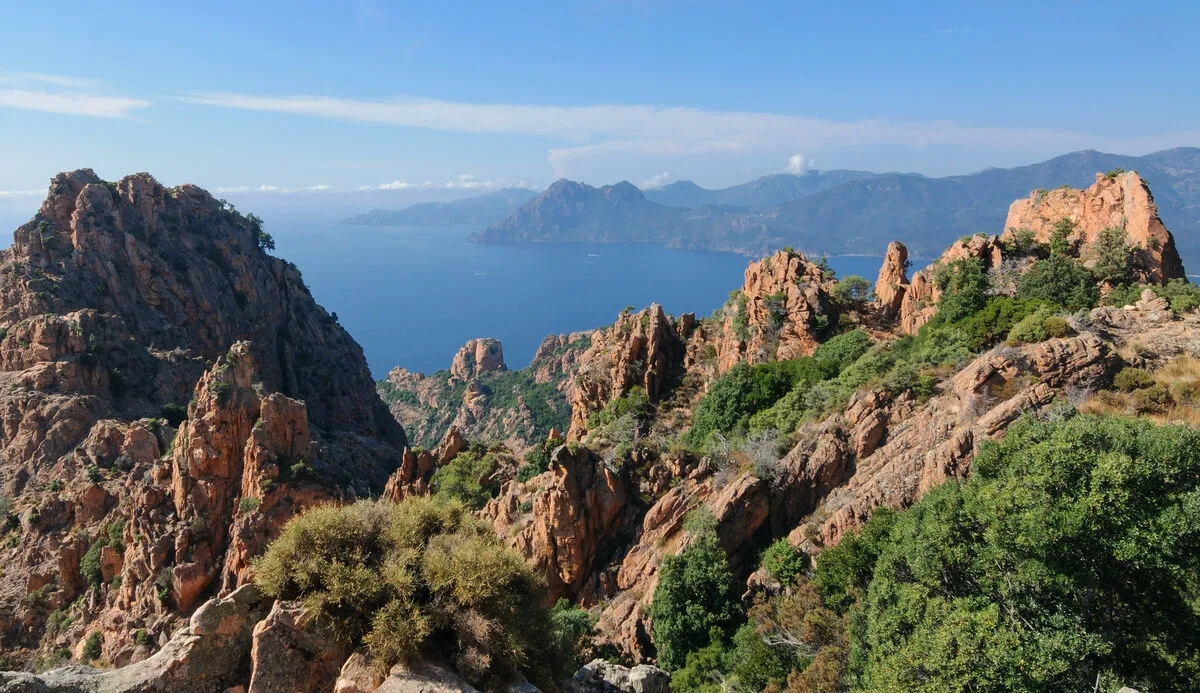
From the limestone cliffs of Bonifacio, one of the most vertiginous towns in the Mediterranean, you can see Sardinia on a clear day. South Corsica is the southern half of the island where mountains plunge into a sea of unreal colours, where Ajaccio basks in the golden light that witnessed Napoleon's birth, and where the Bavella Needles cut the sky like granite lace.
Ajaccio: The Imperial City
Ajaccio, préfecture of Corse-du-Sud and capital of Corsica, is a luminous city nestled in a magnificent gulf, backed by the snow-capped summit of Monte Cinto to the north. It is above all the city of Napoleon Bonaparte, born here on 15 August 1769.
The Maison Bonaparte and the Napoleon Museum
The Maison Bonaparte, the family home where the Emperor was born, is a national museum tracing Napoleon's childhood and youth through period furniture, family portraits and personal objects. Entry costs about 7 euros and the visit takes 1 hour. The Musée Fesch, housed in the palace built by Cardinal Fesch (Napoleon's uncle), holds the most important collection of Italian paintings in France after the Louvre, with works by Botticelli, Titian, Veronese and Bellini. Entry costs about 8 euros and the visit takes 1.5 to 2 hours. The adjoining Imperial Chapel houses the tombs of several Bonaparte family members.
The Old Town and the Market
The old town of Ajaccio, with its colourful lanes, palm-shaded squares and ochre and pastel façades, can be explored in 1 to 2 hours. The Place du Diamant (Place De Gaulle), with its equestrian statue of Napoleon surrounded by his four brothers, is the heart of Ajaccio life. The covered market on Place Campinchi, open every morning, overflows with Corsican charcuterie (lonzu, coppa, prisuttu, figatellu), sheep's-milk cheese (brocciu), maquis honey and Corsican wines. The harbour terraces offer a superb view of the gulf at sunset.
The Sanguinaires Islands
The Îles Sanguinaires, four islets of red porphyry at the entrance to the Gulf of Ajaccio, offer one of the most beautiful sunsets in the Mediterranean. The Route des Sanguinaires (D111), which follows the coast for 12 kilometres from Ajaccio, is a magnificent drive and walk. Boat trips to the islands depart from Ajaccio harbour (about 28 euros per adult, 1.5 hours). The Pointe de la Parata, accessible on foot, provides an exceptional viewpoint over the islands and the gulf.
Bonifacio: The Citadel on the Cliff
Bonifacio is arguably the most spectacular town in Corsica, perched on white limestone cliffs sculpted by wind and sea at the island's extreme south, facing Sardinia.
The Upper Town and the King of Aragon's Staircase
The Upper Town, enclosed by Genoese ramparts, is reached via the Montée Rastello or the Montée Saint-Roch. Its narrow streets lined with tall pastel-fronted houses, Romanesque churches and shaded squares create a unique setting. The King of Aragon's Staircase, 187 steps cut into the limestone cliff descending almost to the sea, is Bonifacio's emblematic site. Legend has it that these steps were carved in a single night by Aragonese troops during the 1420 siege. Access costs about 4 euros and the descent (then ascent) takes 30 minutes. The view from below of the cliffs and the sea is breathtaking.
The Cliffs and Sea Caves by Boat
The best way to discover Bonifacio is from the sea. Boat excursions (about 25 to 35 euros per adult, 1 hour) follow the dizzying white cliffs, 60 to 70 metres high, and enter sea caves hollowed by erosion, including the famous Sdragonato cave whose pierced ceiling traces the outline of Corsica. The view of the citadel from the sea, with houses hanging over the void, is unforgettable.
The Lavezzi Islands
The Lavezzi Islands, a nature reserve off Bonifacio, are an archipelago of wind-polished granite set in turquoise, crystal-clear waters worthy of the tropics. Shuttles from Bonifacio harbour (about 35 euros return) drop visitors on the main island for the day. Diving and snorkelling are outstanding, with abundant marine life (grouper, moray eels, starfish). A waymarked path circles the island in 1 hour, passing the memorial to the wreck of the Sémillante (1855). Note: there is no shade and no shops; bring water, food and sun protection.
The Calanques of Piana and the Gulf of Porto
The Calanques of Piana and the Gulf of Porto, inscribed on the UNESCO World Heritage list, form one of the most extraordinary natural landscapes in Europe.
The Calanques of Piana
The Calanques of Piana are a chaos of orange-red granite sculpted by erosion into fantastic shapes: towers, needles, organ pipes, hearts and human profiles succeed one another for 3 kilometres along the D81 between Porto and Piana. The road is spectacular but narrow: come in the morning or evening to avoid summer traffic jams. Several hiking trails penetrate the calanques, notably the mule path (1.5-hour round trip) descending to a hidden cove. The village of Piana, with its white houses and church on a shaded square, is listed among the Most Beautiful Villages in France.
Porto and the Scandola Reserve
Porto, a small settlement at the head of its gulf framed by red cliffs, is the departure point for boat trips to the Scandola Nature Reserve, accessible only by sea. This reserve, a UNESCO World Heritage Site, protects a volcanic coastline of red cliffs, caves, basalt organ pipes and waters populated by ospreys, cormorants and dolphins. Excursions last 2.5 to 4 hours depending on the route (about 45 to 65 euros per adult) and often include the fishing village of Girolata, reachable only by sea or by a mountain trail. The Genoese tower of Porto, atop the promontory, offers a panorama across the gulf for about 4 euros.
The Bavella Needles
The Aiguilles de Bavella, a chain of jagged granite peaks between 1,600 and 1,855 metres, form the most iconic mountain silhouette in Corsica.
The Pass and the Hikes
The Col de Bavella (1,218 m), crossed by the D268, offers a grandiose panorama of pink-granite needles rising above the Corsican pine (laricio) forest. It is the starting point for numerous hikes, from the gentle walk to the Trou de la Bombe (1.5-hour round trip), a natural arch with a plunging view of the valley, to more demanding ascents towards the needles themselves. The Purcaraccia natural pools, cascades and turquoise basins carved into the granite, are reached by a 1.5-hour trail (intermediate level). In summer, swimming in these ice-cold pools amid the forest is an incomparable pleasure.
Propriano, Sartène and the Interior
Sartène: The Most Corsican of Corsican Towns
Sartène, which Prosper Mérimée called "the most Corsican of Corsican towns," is a grey-granite town clinging to an amphitheatre of hills. Its old quarter of dark lanes, vaulted passages and tall, austere houses exudes an intense atmosphere. The Catenacciu, a Good Friday procession in which a chained penitent carries a cross through the town, is one of the most striking religious ceremonies in the Mediterranean. The Museum of Corsican Prehistory, housed in the former prison, holds remarkable collections (entry about 4 euros). Sartène takes 1 to 2 hours to explore.
The Southern Beaches
The coastline of South Corsica offers some of the finest beaches in the Mediterranean. Palombaggia, with its umbrella pines, fine sand and turquoise water, is regularly ranked among the most beautiful beaches in Europe. Santa Giulia, a wide bay of white sand with shallow water, is ideal for families. Rondinara, a perfectly circular cove between Bonifacio and Porto-Vecchio, is a preserved jewel. In summer, access to the most popular beaches is regulated and parking may cost 5 to 10 euros.
Practical Tips
Getting Around
Ajaccio-Napoléon-Bonaparte airport connects to major French cities and several European destinations. Ferries link Ajaccio to Marseille, Nice and Toulon (crossing 5 to 12 hours depending on the company, from 45 euros per person). A hire car is essential for exploring South Corsica: public transport is limited and distances, though short as the crow flies, are slow on mountain roads.
Best Time to Visit
May-June and September-October are the ideal months: the sea is warm enough for swimming, temperatures are mild, the maquis blooms in spring and the light turns golden in autumn. July-August is very hot and very busy, with prices that double. Spring is the season of maquis fragrances (cistus, myrtle, immortelle) that perfume the entire island.
Budget
This area is pricier than the French average, especially in high season. Expect to pay 70 to 110 euros per night for a decent hotel, 110 to 170 euros for a charming B&B or boutique hotel, and 170 to 300 euros for premium establishments. Meals range from 18 to 28 euros for lunch to 30 to 55 euros for dinner. To save money, book well in advance, stay slightly away from the most touristy zones (prices drop 20-30%), eat at markets and local food stalls rather than seafront restaurants, and take advantage of the many free activities: hiking, beaches, village walks, panoramic viewpoints.
Explore on the map
Map →📚 Related collections
Related guides
 Regions
Ain: Bresse, Dombes and Pays de Gex
Discover the Ain: world-famous Bresse poultry, the thousand ponds of the Dombes, Pays de Gex facing Mont Blanc and the emerald gorges of Nantua. Complete guide.
 Regions
Aisne: Laon's Medieval Citadel and the Chemin des Dames
Discover the Aisne département: Laon's hilltop medieval city, the Chemin des Dames battlefields, Soissons, the Familistère de Guise and Champagne vineyards. Complete travel guide.