In Le Puy-en-Velay, a 16-metre cast-iron Virgin stands atop one volcanic spire while a chapel clings to another. These two lava needles rising through the town sum up Haute-Loire: a remote territory set on the volcanic highlands of the Massif Central, where geology creates landscapes that look like something out of a dream.
Le Puy-en-Velay: A City on Volcanoes
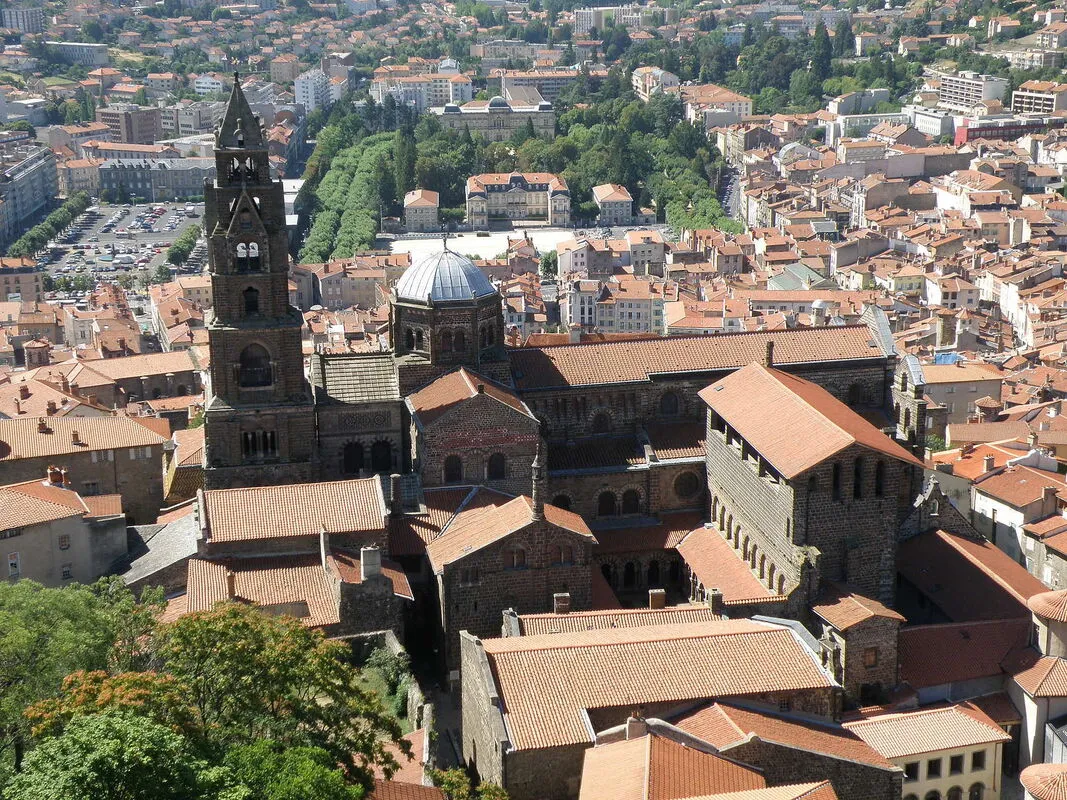
Nothing quite prepares you for the first sight of Le Puy-en-Velay. The city is built among volcanic plugs — jagged remnants of ancient eruptions — each one crowned by a monument: a red-iron Virgin Mary atop the Rocher Corneille, a chapel balanced on a basalt needle, a cathedral clinging to the slope of Mont Anis. It looks like something from a fantasy novel, yet it is entirely real.
Notre-Dame Cathedral
The Cathédrale Notre-Dame du Puy, listed as a UNESCO World Heritage Site as part of the Routes of Santiago de Compostela, is the spiritual heart of the city. Built between the tenth and twelfth centuries, it blends Romanesque, Byzantine and Moorish influences in a style found nowhere else in France. The approach is unforgettable — a long stone staircase climbs steeply and passes directly beneath the nave before emerging into the church. Inside, the venerated Black Madonna presides from the choir. The Romanesque cloister, with its polychrome arches and carved capitals, is a masterpiece of calm. The cathedral is free to enter; the cloister costs about 6 euros.
Chapelle Saint-Michel d'Aiguilhe
Standing 82 metres above the town on a volcanic needle, the Chapelle Saint-Michel d'Aiguilhe is Le Puy's most iconic sight. Built in 962 to commemorate a pilgrimage to Santiago de Compostela, it is reached by climbing 268 steps cut into the basalt. The reward is a dizzying panorama over the city and surrounding mountains, and the chapel itself — tiny, ancient, decorated with faded frescoes and fragments of mosaic barely visible in the half-light. Admission is about 4 euros. Go early in the morning for the best light and smaller crowds.
Green Lentils of Le Puy
Le Puy is the capital of the lentille verte du Puy, the only pulse to hold AOC status in France. Grown on volcanic soils between 600 and 1,200 metres altitude, these small green lentils have a nutty flavour and a firm texture that holds up beautifully in cooking. Every restaurant in town serves them — warm salads with bacon, velvety soups, side dishes with the local dry sausage. Buy a few bags at the Saturday market before you leave.
The GR65 Via Podiensis: Walking to Santiago
Each morning at dawn, pilgrims gather in the cathedral of Le Puy to receive a blessing, then set off on the GR65, the Via Podiensis. It is the most celebrated of the four French routes to Santiago de Compostela, and many walkers consider the opening stages through Haute-Loire to be the most beautiful of the entire journey.
The trail crosses landscapes of eroded volcanoes, flower-filled meadows and granite hamlets. Legendary stages follow one another: Saint-Privat-d'Allier perched on its cliff edge, the Allier gorges spanned by a medieval bridge, Saugues with its Tower of the English. Accommodation is in pilgrim hostels (gîtes d'étape) for 15 to 25 euros per night, where you share the evening meal with fellow walkers and rediscover the slow rhythm of life on foot.
Even if you have no intention of walking to Spain, a few days on the GR65 from Le Puy make for an unforgettable experience. Bring sturdy hiking boots and book your gîtes in advance during July and August.
Lavaudieu: A Romanesque Jewel
About thirty kilometres from Le Puy, the village of Lavaudieu is classified among the Plus Beaux Villages de France (Most Beautiful Villages). Its treasure is a Benedictine abbey founded in the eleventh century, which contains the only intact Romanesque cloister in Auvergne. Brick and volcanic stone arches frame a silent garden — sit for a moment and the present century quietly withdraws. The abbey church holds a striking fourteenth-century Italianate fresco depicting Death and Plague.
The village itself, with its dark lava-stone houses straddling the Senouire river, stone bridges and trailing wisteria, is thoroughly enchanting. A few artisan workshops and a village café complete the picture.
The Allier Gorges
The Allier river has carved spectacular gorges through the volcanic bedrock between Langeac and Brioude, creating one of the wildest landscapes in the Auvergne. The scenic railway through the gorges (departing from Langeac, tickets about 15 euros) offers a thrilling way to see them — the train hugs sheer cliff faces, plunges through tunnels and crosses viaducts high above the emerald water.
For the more adventurous, the Allier is one of France's premier rivers for canoeing and white-water rafting. Several outfitters run guided trips between May and September, with prices typically ranging from 25 to 40 euros per person.
Lac du Bouchet
The Lac du Bouchet is a textbook maar — a perfectly circular lake filling the crater of an extinct volcano, ringed by pine and beech forest. At 1,208 metres above sea level, it offers profound tranquillity. A 3-kilometre path circles the lake in about 45 minutes. Swimming is permitted in summer (unsupervised). It is a place suspended outside of time, perfect for an afternoon of quiet reflection far from any road noise.
La Chaise-Dieu: Abbey and the Dance of Death
Perched at 1,080 metres on the Margeride plateau, the abbey of La Chaise-Dieu (from Casa Dei, "House of God") is one of the great Benedictine foundations of France. The fourteenth-century Abbatiale Saint-Robert impresses with its grand proportions and almost Cistercian austerity.
The abbey's masterpiece is the celebrated Danse Macabre, a fifteenth-century fresco stretching 26 metres along one wall, in which Death leads figures from every walk of life — king, peasant, monk, merchant — in an inescapable dance. It is among the best-preserved examples in Europe. The intricately carved choir stalls and sixteenth-century Flemish tapestries add further depth to a remarkable visit.
Each summer, the Festival de La Chaise-Dieu transforms the abbey into a concert hall for a acclaimed festival of classical and sacred music. Tickets sell fast — book several months ahead.
Puy Lacemaking
An ancestral craft of the Velay region, dentelle du Puy (Puy lace) has been made with bobbins since the fifteenth century. The Lace Museum and Workshop in Le Puy-en-Velay traces the history of this tradition and features lacemakers at work. The finest pieces require hundreds of bobbins manipulated simultaneously — a mesmerising spectacle that reveals the extraordinary patience and skill involved. Allow about 45 minutes and around 5 euros admission.
Practical Information
Getting there: Le Puy-en-Velay is about 2 hours 15 minutes from Lyon by car (no direct TGV service). An express bus connects Lyon to Le Puy in roughly 2.5 hours. The nearest airport is Lyon-Saint-Exupéry.
Best season: May to October. Winters are harsh on these high plateaux. June is ideal for hiking; September brings beautiful autumn colours.
Suggested duration: 3 to 5 days, depending on whether you simply visit the sights or lace up your boots for a few stages on the GR65.
Budget: Haute-Loire is one of the most affordable départements in France. A couple can travel comfortably on 50 to 80 euros per day covering rural gîte accommodation, meals at country inns and admission fees.
Explore on the map
Map →📚 Related collections
Related guides
 Regions
Ain: Bresse, Dombes and Pays de Gex
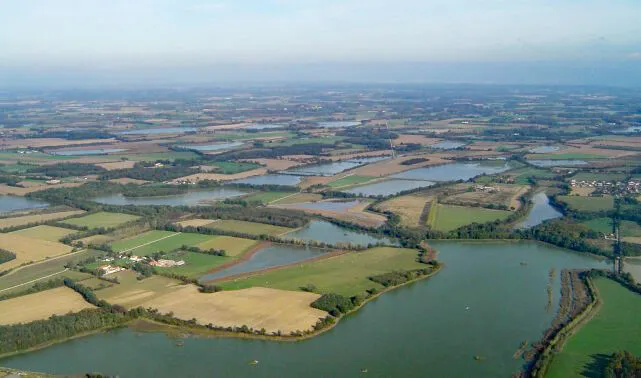
Discover the Ain: world-famous Bresse poultry, the thousand ponds of the Dombes, Pays de Gex facing Mont Blanc and the emerald gorges of Nantua. Complete guide.
 Regions
Aisne: Laon's Medieval Citadel and the Chemin des Dames
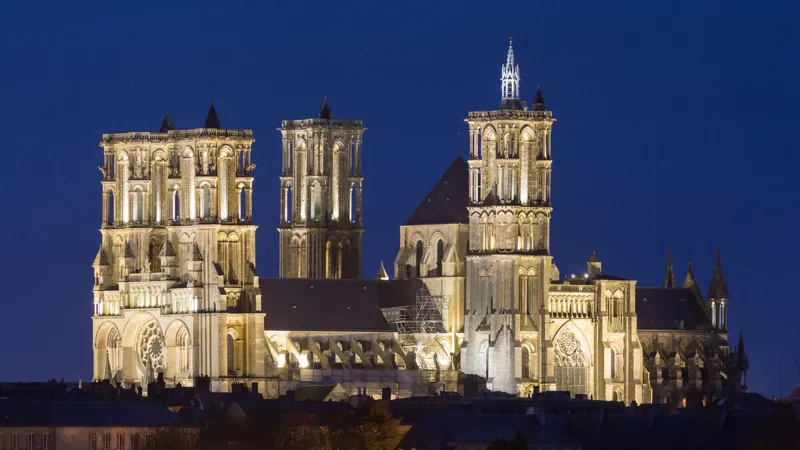
Discover the Aisne département: Laon's hilltop medieval city, the Chemin des Dames battlefields, Soissons, the Familistère de Guise and Champagne vineyards. Complete travel guide.