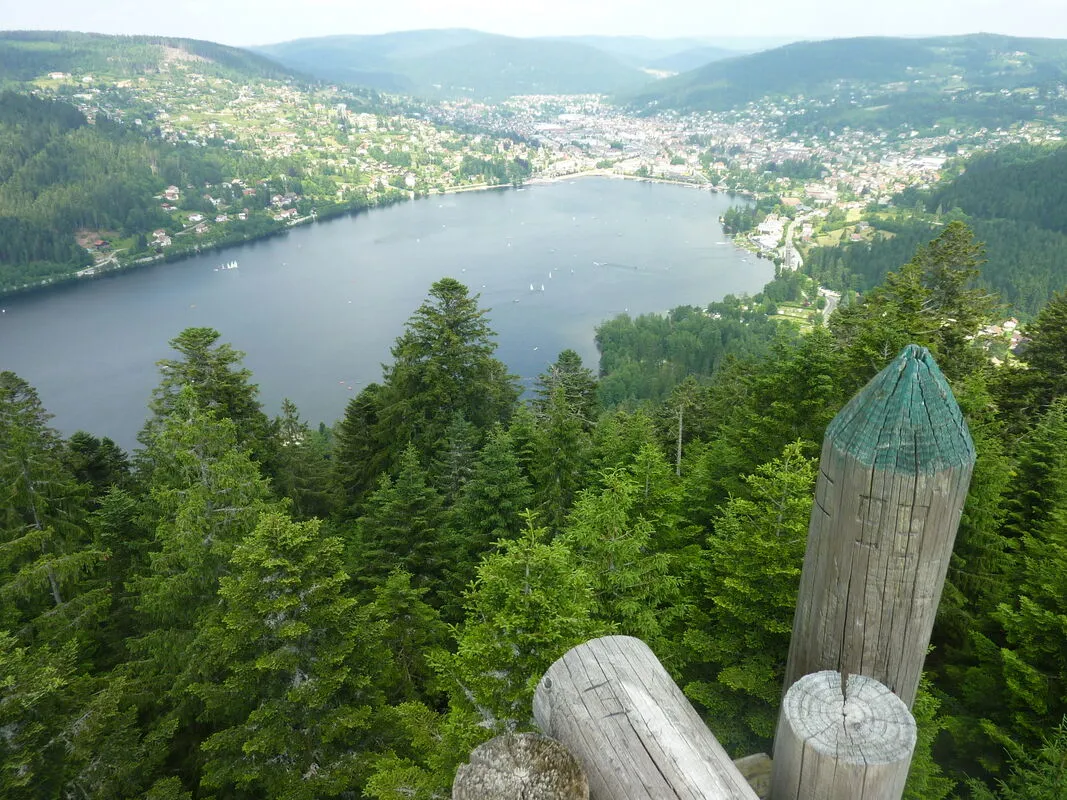
The Vosges are eastern France's gentle mountains. No vertiginous peaks or glaciers here, but instead rounded summits blanketed with high-altitude pastures called chaumes, vast forests of fir and spruce, and glacial lakes of a deep blue. Morning mist on Lac de Gerardmer, the scent of pines after rain, the farmhouse inn serving melting Munster with cumin: the Vosges are the mountains that comfort.
Épinal: City of Images
Épinal, préfecture of the Vosges, is known throughout France for its Images d'Épinal — colourful popular prints that have been illustrating fairy tales, fables, historical events, and scenes of daily life since the 18th century. The French expression "image d'Épinal," meaning an idealised, rosy picture, has entered everyday speech.
The Cité de l'Image (environ 8 euros, allow 90 minutes) is an interactive museum in the premises of the Imagerie d'Épinal, which still produces prints today. Visitors discover the manufacturing techniques — woodblock engraving, stencilling, hand colouring — and can watch live demonstrations. A workshop even lets you create your own print (environ 3 euros supplement), an original and authentic souvenir.
The Departmental Museum of Ancient and Contemporary Art (environ 5 euros) surprises with the quality of its holdings: Rembrandt, Georges de La Tour (including the celebrated "Job Mocked by His Wife"), and a strong contemporary section. The museum is set on an island in the Moselle, in a leafy setting.
Épinal also offers pleasant walks: the Parc du Cours, the Moselle quays, the Basilica of Saint-Maurice (Romanesque and Gothic), and the castle hill with panoramic views over the town and valley.
Gérardmer: The Pearl of the Vosges
Gérardmer is the département's flagship resort, dubbed "the Pearl of the Vosges" for the beauty of its lake and mountain setting. Lac de Gérardmer, the largest natural lake in the Vosges (115 hectares), lies at the head of a glacial valley surrounded by fir forests. Its clear waters, open for summer swimming (free beach, bracing water at 18 to 22 degrees C at best), mirror the surrounding mountains in a scene of perfect serenity.
In winter, Gérardmer becomes a family-friendly ski resort. The Mauselaine area offers 21 runs (green to black) between 750 and 1,150 metres altitude, plus cross-country skiing and snowshoeing trails. A day pass costs around 30 euros for an adult. Snow cover can be unreliable — this is not the Alps — but the charm of the snow-dusted forests and the warmth of the mountain lodges more than compensate.
The Daffodil Festival, a biennial event held in April (even-numbered years), is unique: floats decorated with thousands of wild daffodils parade through the town streets in an explosion of yellow and good cheer.
The Vosges Lakes
Lac de Gérardmer is not alone. Lac de Longemer, a few kilometres away, is wilder and quieter — ideal for canoeing and fishing. Lac de Retournemer, smaller and more secretive still, is set in a dark, mysterious glacial cirque. A hiking trail links all three lakes (~12 kilometres, 4 hours, moderate elevation gain) and is one of the most beautiful walks in the département.
The Route des Crêtes: Panoramas and Mountain Pastures
The Route des Crêtes is one of the finest scenic drives in France. Created during the First World War to link the Vosges valleys without being visible to the enemy (the Franco-German border then ran along the crest), it winds for 77 kilometres between the Col du Bonhomme and Cernay, offering grand panoramas on both sides: the Alsace plain and the Black Forest to the east, the Vosges valleys to the west.
The most spectacular viewpoints are the Grand Ballon (1,424 metres, the highest point of the Vosges), the Hohneck (1,363 metres, with views into three countries on a clear day), and the Markstein. On the chaumes — the broad grassy summit pastures — farm-inns (called marcaires) serve traditional meals: blueberry tart, roïgabrageldi (a gratinéed potato cake), farmhouse Munster cheese, and buttermilk. A marcaire meal costs around 15 to 22 euros and is one of the most authentic gastronomic experiences in the Grand Est region.
Plombières-les-Bains: Hot Springs and History
Plombières-les-Bains is a spa town nestled in a narrow valley, famous since Roman times for its hot springs (water temperatures ranging from 20 to 84 degrees C depending on the source). Napoleon III was a regular visitor, and it was in this improbable setting that the 1858 Pact of Plombières was negotiated, paving the way for Italian unification.
The town preserves eclectic spa-era architecture — neoclassical baths, Second Empire hotels, bandstands, and parks — that tells two millennia of bathing history. The Thermes Napoléon offers treatments and access to a wellness area (from environ 18 euros for pool access). Plombières ice cream, created here according to legend for Napoleon III, is a frozen dessert studded with candied fruit and kirsch, available in local patisseries (environ 4 to 6 euros).
The Vosges Mountains: Hiking and Waterfalls
The Vosges are a hiker's paradise. The GR5, which crosses the range from north to south, passes through the département's finest landscapes. Among the most popular hikes:
The Cascade du Tendon (a 32-metre waterfall and a smaller neighbour) is reached by an easy 20-minute trail from the car park (free). The peat bogs of the Vologne valley, rare and fragile ecosystems, are explored on boardwalk paths. The Saut des Cuves, a series of giant potholes carved by the Vologne river near Gérardmer, is an impressive sight after rainfall.
In winter, beyond downhill skiing at Gérardmer and La Bresse, the département has an excellent network of cross-country ski and snowshoe trails around Lac de Lispach, the Plateau des Mille Étangs (on the Haute-Saône side), and the Hohneck chaumes.
Remiremont and Vosges Traditions
Remiremont, at the foot of the mountains, is a small, elegant town built around a former abbey of noble canonesses. Its Rue Charles-de-Gaulle, lined with arcades, is one of the finest shopping streets in Lorraine. The Musée Charles-de-Bruyères (environ 4 euros) displays painting and decorative-art collections in a refined setting.
Traditional Vosges crafts remain vibrant: violin-making in Mirecourt (the town has produced violins since the 17th century), lace-making in Luxeuil, mountain cheeses (Munster, Géromé), and fruit brandies (mirabelle, raspberry, kirsch) all shape the département's cultural identity.
Practical Information
- When to visit: every season has its charm — summer for hiking and lakes, autumn for colours and mushroom foraging, winter for skiing and Christmas markets, spring for the daffodil festival
- Getting around: a car is essential; Épinal is 2 hours 30 minutes from Paris by TGV (via Nancy); Gérardmer is 50 minutes from Épinal by road
- Budget: an affordable département — 55 to 90 euros per double room, 15 to 22 euros for a farm-inn meal
- Suggested duration: 4 to 5 days for a thorough tour; 2 days are enough for Gérardmer and the Route des Crêtes
- Don't miss: a meal in a farm-inn on the mountain pastures, the Route des Crêtes on a clear day, Lac de Gérardmer, and a visit to the Cité de l'Image in Épinal
Explore on the map
Map →📚 Related collections
Related guides
 Regions
Ain: Bresse, Dombes and Pays de Gex
Discover the Ain: world-famous Bresse poultry, the thousand ponds of the Dombes, Pays de Gex facing Mont Blanc and the emerald gorges of Nantua. Complete guide.
 Regions
Aisne: Laon's Medieval Citadel and the Chemin des Dames
Discover the Aisne département: Laon's hilltop medieval city, the Chemin des Dames battlefields, Soissons, the Familistère de Guise and Champagne vineyards. Complete travel guide.