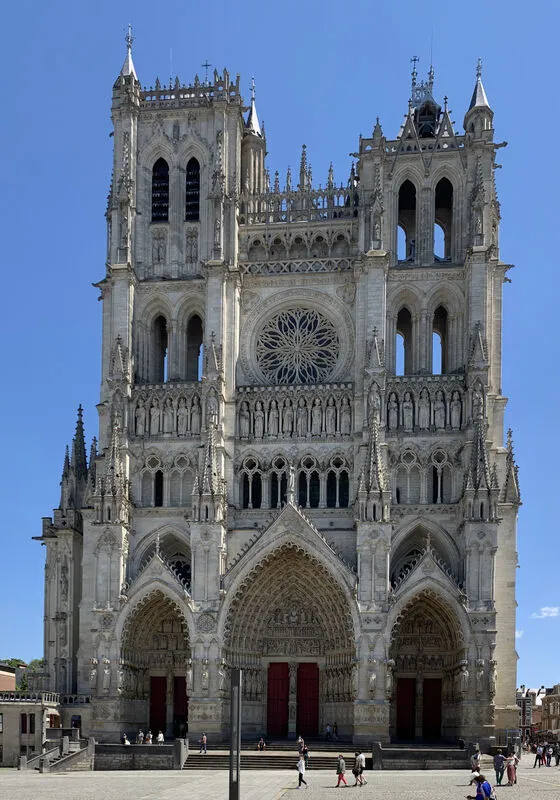
The cathedral of Notre-Dame d'Amiens is the largest in France -- bigger than Notre-Dame de Paris. On summer evenings, its facade lights up in colour, recovering the polychrome the centuries have erased. Two grand spectacles anchor the Somme: Amiens and its hortillonnages, floating gardens unique in the world, and the Bay of the Somme, one of the finest estuaries in Europe, where seals bask on sandbars at low tide.
Amiens: The Cathedral and the Floating Gardens
Notre-Dame Cathedral
The Cathedral of Notre-Dame d'Amiens is simply the largest Gothic cathedral in France by interior volume — you could fit Notre-Dame de Paris inside it twice over. Inscribed on the UNESCO World Heritage List, it was built in the remarkably short span between 1220 and 1288, which gives it an exceptional architectural unity. The west front, adorned with more than 3,000 statues, is a veritable book in stone; the central portal, devoted to the Last Judgment, is of extraordinary delicacy.
The interior astonishes with its height (42.30 metres to the vault) and luminosity. The choir stalls, carved in the 16th century by Picard craftsmen, form one of the finest ensembles of wood sculpture in Europe — more than 4,000 biblical and secular figures in a dazzling profusion of detail. On summer evenings and in December, the Polychromy light show projects the original medieval colours onto the cathedral facade — a revelation that transforms one's understanding of the building. The show is free.
The Hortillonnages
The Hortillonnages of Amiens are a 300-hectare network of floating gardens threaded with narrow canals (called rieux), a legacy of market gardening that dates back to the Middle Ages. A guided boat tour in a traditional flat-bottomed barque à cornet (environ 7 euros, 45 minutes) is a unique experience: you glide in near-silence between cultivated plots, secret gardens, weeping willows, and lush vegetation — all within the city centre. On Saturday mornings, a floating market continues the centuries-old tradition of selling produce directly from the boats.
The Saint-Leu Quarter
The Saint-Leu quarter, at the foot of the cathedral, was once home to dyers and weavers and is laced with channels of the Somme. Its colourful half-timbered houses, footbridges spanning the canals, and waterside restaurants make it the vibrant heart of the city — a miniature Bruges where locals come to dine and linger on warm evenings.
The Bay of Somme: Vastness and Light
The Bay of Somme is one of France's largest estuaries and one of the most spectacular natural sites on the entire Channel coast. Classified as a Grand Site de France and a member of the club of the world's most beautiful bays, it reveals at low tide vast stretches of sand and mudflat where the light shifts hour by hour and season by season. Turner and Degas, Colette and Jules Verne — Amiens' most famous son — all fell under its spell.
Seals in the Bay
The Bay of Somme is home to France's largest colony of harbour seals (around 400 individuals) and a growing population of grey seals. They can be observed at low tide, hauled out on the sandbanks near the Pointe du Hourdel. Naturalist guides lead accompanied walks (environ 8 to 12 euros, 2 to 3 hours) to approach the seals respectfully — binoculars are essential. The best viewing conditions occur 1 to 2 hours before low tide.
Crossing the Bay on Foot
The cross-bay walk from Saint-Valery to Le Crotoy (or vice versa) is an unforgettable experience. Led by a compulsory guide (environ 8 euros, 3 to 4 hours), you walk barefoot across the wet sand, ford tidal channels, spot birds and distant seals, and feel the immensity of the place in your bones. The crossing depends on tides and weather — booking is essential.
Saint-Valery-sur-Somme: The Medieval Gem
Saint-Valery-sur-Somme is the jewel of the Bay. This small medieval port — from which William the Conqueror set sail for England in 1066 — preserves a walled upper town, flower-filled lanes, fishermen's cottages of pebble and brick, and sweeping views across the estuary. The Porte de Nevers, the Guillaume towers, and the sailors' quarter are landmarks on an enchanting walk.
The quays, lined with seafood restaurants, are the perfect place to enjoy Bay mussels, fresh cockles, or a ficelle picarde (a gratinéed crêpe filled with ham and mushrooms). Allow 15 to 25 euros for a full meal with a view of the Bay.
Le Crotoy: The South-Facing Beach
On the opposite side of the estuary, Le Crotoy is a genteel seaside resort whose unique distinction is a beach facing due south — the only one on the entire English Channel coast. The light is exceptional, and you begin to understand why Seurat and Toulouse-Lautrec came here to paint. Jules Verne wrote Twenty Thousand Leagues Under the Seas in a villa overlooking the Bay.
The oyster port produces excellent Bay of Somme oysters that can be sampled on the spot, directly from the producers, from around 8 euros a dozen. The Friday morning market is particularly lively.
The Bay of Somme Steam Railway
The Chemin de Fer de la Baie de Somme is one of France's finest heritage railways. Its historic steam trains link Le Crotoy, Saint-Valery, and Cayeux-sur-Mer along the edge of the estuary (environ 14 euros return, about 1 hour each way). The slow pace, the plume of steam, and the scenery of salt marshes and dunes make for a journey out of time. In high season, themed trains (jazz evenings, dinner on board) add a festive touch.
Remembrance: The Somme Battlefields
The Battle of the Somme (July–November 1916) was one of the deadliest in history: over one million casualties in five months. The département preserves a memorial landscape of rare intensity.
The Thiepval Memorial, the largest British war memorial in the world, bears the names of 72,337 soldiers with no known grave. Its mass of red brick, designed by Lutyens, is deeply moving. The adjacent museum (free) sets the battle in context. The Newfoundland Memorial at Beaumont-Hamel (free), managed by Canada, preserves a battlefield virtually untouched — trenches, shell craters, skeletal trees — in a state of preservation that is chilling. The Historial de la Grande Guerre in Péronne (environ 9 euros) offers a comparative perspective on the war as experienced by French, British, and German soldiers.
Practical Information
- When to visit: May to September for the Bay (seals are present year-round); summer for the cathedral Polychromy show; November for migratory birds
- Getting around: Amiens is 1 hour 15 minutes from Paris by TGV; a car is essential for the Bay and the memorials
- Budget: an affordable département — 55 to 90 euros per double room; 15 to 25 euros for a seafood meal in the Bay
- Suggested duration: 4 to 5 days to see everything; 2 days for the Bay of Somme alone
- Don't miss: Amiens Cathedral (and its summer Polychromy show), a cross-bay walk, the seals at Le Hourdel, and a steam train ride along the estuary
Explore on the map
Map →📚 Related collections
Related guides
 Regions
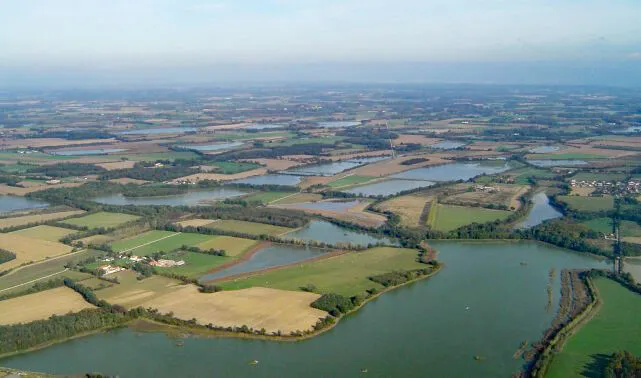
Ain: Bresse, Dombes and Pays de Gex
Discover the Ain: world-famous Bresse poultry, the thousand ponds of the Dombes, Pays de Gex facing Mont Blanc and the emerald gorges of Nantua. Complete guide.
 Regions
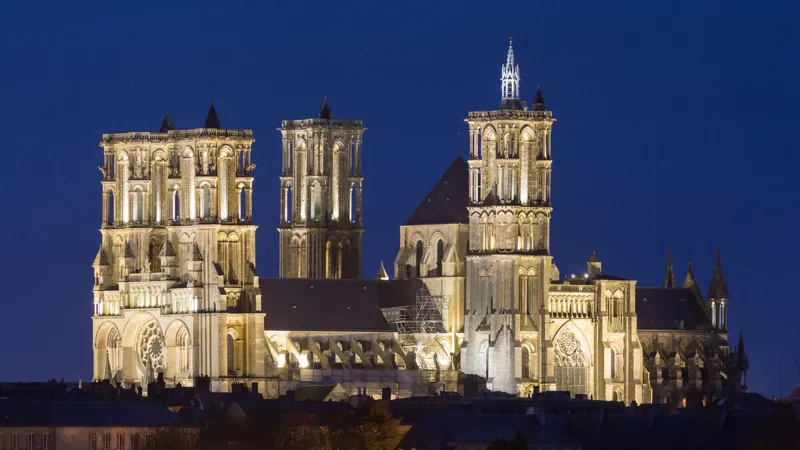
Aisne: Laon's Medieval Citadel and the Chemin des Dames
Discover the Aisne département: Laon's hilltop medieval city, the Chemin des Dames battlefields, Soissons, the Familistère de Guise and Champagne vineyards. Complete travel guide.