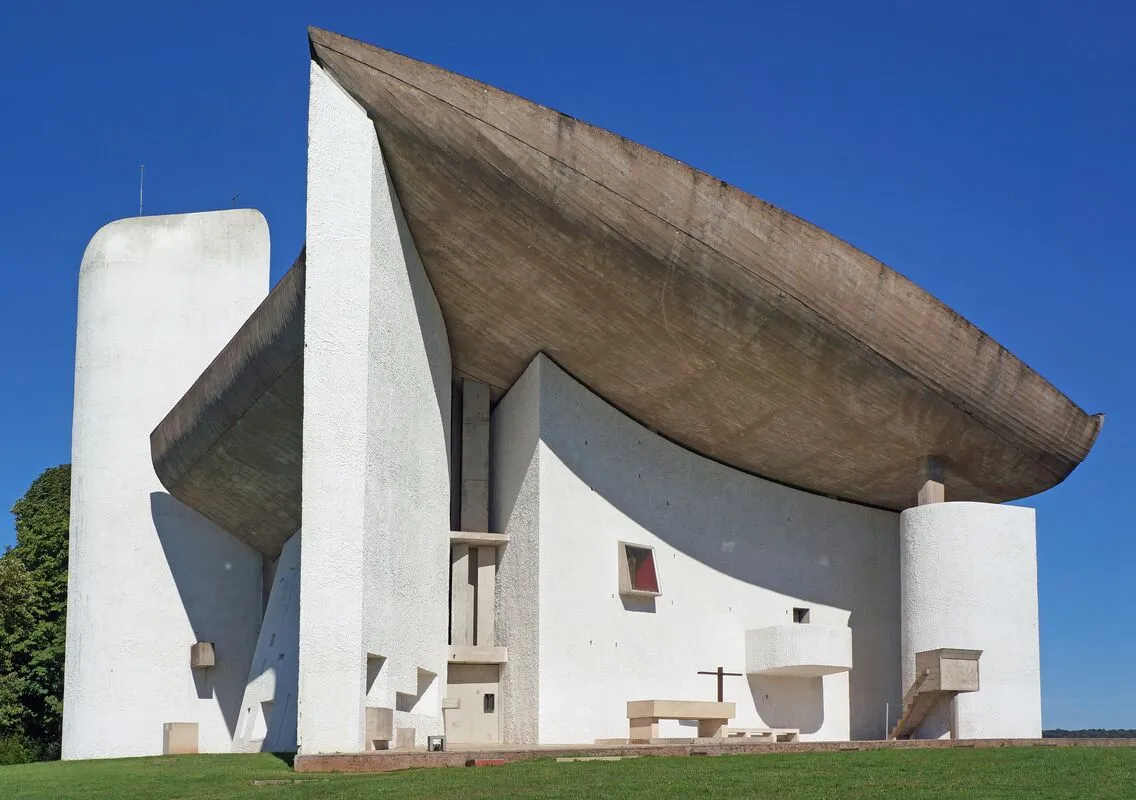
At Ronchamp, Le Corbusier's chapel of Notre-Dame-du-Haut rises on its hilltop like a white vessel set down on the grass. This major twentieth-century landmark captures the spirit of Haute-Saone: an unexpected treasure in a department almost nobody thinks to visit. Gentle hills, deep forests, thermal villages -- everything here invites a slow-motion journey, far from beaten tracks.
Vesoul, the Understated Capital
The Colline de la Motte
Vesoul, préfecture of Haute-Saône, is a pleasantly human-scaled town best discovered by looking up toward the Colline de la Motte, a limestone butte that commands the centre from its 378-metre summit. The easy ascent takes roughly twenty minutes and rewards walkers with a 360-degree panorama sweeping across the Vosges, the Jura and, on clear days, the first Alpine peaks. An orientation table helps identify the landmarks. It is where locals gather at sunset, and you should join them.
The Musée Georges-Garret
The Musée Georges-Garret (free admission) occupies a former Ursuline convent and holds an eclectic collection ranging from Gallo-Roman archaeology to nineteenth-century painting, including a remarkable group of sculptures by Jean-Léon Gérôme, the town's most famous son and a celebrated Orientalist painter of the Second Empire. The museum is well worth an hour and constitutes a pleasant surprise in a city of this size.
The Old Town
The historic centre of Vesoul preserves handsome townhouses from the sixteenth and seventeenth centuries, vaulted passages and interior courtyards that reveal themselves to those who wander. The Church of Saint-Georges, with its classical facade and luminous interior, anchors a stroll that leads naturally to the shores of Lac de Vesoul-Vaivre, a large lake equipped for swimming, pedalos and lakeside walks (free access).
Luxeuil-les-Bains, a Millennial Spa Town
Thermal Heritage with Roman Roots
Luxeuil-les-Bains is one of the oldest thermal spa towns in France. Its hot springs, already exploited by the Romans, feed a modern thermal establishment offering treatments in rheumatology, phlebology and wellness stays. The Thermes de Luxeuil provide access to a relaxation area with thermal pools, hammam and saunas from approximately 18 euros for two hours. It is the perfect stop for recharging after a day of hiking or sightseeing.
The Abbey and Medieval Heritage
Luxeuil also owes its fame to its abbey, founded in 590 by the Irish monk Saint Columban. This monastery was one of the most influential in Merovingian Europe, establishing daughter houses across the continent. While the original abbey has largely disappeared, the Basilica of Saint-Pierre retains magnificent Romanesque capitals and a classified organ. The adjacent cloister hosts exhibitions in summer. The town also possesses an exceptional ensemble of arcaded houses from the fifteenth and sixteenth centuries, among the best preserved in Franche-Comté.
Luxeuil Lace
Luxeuil is the birthplace of a lacemaking tradition dating to the seventeenth century. The Conservatoire de la Dentelle (free entry) presents this unique needle-lace technique, distinct from bobbin lace. Demonstrations by lacemakers are regularly organised, and handmade pieces can be purchased in the adjoining shop — a distinctive souvenir with genuine artisanal pedigree.
Ronchamp, Le Corbusier's Masterpiece — UNESCO
The Chapel of Notre-Dame du Haut
The Chapelle Notre-Dame du Haut at Ronchamp is one of the most iconic works of twentieth-century architecture. Built between 1950 and 1955 by Le Corbusier on a hilltop overlooking the small former mining town, it was inscribed on the UNESCO World Heritage list in 2016 as part of Le Corbusier's architectural contribution. Its unique silhouette — a curving concrete roof evoking the prow of a ship, white walls pierced by irregular windows with coloured glass — overturns every convention of religious architecture.
The interior, bathed in subdued light filtering through openings of varying sizes and hues, creates an atmosphere of extraordinary contemplation. The site visit (around 8 euros) also includes the Monastery of the Poor Clares and the Porterie, two buildings added by Renzo Piano in 2011 in respectful dialogue with Le Corbusier's work. The landscaped park surrounding the chapel offers remarkable views over the Vosges and the plain below.
Ronchamp's Mining Heritage
Before becoming a landmark of architecture, Ronchamp was an active coal basin from the eighteenth century until 1958. The Musée de la Mine (around 4 euros) traces the history of this industry through scale models, tools and personal testimonies. A reconstructed mine gallery conveys the harsh conditions in which miners worked. It provides a compelling context for the chapel, grounding Le Corbusier's commission in the social fabric of the community it was built to serve.
The Ognon Valley and the Saône
Pesmes, One of the Most Beautiful Villages
Pesmes, classified among the Most Beautiful Villages of France, is a medieval jewel set on the banks of the Ognon river. Its stone houses with limestone-slab roofs, Renaissance château, stairway lanes and old bridge compose an ensemble of irresistible charm. The village is home to working artisans — ceramicists, sculptors, painters — whose studios welcome visitors. The Saturday morning summer market is a small gem of authenticity.
Gray and the Baron Martin Museum
Gray, sub-prefecture of Haute-Saône, is a town of character set on the banks of the Saône. Its Musée Baron Martin (free admission), housed in a seventeenth-century château, holds a remarkable collection of Flemish paintings, old master drawings and period furniture. The stone bridge over the Saône and the shaded quays invite leisurely strolling. Cyclists will enjoy the voie verte (greenway) that follows the Saône for dozens of kilometres on flat terrain.
Nature and Outdoor Activities
The Thousand Ponds Plateau
In the north of the département, the Plateau des Mille Étangs (Thousand Ponds) is a landscape unique in France. A legacy of the last ice age, this territory scattered with hundreds of ponds, peat bogs and heathland evokes an almost Scandinavian atmosphere. Marked hiking trails thread through this mysterious country. The Mille Étangs interpretive trail (approximately 6 kilometres, 2 hours) is the best introduction to this singular ecosystem. Access is free.
The Saône by Canoe
The Saône, a tranquil and generous river, is ideal for a canoe descent. Several operators offer trips of 2 to 6 hours between Ray-sur-Saône and Gray, with return transport included. Prices start at around 20 euros per person. The Château de Ray-sur-Saône, perched on its cliff above the river, provides a spectacular departure point and is itself worth a visit for its beautifully restored interiors.
Practical Information
Getting there: Vesoul is approximately 2 hours 30 minutes from Paris by car (A5 then N19). Vesoul station is served by regional trains from Besançon (40 minutes) and Belfort (50 minutes). The nearest TGV stop is Besançon Franche-Comté TGV.
Getting around: A car is virtually essential. The departmental roads cross bucolic landscapes and are rarely congested. The greenways along the Saône and the Ognon are perfect for cycling.
Best time to visit: May to September for outdoor activities and the thermal baths. June is ideal for the Thousand Ponds, when the water is covered in water lilies. Autumn colours the beech forests. Winter is very quiet, but the Ronchamp chapel remains open year-round.
Budget: Haute-Saône is one of the least expensive destinations in France. Set menus in village restaurants start at 12 euros. Bed-and-breakfasts offer rooms from 45 euros for two. Local specialities to seek out: cancoillotte (a liquid Franc-Comtois cheese spread), griottines from Fougerolles (cherries preserved in kirsch) and kirsch de Fougerolles, the only cherry brandy with AOC status in France.
Explore on the map
Map →📚 Related collections
Related guides
 Regions
Ain: Bresse, Dombes and Pays de Gex
Discover the Ain: world-famous Bresse poultry, the thousand ponds of the Dombes, Pays de Gex facing Mont Blanc and the emerald gorges of Nantua. Complete guide.
 Regions
Aisne: Laon's Medieval Citadel and the Chemin des Dames
Discover the Aisne département: Laon's hilltop medieval city, the Chemin des Dames battlefields, Soissons, the Familistère de Guise and Champagne vineyards. Complete travel guide.