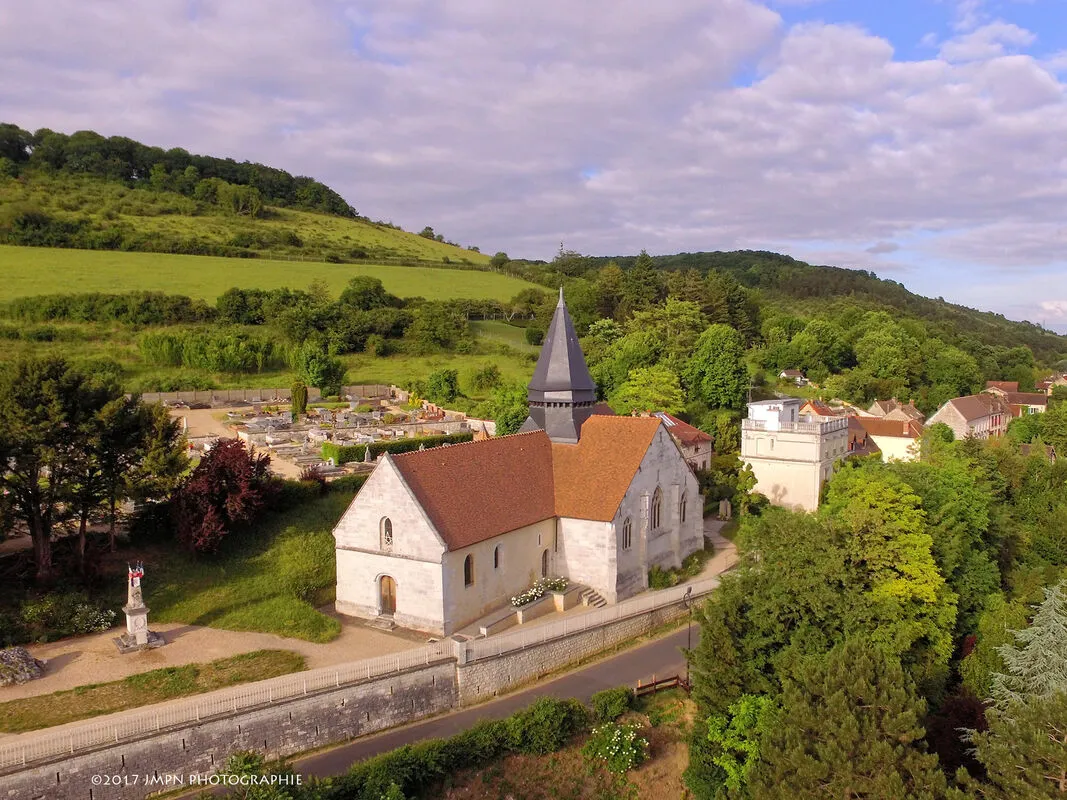
Monet did not choose Giverny by chance. The Norman light, the meanders of the Seine, the deep forests of the Eure compose a tableau that changes with every hour. This Green Normandy department is the one most travellers rush through on their way to the coast -- a mistake this guide intends to correct.
Giverny: Walking Into an Impressionist Painting
Giverny is where Claude Monet lived and painted for 43 years, from 1883 until his death in 1926. This small village on the banks of the Seine became the birthplace of some of the most famous paintings in the world — the Water Lilies, the Japanese Bridge, the haystacks.
The Monet House and Gardens (~11 euros) are divided into two parts. The Clos Normand, in front of the house, is a riot of planned colour from April to October — tulips, irises, peonies, roses, and nasturtiums bloom in carefully designed waves. The Water Garden, across a small road, is the world of the Nympheas — a pond of water lilies crossed by the wisteria-draped Japanese bridge that Monet painted endlessly.
The house itself is a delight: the yellow dining room, the blue-tiled kitchen, and walls hung with Japanese prints reveal the man behind the masterpieces. Allow 90 minutes to 2 hours for the full visit.
Practical advice: The gardens are open from late March to early November. Arrive at the 9:30am opening or after 4pm to dodge the heaviest crowds. May and June offer the peak flowering season. Parking is free nearby.
The Museum of Impressionisms (~8 euros), 200 metres from the house, hosts high-quality temporary exhibitions that contextualise Monet within the broader movement. Give Giverny a full half-day to appreciate it without rushing.
Chateau Gaillard: Richard the Lionheart's Stronghold
Perched on a chalk cliff high above a sweeping bend of the Seine, Chateau Gaillard is one of the most spectacularly sited castles in France. Richard the Lionheart built it in a single year (1197-1198) to block the French king's advance on Rouen, and even in ruins the fortress radiates defiant power.
The outer grounds are freely accessible year-round; the inner keep costs about 4 euros (open April to November). The view from the top is extraordinary — the Seine loops below in a vast meander framed by white cliffs and forest. It ranks among the finest panoramas in the entire Seine valley.
The village of Les Andelys at the foot of the cliff has a peaceful old quarter and a handsome collegiate church. Several marked hiking trails let you combine the castle visit with a walk along the clifftops, taking 2 to 3 hours for the full loop.
Lyons-la-Foret: Fairytale Village in a Cathedral of Beeches
Lyons-la-Foret is classified among France's Most Beautiful Villages, and it earns every syllable of the title. Timber-framed houses cluster around an 18th-century covered market hall, surrounded by the Forest of Lyons, one of the finest beech forests in Europe.
Claude Chabrol chose the village as the setting for his film adaptation of Madame Bovary, and the timeless atmosphere makes it easy to see why. The central square with its wooden market hall, the ancient bakery, and the flower-laden facades compose a quintessentially Norman scene. The composer Maurice Ravel lived here and wrote Le Tombeau de Couperin in this setting.
The forest itself is magnificent for walking or cycling. Centuries-old beeches form cathedral-like canopies over the paths, and the light filtering through the leaves is mesmerising in autumn. Nearby, the ruins of Mortemer Abbey (12th century, set in a landscaped park, ~8 euros) add a touch of Gothic mystery with their associated ghost legends.
The Seine Valley: Cliffs, Meanders, and Hidden Villages
The Seine cuts through the Eure in wide, lazy meanders bordered by chalk cliffs. This stretch of the valley is a landscape treasure that remains surprisingly unvisited. The road between Vernon and Les Andelys passes through picture-postcard countryside — flint-and-plaster villages, apple orchards, and wooded islands midstream.
Vernon, the gateway to Giverny, has its own charm. The Vieux Moulin (Old Mill), a half-timbered structure perched on the piers of a ruined medieval bridge, is one of the most photographed images in Normandy. The collegiate church of Notre-Dame and the tower of the former castle are also worth a look.
Further south, the Cote des Deux-Amants offers a dramatic natural viewpoint over the confluence of the Seine and Andelle rivers. According to legend, a young man had to carry his beloved to the summit to win her hand — he died of exhaustion, and she died of grief. The panorama, at least, is life-affirming.
Bec-Hellouin Abbey: Medieval Learning and Monastic Peace
Le Bec-Hellouin is one of the prettiest villages in the Eure — a single street of impeccably kept timber-frame houses. But its fame rests on the Abbey of Bec, founded in 1034. This was one of medieval Europe's great intellectual centres; two of its abbots went on to become Archbishops of Canterbury, exporting Norman learning to England.
The abbey is still home to a community of Olivetan monks. Guided tours (about 7 euros, varying schedules) take you through the abbey church, cloisters, and gardens. The atmosphere is genuinely contemplative. The monastic shop sells handmade ceramics crafted by the monks themselves.
Pont-Audemer, Verneuil-sur-Avre, and Other Hidden Gems
Pont-Audemer is nicknamed the "Venice of Normandy" for the canals of the River Risle that thread through its centre. Half-timbered houses lean over the waterways, and the narrow lanes invite aimless wandering. The Church of Saint-Ouen contains remarkable Renaissance stained glass worth seeking out.
At the département's southern edge, Verneuil-sur-Avre was once a frontier fortress town between Normandy and France. Its three medieval churches, the richly sculpted Madeleine Tower rising 56 metres, and streets of ancient houses make it a heritage stop of the first order — with virtually no tourist crowds.
Louviers, between Rouen and Evreux, surprises visitors with its Church of Notre-Dame, whose south porch is one of the most extravagantly decorated examples of Flamboyant Gothic in Normandy. The town's medieval prosperity came from the wool trade, and traces of that wealth appear on every corner.
Practical Tips
- Best time to visit: May to June for Giverny's gardens in peak bloom; October for autumn colours in the Forest of Lyons
- Getting around: Vernon is 45 minutes from Paris Saint-Lazare by train; a shuttle runs from Vernon station to Giverny in season. A car is essential for the rest of the département
- Budget: The Eure is one of the most affordable areas in Normandy for accommodation; expect 60 to 90 euros for a quality B&B
- Suggested duration: 3 to 4 days for a full circuit; 1 day if visiting Giverny alone
- Don't miss: Giverny at opening time, the Chateau Gaillard panorama at sunset, and a walk beneath the beeches of Lyons-la-Foret
Explore on the map
Map →📚 Related collections
Related guides
 Regions
Ain: Bresse, Dombes and Pays de Gex
Discover the Ain: world-famous Bresse poultry, the thousand ponds of the Dombes, Pays de Gex facing Mont Blanc and the emerald gorges of Nantua. Complete guide.
 Regions
Aisne: Laon's Medieval Citadel and the Chemin des Dames
Discover the Aisne département: Laon's hilltop medieval city, the Chemin des Dames battlefields, Soissons, the Familistère de Guise and Champagne vineyards. Complete travel guide.