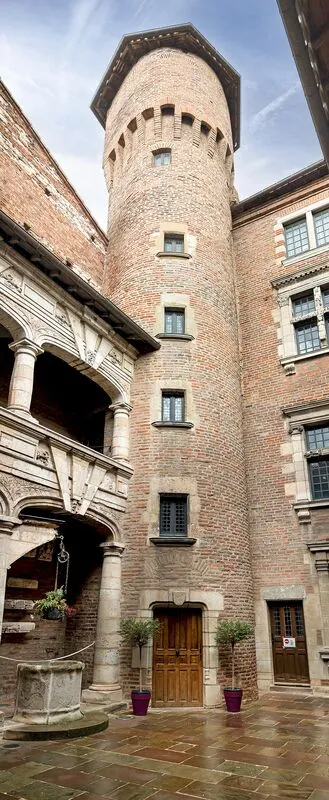
The Cathedrale Sainte-Cecile in Albi, a fortress of red brick towering above the Tarn, is the largest brick cathedral in the world. Inside, a 200-square-metre Last Judgement and a rood screen of astonishing delicacy justify the journey alone. The Tarn department then unfurls its treasures along the river: the Sidobre and its granite boulders stacked as if by giants, the hilltop villages of the Pays de Cocagne, and the Gaillac vineyards, among the oldest in France.
Albi: The Episcopal City
The Cathédrale Sainte-Cécile
The Cathédrale Sainte-Cécile in Albi is an architectural experience without parallel. From the outside, it looks more like a fortress than a place of worship: a sheer mass of red brick rising 40 meters, austere and imposing, with no visible flying buttresses or rose windows. This martial appearance is a legacy of the thirteenth-century Cathar Crusade -- the cathedral was built to assert the power of the Roman Church over a land deemed heretical.
Step inside and everything changes. The interior is an explosion of color: vaults entirely covered in Italian Renaissance paintings depicting the Last Judgment, heaven and hell, across nearly 18,500 square meters of painted surface -- the largest in Europe. The rood screen of flamboyant stone lacework, one of the few surviving in France, separates the nave from the choir with astonishing delicacy. Entry to the cathedral is free. The enclosed choir costs about 3 euros to visit and is well worth it.
The Toulouse-Lautrec Museum and the Palais de la Berbie
Adjacent to the cathedral, the Palais de la Berbie, the former fortified residence of Albi's bishops, has housed the Musée Toulouse-Lautrec since 1922. It holds the world's largest collection devoted to the painter who was born in Albi in 1864. More than a thousand works trace his entire career: early family portraits, scenes of the Moulin Rouge and Montmartre, the groundbreaking posters that revolutionized advertising art, and incisive drawings of Parisian cabaret life. Entry costs approximately 10 euros. Allow at least 90 minutes.
The gardens of the Palais de la Berbie, laid out in terraces above the Tarn, offer one of the finest viewpoints over the river, the eleventh-century Pont-Vieux and the red rooftops of the old town. Access to the gardens is free.
The Pont-Vieux and the Tarn Riverbanks
The Pont-Vieux, built around 1040, is one of the oldest bridges in France still in regular use. Its arches span the Tarn in a scene that reflects in the green water below, framed by the red mass of the cathedral and the Berbie. The riverbanks have been developed into a pedestrian promenade that follows the Tarn for several kilometers, offering shifting perspectives on the episcopal city. The entire episcopal city of Albi has been a UNESCO World Heritage Site since 2010.
Cordes-sur-Ciel
The Bastide in the Clouds
Cordes-sur-Ciel, classified among the Plus Beaux Villages de France, is a Gothic bastide founded in 1222 by the Count of Toulouse in the aftermath of the Cathar Crusade. Perched on a conical hill 300 meters above the valley, it sometimes emerges on autumn mornings from a sea of fog filling the Cérou Valley, giving the impression of floating in the sky -- hence its name.
Cobbled lanes spiral upward through four successive rings of fortifications to the summit. The Gothic houses along the Grand-Rue Raymond VII, with their ogival windows and carved hunting and falconry scenes, are among the finest in Occitanie. The medieval market held in July draws thousands of visitors. Allow at least 90 minutes to explore on foot. Access to the village is free; a small tourist train links the car park to the top (about 4 euros).
The Sidobre
Granite Chaos
The Sidobre is a granite plateau unique in Europe, located between Castres and Lacaune. Across roughly 50 square kilometers, erosion has sculpted the granite into fantastical forms: balancing rocks, stacked chaos, rivers of stone. The most famous site is the Peyro Clabado, a 780-tonne boulder balanced on a tiny pedestal in apparent defiance of gravity. Nearby, the Roc de l'Oie (Goose Rock) and the Chapeau de Napoléon (Napoleon's Hat) complete this natural gallery.
The Lac du Merle, fringed by granite formations, is an ideal starting point for marked walks lasting from 30 minutes to 2 hours. The trails are well maintained, shaded and suitable for families. Access is free. The Sidobre is also a major center of the French granite industry, and several quarries offer guided tours.
Gaillac and Its Vineyards
One of the Oldest Vineyards in France
The Gaillac wine region is one of the oldest in France, with origins dating to the first century AD. Its vineyards spread across the hillsides on either side of the Tarn, producing a remarkably varied range: robust reds from Braucol and Duras grapes, dry and sweet whites from Mauzac and Loin de l'Oeil (Len de l'El), and an ancestral sparkling wine, the méthode gaillacoise, which predates Champagne.
The Abbaye Saint-Michel, overlooking the river in the heart of town, houses the Maison des Vins de Gaillac, where visitors can taste and purchase local wines. Numerous estates welcome visitors in the surrounding hills, often with views over the Tarn Valley. Tastings are generally free or at token cost. The Gaillac wine festival in early August turns the town center into a vast open-air tasting room.
Castres
The Goya Museum and Le Nôtre's Gardens
Castres, the sub-prefecture of the Tarn, is a lively town on the River Agout, known for its colorful half-timbered houses on stilts lining the riverbank. The Musée Goya -- Musée d'Art Hispanique, housed in the former bishop's palace, holds the largest collection of Spanish art in France outside the Louvre. Works by Goya (including an exceptional series of engravings), Velázquez, Murillo and Pacheco hang in elegant period rooms. Entry costs about 5 euros.
The Jardin de l'Évêché, designed by André Le Nôtre, the gardener of Versailles, is a miniature formal French garden best viewed from the museum windows above. Its geometric boxwood parterres and flower beds overhang the Agout. Access is free.
Ambialet and Sorèze
A Meander and an Abbey School
Ambialet occupies one of the most dramatic river meanders in France: the Tarn loops so tightly here that the peninsula narrows to just 30 meters at its neck. A Romanesque priory crowns the rocky promontory, offering an aerial view over the river below. It is a peaceful place for a stroll and a perfect stop along the way.
Sorèze, at the foot of the Montagne Noire, is home to a former abbey school founded in the eighth century and later converted into a royal military academy under Louis XVI. Today the site houses a hotel-restaurant and the Musée Dom Robert, devoted to contemporary tapestries inspired by nature (entry about 7 euros). The gardens and grounds are freely accessible.
Practical Tips
Getting Around
Albi is one hour from Toulouse by car (75 km) and connected by regional TER train (about 1 hour 10 minutes). A car is needed for the Sidobre and the wine country. Roads are pleasant and well maintained.
Suggested Itinerary: 4 to 6 Days
- Day 1: Albi -- Cathédrale Sainte-Cécile, Toulouse-Lautrec museum, Pont-Vieux.
- Day 2: Cordes-sur-Ciel and Gaillac vineyards.
- Day 3: Castres -- Goya museum, Jardin de l'Évêché, Ambialet.
- Day 4: Sidobre -- Peyro Clabado, Lac du Merle.
- Days 5-6: Sorèze, Montagne Noire, wine detours.
Best Time to Visit
April to June and September to October offer ideal weather. Summer is hot but pleasant in the higher Sidobre. Autumn in the Gaillac vineyards is particularly beautiful.
Budget
Accommodation ranges from 50 to 80 euros per night for a budget hotel, 80 to 130 euros for a B&B or charming hotel, and 130 to 220 euros for upscale options. A restaurant lunch runs 14 to 22 euros, dinner 25 to 40 euros. Local farmers' markets provide excellent produce for picnics at reasonable prices. Hiking, village exploration and most churches are free. Paid sites and museums cost 6 to 15 euros per person. To keep costs in check, look for weekday set-lunch menus, stay in rural gites or quality campsites, and enjoy the free tastings many local producers offer.
Explore on the map
Map →📚 Related collections
Related guides
 Road trips
The Alsace Wine Route: Vineyards and Charming Villages
Explore the Alsace Wine Route from Marlenheim to Thann. Picturesque villages, wine tastings and tips for an unforgettable road trip.
 Road trips
Aude: Carcassonne and Cathar Country
Guide to the Aude: Carcassonne citadel, Cathar castles, Canal du Midi, Narbonne, Fontfroide Abbey. Vertiginous fortresses and Languedoc vineyards.