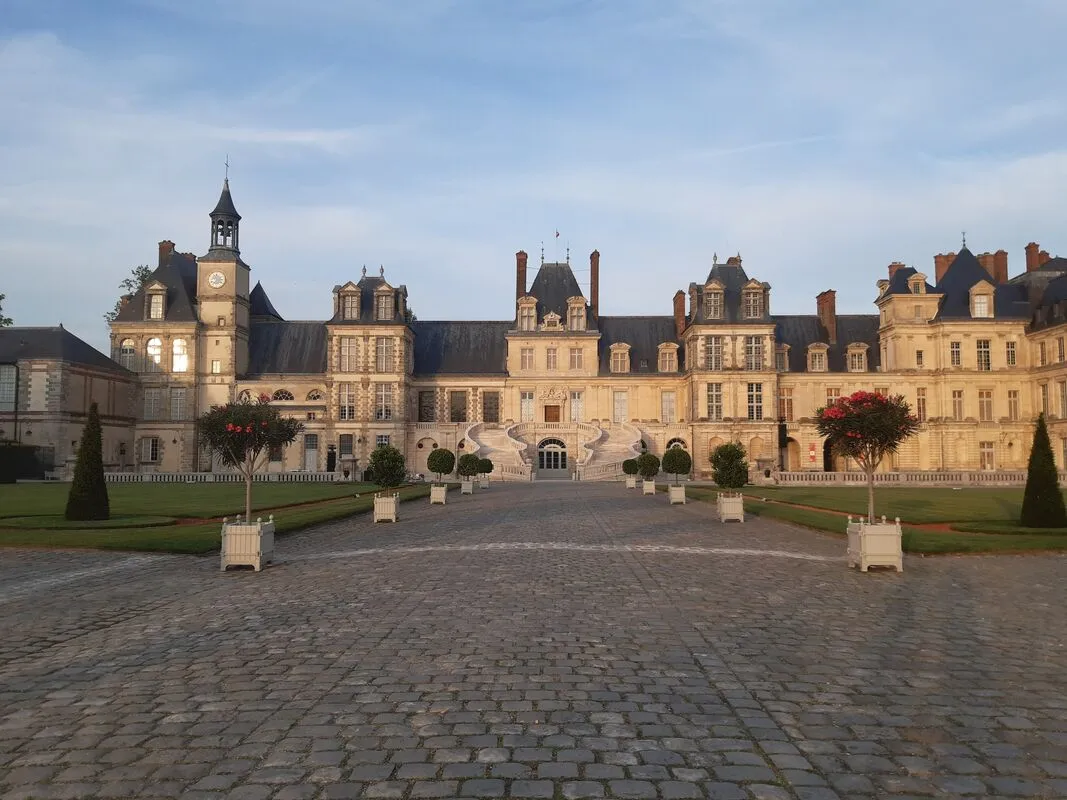
The forest of Fontainebleau, playground of Impressionist painters and boulder-climbers from around the globe, covers 25,000 hectares at the gates of Paris. The chateau, which saw Francois I, Napoleon and de Gaulle pass through, is the largest in France. But Seine-et-Marne, the biggest department in Ile-de-France, also hides Provins, a fortified medieval town inscribed as a UNESCO World Heritage Site, and Brie countryside where the cheese still flows in artisan dairies.
Fontainebleau: The Palace and the Forest
Fontainebleau embodies the perfect alliance between culture and nature. The Château de Fontainebleau, a royal residence for eight centuries, is one of the largest and most richly furnished palaces in France. Unlike Versailles, built as a single project, Fontainebleau is an architectural palimpsest where every era left its mark: the Francis I Gallery with its Renaissance frescoes, Napoleon's private apartments, and the recently restored Imperial Theatre. Admission costs around 12 euros (free on the first Sunday of each month), and you should allow at least 2 to 3 hours for a thorough visit.
The gardens are free to enter and deserve a long stroll. The English garden, the Grand Parterre — the largest formal garden in Europe — and the canal offer magnificent perspectives in every season. In spring, the wisteria draped over the Fountain Courtyard is spectacular.
The Forest of Fontainebleau
The Forest of Fontainebleau is a natural treasure spanning 25,000 hectares, classified as a UNESCO biosphere reserve. Its sandstone boulder fields, sandy gorges, and centuries-old oak trees make it a paradise for hikers and climbers. Bouldering has been practised here for over a century, and sites like Bas Cuvier, Isatis, and Apremont attract climbers from around the world. No fancy gear needed: a crash pad, climbing shoes, and a guidebook are enough.
For walkers, the Denecourt-Colinet trails marked in blue offer varied routes. The Gorge aux Loups, Mont Aigu, and Gorges de Franchard are must-sees. In autumn, the forest puts on a blazing display of colour and mushroom hunters comb the undergrowth.
Practical tip: park at Franchard or Bas-Bréau car parks for quick access to the best trails. The tourist office sells detailed IGN maps (around 6 euros).
Provins: UNESCO Medieval City
Provins, in the southeast of the department, is a genuine journey through time. This former capital of the Counts of Champagne, listed as a UNESCO World Heritage Site since 2001, preserves a remarkable medieval ensemble. The 13th-century ramparts still encircle the upper town for over a kilometre, offering a unique panoramic walk.
The Tour César, a 12th-century octagonal keep, dominates the city and provides striking views over the rooftops of Provins and the Brie countryside. Admission is around 5 euros. At its foot, the Collegiate Church of Saint-Quiriace testifies to the ambition of the Counts of Champagne, who aspired to build a cathedral.
The Underground Passages and Medieval Shows
The underground passages of Provins form a network of galleries dug from the 12th century onwards, used for storing wool and by cloth workers. The guided tour (environ 5 euros) is fascinating and refreshingly cool in summer. From May to October, the medieval shows — Les Aigles des Remparts (equestrian falconry) and La Légende des Chevaliers (jousting) — are genuine crowd-pleasers. Expect around 14 euros per show or 22 euros for a combined ticket.
On Saturday mornings, the Provins market sets up its stalls in the lower town. Do not leave without tasting the Rose of Provins, available as jam, sweets, syrup, and even mustard. This rose, brought back from the Crusades by Thibaud IV of Champagne, is the town's emblem.
Vaux-le-Vicomte: The Château That Inspired Versailles
The Château de Vaux-le-Vicomte, at Maincy near Melun, is a 17th-century jewel. Built for Nicolas Fouquet, Superintendent of Finances to Louis XIV, by the genius trio of Le Vau (architect), Le Brun (painter), and Le Nôtre (landscape designer), this estate was so magnificent that it provoked the Sun King's jealousy. Fouquet was arrested, and Louis XIV appropriated his artists to create Versailles.
The château visit (environ 18 euros, gardens included) reveals superbly furnished interiors, including the grand oval salon topped by a dome painted by Le Brun. Le Nôtre's French formal gardens, with their embroidered parterres, fountains, and perspectives, are considered his masterpiece.
Not to be missed: the candlelight evenings held every Saturday from May to October. Over 2,000 candles illuminate the gardens and château, creating a magical atmosphere. Supplement of around 8 euros on top of the daytime ticket.
Disneyland Paris: Magic on the Capital's Doorstep
Whether you are a theme park enthusiast or not, Disneyland Paris at Marne-la-Vallée is an institution. Opened in 1992, the resort comprises two parks — Disneyland Park and Walt Disney Studios — attracting over 15 million visitors annually.
A single-park day ticket starts at around 56 euros online (variable pricing by date), and a two-park ticket at approximately 81 euros. To avoid queues, favour Tuesdays and Wednesdays outside school holidays, and arrive at opening time. Disney Premier Access (from 8 euros per ride) can dramatically cut waiting times on headline attractions.
Budget tip: book your tickets in advance on the official website for the best rates. Disney hotels are expensive, but Val d'Europe partner hotels offer more affordable options from around 80 euros per night.
Rural Heritage and Villages
Beyond these major sites, Seine-et-Marne harbours quiet treasures. Moret-sur-Loing, where Impressionist painter Alfred Sisley lived, is a charming village on the river with old houses and a medieval bridge. Barbizon, on the edge of Fontainebleau forest, was the birthplace of the pre-Impressionist painting school. The Auberge Ganne, now a museum (environ 6 euros), traces that era when Millet, Corot, and Rousseau painted en plein air.
Blandy-les-Tours has one of the rare medieval castles still standing in Île-de-France (environ 6 euros admission). Its towers and keep offer a plunge into 14th-century military architecture. Further north, Meaux merits a stop for its Gothic cathedral and its Great War Museum (environ 10 euros), one of Europe's most important on the 1914-1918 conflict.
Seine-et-Marne Gastronomy
Seine-et-Marne is a farming department proud of its local produce. Brie de Meaux and Brie de Melun, both AOC cheeses, are absolute essentials. Brie de Meaux is creamy and mild, while Brie de Melun is smaller and more pungent. Visit the Maison du Brie in Meaux to learn all about their production.
Moutarde de Meaux, produced since 1632 by the Pommery house, is an old-fashioned wholegrain mustard. For those with a sweet tooth, the sucre d'orge de Moret (barley sugar), made by nuns since the 17th century, is a unique artisanal confection.
Craft beer and cider lovers will find several local breweries that have emerged in recent years, offering farm-gate tastings for around 5 to 8 euros.
Practical Tips
- When to visit: April to June for gardens in bloom and fine weather without summer crowds, September to October for autumn colours in the Fontainebleau forest
- Getting around: RER A serves Marne-la-Vallée, Transilien R connects Paris-Gare de Lyon to Fontainebleau-Avon and Moret, but a car is essential for Provins and Vaux-le-Vicomte
- Food budget: expect 15 to 25 euros for a lunch menu at a village inn, 25 to 45 euros at Fontainebleau restaurants
- Suggested duration: 3 to 5 days for a full tour of the department, 1 day per major site
- Must-do experiences: a candlelight evening at Vaux-le-Vicomte, a bouldering session in Fontainebleau forest, and a medieval show in Provins
Explore on the map
Map →📚 Related collections
Related guides
 Regions
Ain: Bresse, Dombes and Pays de Gex
Discover the Ain: world-famous Bresse poultry, the thousand ponds of the Dombes, Pays de Gex facing Mont Blanc and the emerald gorges of Nantua. Complete guide.
 Regions
Aisne: Laon's Medieval Citadel and the Chemin des Dames
Discover the Aisne département: Laon's hilltop medieval city, the Chemin des Dames battlefields, Soissons, the Familistère de Guise and Champagne vineyards. Complete travel guide.