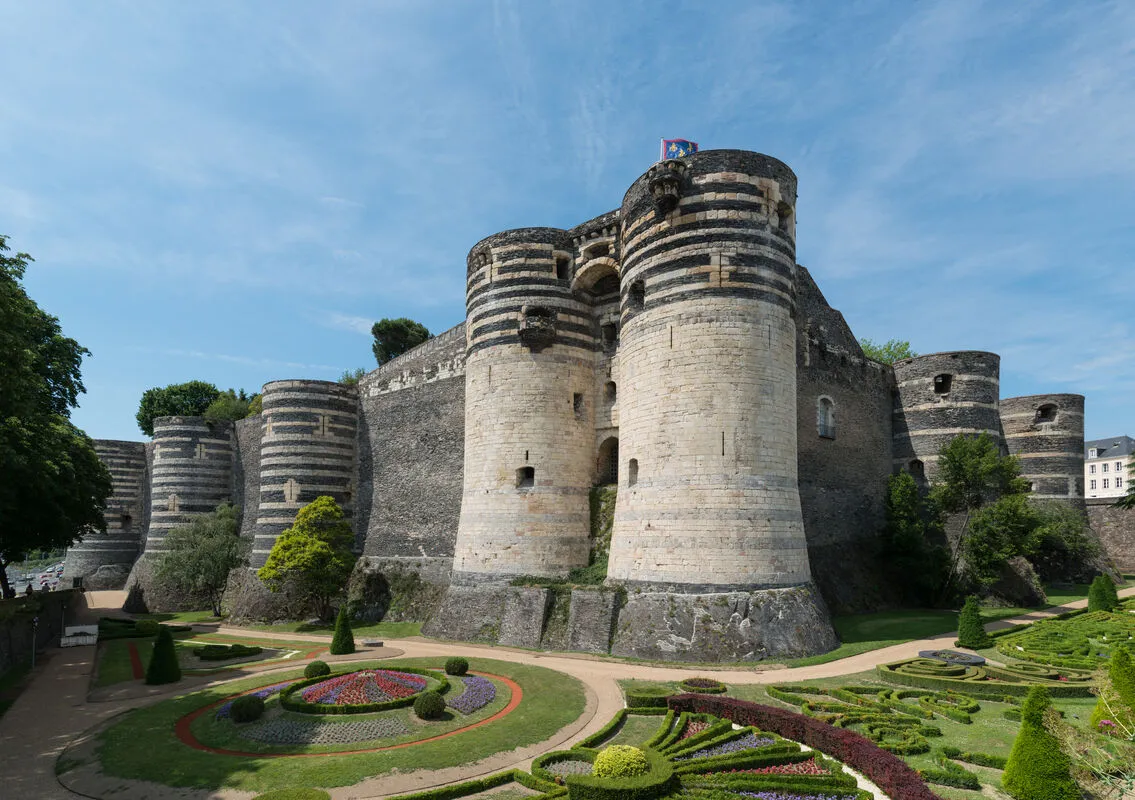
Anjou invented the French art of living gently. Maine-et-Loire, its beating heart, unfurls a landscape of white tuffeau stone, hillside vineyards, troglodyte villages hollowed out of the rock, and a river -- the Loire -- that flows here with the nonchalance of a Sunday afternoon. The Chateau d'Angers and its Apocalypse Tapestry, the cellars of Saumur, the gardens of Anjou: everything invites you to slow down.
Angers: Capital of Anjou
The Château d'Angers and the Apocalypse Tapestry
The Château d'Angers raises its 17 slate-dark towers above the River Maine, forming one of the most imposing medieval fortresses in France. Built in the 13th century by the regent Blanche of Castile, it houses a priceless treasure: the Tapestry of the Apocalypse (environ 9.50 EUR). Commissioned around 1375 by Duke Louis I of Anjou, this monumental work still measures 100 metres in length out of an original 140. Its scenes drawn from the Book of Revelation unfold a richness of colour and detail that leaves visitors speechless. The climate-controlled gallery where it is displayed is kept in semi-darkness to protect the fibres and to create an atmosphere of contemplation.
Practical tip: allow at least 1 hour 30 minutes for the visit. A free audio guide accompanies the tour and illuminates the symbolism of each panel. The castle's hanging gardens, with views over the city, are included in the entry ticket.
The Galerie David d'Angers
In the former Toussaint abbey church, the Galerie David d'Angers (environ 6 EUR) displays the works of the Romantic sculptor Pierre-Jean David, a native of Angers. Beneath a contemporary glass roof that floods the nave with light, busts, medallions and funerary monuments stand alongside the original plaster model for the pediment of the Panthéon in Paris. An underrated gem.
The Old Town
Historic Angers is best explored on foot. The Maison d'Adam, a 15th-century half-timbered house decorated with comical carved figures, is one of the most photographed buildings in the city. Cathédrale Saint-Maurice, whose single nave is one of the widest in France, contains magnificent stained-glass windows spanning the 12th to the 19th century. The pedestrianised streets around the Place du Ralliement are filled with shops, cafés and restaurants.
On Sunday mornings, the La Doutre market on the right bank of the Maine is a foodie pilgrimage: rillauds d'Anjou (slow-cooked pork belly), fouées (small bread rolls puffed up in a wood-fired oven), Sainte-Maure goat's cheese, fruits from the Anjou orchards.
Terra Botanica
On the outskirts of Angers, Terra Botanica (environ 22 EUR adult, environ 16 EUR child) is Europe's first theme park dedicated to the plant kingdom. Tropical greenhouses, themed gardens, boat rides and immersive attractions make it a pleasant family outing, especially in spring when the horticultural collections are at their peak. Allow a full day.
Saumur: Between Loire and Hillsides
The Château de Saumur
Perched on a limestone bluff, the Château de Saumur presides over the Loire with a grace reminiscent of the illuminations in the Très Riches Heures du Duc de Berry, in which it appears prominently. The museum inside (environ 8 EUR) displays collections of ceramics and decorative arts, but it is above all the panorama from the terrace that rewards the climb: the Loire, the slate roofs of the town, vineyards cascading down the hillsides.
The Cadre Noir and the Art of Riding
Saumur is the French capital of the horse. The Cadre Noir, the national riding school founded in 1828, perpetuates the French tradition of academic equitation, inscribed on the UNESCO Intangible Cultural Heritage list. Guided visits (environ 10 EUR) take in the stables, the riding arenas and, schedule permitting, training sessions led by the school's écuyers. The Cadre Noir Galas, equestrian shows performed in full ceremonial dress, take place several times a year (environ 25-45 EUR).
The Saumur Wine Caves
The tuffeau hillsides along the Loire have been quarried for building stone over the centuries. The abandoned galleries have become ideal cellars for ageing Saumur's sparkling wines. Bouvet-Ladubay (environ 5 EUR) and Langlois-Château (environ 7 EUR) offer tours of their underground galleries followed by tastings. The constant coolness of the caves (environ 12 °C) and the dim light of the kilometres-long tunnels create a unique atmosphere.
The Troglodyte Dwellings of Anjou
Rochemenier Troglodyte Village
Anjou has the highest concentration of troglodyte sites in France. The village troglodytique de Rochemenier (environ 7 EUR) is a cluster of underground farms dug into the falun stone, where families lived until the 20th century. Visitors walk through furnished living rooms, an underground chapel, stables and wine cellars. The experience is as moving as it is informative.
Souzay-Champigny and the Cliff Dwellings
Along the Loire between Saumur and Montsoreau, the village of Souzay-Champigny lines up white facades carved directly into the tuffeau cliff face. Some troglodyte dwellings are still inhabited, others have been converted into gîtes or restaurants. Le Mystère des Faluns (environ 9 EUR) offers a scenographic tour through former quarries, blending geology, history and spectacle.
Doué-en-Anjou and the Bioparc
In Doué-en-Anjou, the Bioparc (environ 22 EUR) is a zoo set in former open-air falun quarries. The animals, including many endangered species, roam in natural enclosures formed by the rock walls. The troglodyte vulture arena and the large aviary are particularly spectacular.
The Vineyards of Anjou
Appellations and Grape Varieties
Anjou is a viticultural mosaic. Chenin Blanc reigns supreme among the whites, from the dry, mineral Savennières to the lusciously sweet Coteaux-du-Layon, with the prestigious Quarts-de-Chaume and Bonnezeaux recognised among the world's finest dessert wines. In red, Cabernet Franc produces Saumur-Champigny: fruity, elegant and perfect with a summer barbecue.
The Wine Route
The Anjou wine route meanders between hillsides, tuffeau villages and the banks of the Loire. The village of Savennières, perched above the river, produces one of France's great dry white wines. Further east, the Layon valley offers rolling landscapes of golden vines in autumn. Most estates welcome visitors by appointment, with tastings ranging from free to around 8 EUR for the most prestigious cuvées.
Montsoreau and Fontevraud
Montsoreau: A Loire Village
Classified among the Most Beautiful Villages of France, Montsoreau stretches along the Loire beneath its 15th-century castle. The Château de Montsoreau (environ 8 EUR) now houses a museum of contemporary art (the Philippe Méaille collection), creating a striking dialogue between Renaissance architecture and conceptual works. The quays, narrow streets and Loire light combine to produce a scene of rare serenity.
The Royal Abbey of Fontevraud
A few kilometres from Montsoreau, the Abbaye Royale de Fontevraud (environ 13 EUR) is one of the largest monastic complexes in Europe. Founded in 1101 and governed by abbesses of royal blood, it holds the effigies of Eleanor of Aquitaine, Henry II Plantagenet and Richard the Lionheart. Now a cultural centre, it hosts exhibitions, concerts and artist residencies in a majestic setting.
Practical Information
Getting there: Angers is 1 hour 30 minutes from Paris by TGV. Saumur is 45 minutes from Angers by TER regional train. The A11 motorway connects Paris to Angers in about 3 hours.
Getting around: a car is essential for the vineyards and troglodyte sites. The Loire à Vélo, a signposted cycling route, follows the river through the département and is an ideal way to link Saumur, Montsoreau and Fontevraud.
Best time to visit: May to October. Spring is ideal for the gardens and Terra Botanica. Summer for the Loire banks and equestrian galas. Autumn brings the vineyards to glorious colour during the harvest season.
Food budget: expect 12-18 EUR for a weekday lunch in a brasserie, 25-40 EUR for a meal in a terroir restaurant. Fouées garnies, a local speciality of stuffed bread rolls, can be enjoyed in troglodyte restaurants for around 15-20 EUR for a full menu.
Don't miss: the Apocalypse Tapestry in its dimly lit gallery, a tasting of Coteaux-du-Layon at sunset overlooking the vines, and dinner in a troglodyte restaurant along the Loire.
Explore on the map
Map →📚 Related collections
Related guides
 Regions
Ain: Bresse, Dombes and Pays de Gex
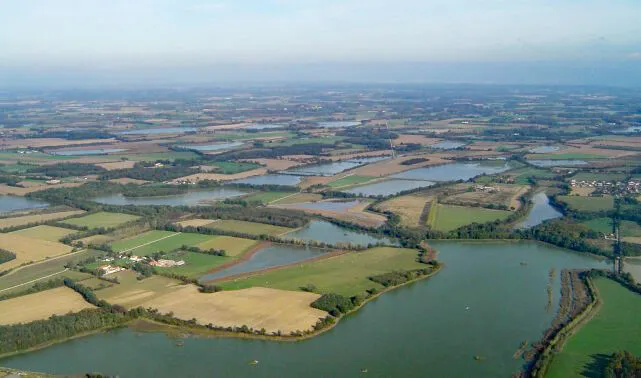
Discover the Ain: world-famous Bresse poultry, the thousand ponds of the Dombes, Pays de Gex facing Mont Blanc and the emerald gorges of Nantua. Complete guide.
 Regions
Aisne: Laon's Medieval Citadel and the Chemin des Dames
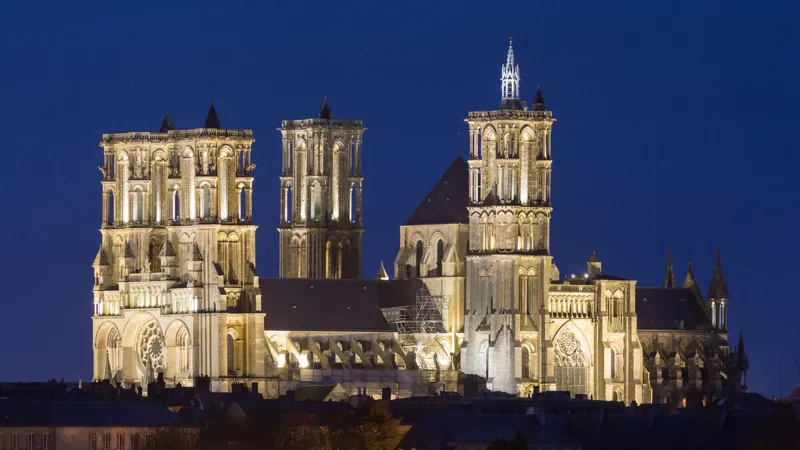
Discover the Aisne département: Laon's hilltop medieval city, the Chemin des Dames battlefields, Soissons, the Familistère de Guise and Champagne vineyards. Complete travel guide.