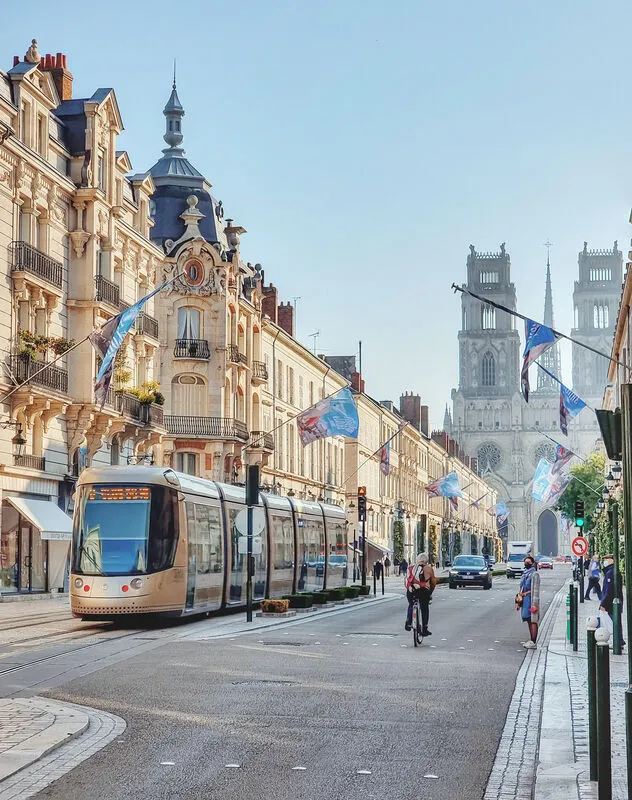
Just over an hour by train from Paris, you arrive in Orleans, the city of Joan of Arc, a place of art and memory whose much-rebuilt cathedral stands proudly above the Loire. The Loiret is the department that opens the Loire Valley for anyone heading south from the capital, and behind Orleans stretches the Sologne, a world of forests, ponds and discreet chateaux where nature has kept the upper hand.
Orléans: The City of Joan of Arc
Orléans and Joan of Arc are inseparable. It was here that the young warrior lifted the English siege on 8 May 1429, a turning point in the Hundred Years' War. The memory of that event permeates the entire city: statues, plaques, street names and, every May, the Fêtes Johanniques, ten days of historical celebrations featuring medieval costume parades, concerts and military re-enactments.
The Maison de Jeanne d'Arc (~5 euros), rebuilt on the site where she stayed during the siege, retraces the Maid's epic through scale models, films and period documents. It is a good starting point for understanding the historical context before exploring the city.
The Cathedral of Sainte-Croix
The Cathedral of Sainte-Croix is the landmark monument of Orléans. Its construction spanned several centuries, but it was Henry IV who turned it into a symbol of national reconciliation after the Wars of Religion. The neo-Gothic facade, completed in the 18th century, is spectacular in its height and symmetry. Inside, remarkable modern stained-glass windows depict the life of Joan of Arc. Entry is free; the tower climb costs a few euros and rewards with an exceptional panorama over the Loire and the Beauce plain.
The Historic Centre
The heart of Orléans has been beautifully restored. The Rue de Bourgogne, the commercial artery running east to west through the old town, is lined with Renaissance facades and independent shops. The Place du Martroi, dominated by the equestrian statue of Joan of Arc, is the nerve centre. Surrounding pedestrianised streets brim with cafés, restaurants and pastry shops.
The Musée des Beaux-Arts (~6 euros) holds a collection of European painting from the 15th to the 20th century that is well worth a detour, with works by Velázquez, Correggio, Boucher and Gauguin. The Musée Historique et Archéologique (~4 euros), housed in the Hôtel Cabu, preserves the Neuvy-en-Sullias treasure, an exceptional group of Gallo-Roman bronzes including a life-sized horse.
The Loire Waterfront in Orléans
The quays of the Loire in Orléans have been redesigned for pedestrians and cyclists. The walk along the river, from the Pont George V to the Parc Floral de la Source, offers magnificent views and a calming atmosphere. The medieval bridge, with its stone arches, is one of the finest Loire crossings.
Château de Sully-sur-Loire: The River Fortress
The Château de Sully-sur-Loire (~9 euros) is one of the most imposing fortresses in the Loire Valley. Its massive moat-encircled towers, 14th-century keep and timber roof structure shaped like an inverted ship's hull — one of the oldest in France — make it an exceptional monument. The château was the property of Maximilien de Béthune, Duke of Sully, minister to Henry IV, who made it his principal residence.
The guided visit (about 75 minutes) leads through medieval halls, ducal apartments and the spectacular keep roof. The park, laid out along the Loire, is ideal for picnics and strolls. In summer, the Festival de Sully et du Loiret fills the château with classical music concerts in a magnificent setting.
The Loiret's Sologne: The Great Green Silence
The Sologne covers the southern part of the département across tens of thousands of hectares of pine, oak and birch forest, interspersed with ponds, heathland and clearings. This flat, damp, wooded territory possesses a melancholy beauty that shifts with the seasons: morning mists in autumn, carpets of heather in summer, immense skies in winter.
La Ferté-Saint-Aubin
The Château de la Ferté-Saint-Aubin (~12 euros) is an essential Sologne stop. This 17th-century château, still inhabited, can be visited from cellar to attic in a relaxed atmosphere that appeals to families. The working kitchens, where madeleines are baked in front of visitors, are a highlight. The 40-hectare park offers traditional games, a treetop adventure course and, in autumn, a mushroom weekend dedicated to the fungi of the Sologne.
Ponds and Wildlife Watching
The Sologne ponds are havens of biodiversity. The Domaine du Ciran at Ménestreau-en-Villette (~8 euros) introduces visitors to Sologne ecosystems through nature trails, hides and exhibitions. In autumn, the stag rut echoes through the forests: several estates offer guided nocturnal outings (around 15 to 20 euros per person).
The Forest of Orléans: The Green Lung
The Forest of Orléans is the largest state forest in mainland France. Its 35,000 hectares of oak, pine and hornbeam stretch east and north of Orléans. Less well known than Fontainebleau or Compiègne, it nevertheless offers outstanding opportunities for walking, mountain biking and nature observation.
The Arboretum des Grandes Bruyères (~10 euros), in the heart of the forest, is a 12-hectare botanical garden specialising in tree and shrub collections from around the world. Magnolias, rhododendrons and Japanese maples create spectacular displays in spring and autumn.
The forest ponds, notably the Étang de la Vallée and the Étang du Ravoir, are renowned birdwatching sites. Ospreys, grey herons and kingfishers nest here regularly.
Gien: Faience and the Château
Gien is a town of character set on the banks of the Loire. Its Château de Gien (~8 euros), built in red and black bricks arranged in geometric patterns, houses the International Hunting Museum, one of the most comprehensive in France. Collections range from antique weapons to animal paintings by François Desportes and Jean-Baptiste Oudry.
The Gien Faience Factory, founded in 1821, continues a tradition of fine earthenware renowned worldwide. The factory shop sells pieces at reduced prices, and the workshop can be visited by appointment. A piece of Gien faience makes an excellent souvenir.
Food and Drink in the Loiret
The table in the Loiret draws on the Loire, the Sologne and the Beauce.
- Cotignac d'Orléans, quince paste set in small round wooden boxes, is a historic confection already prized by the kings of France
- Orléans vinegar, artisanally produced since the Middle Ages, is among the finest in France
- Sologne game, in terrine, stew or roast form, is unmissable in autumn and winter
- Orléanais wines, light reds and rosés, make pleasant mealtime companions
- Praline tart and pithiviers (puff pastry with almond cream) are the local sweet treats
Restaurants in Orléans offer menus between 15 and 28 euros. Sologne inns serve terroir menus between 18 and 30 euros, with game taking centre stage in season.
Practical Tips
- Best time to visit: May for the Joan of Arc festivities in Orléans; June for forest and ponds; September to October for the stag rut and mushroom foraging in the Sologne
- Getting there: Orléans is 1 hour 10 minutes from Paris by train. A car is essential for the Sologne, Sully and the forest
- Visit budget: Expect 25 to 40 euros per person for a full day (2 to 3 paid sites, free nature access)
- Suggested duration: 3 to 5 days for Orléans, Sully, the Sologne and the Forest of Orléans
- Don't miss: the Cathedral of Sainte-Croix at dusk, the Château de Sully reflected in its moat, and a misty dawn over a Sologne pond
Explore on the map
Map →📚 Related collections
Related guides
 Regions
Ain: Bresse, Dombes and Pays de Gex
Discover the Ain: world-famous Bresse poultry, the thousand ponds of the Dombes, Pays de Gex facing Mont Blanc and the emerald gorges of Nantua. Complete guide.
 Regions
Aisne: Laon's Medieval Citadel and the Chemin des Dames
Discover the Aisne département: Laon's hilltop medieval city, the Chemin des Dames battlefields, Soissons, the Familistère de Guise and Champagne vineyards. Complete travel guide.