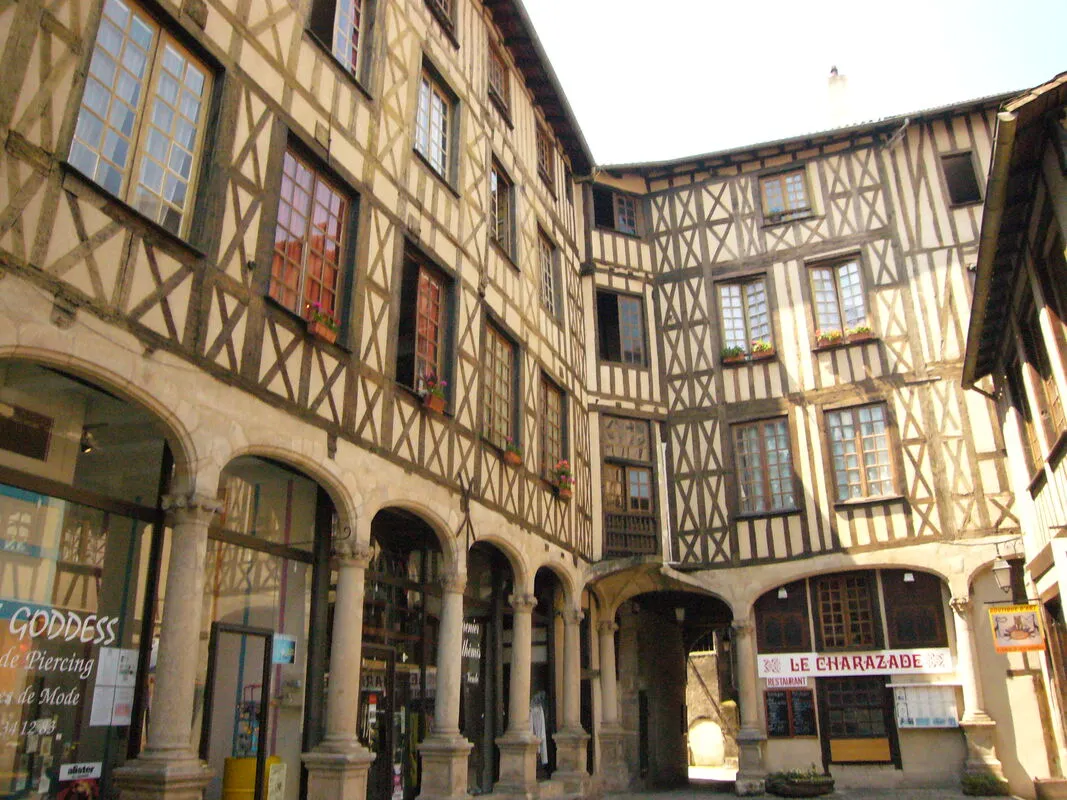
For three centuries, the name Limoges has meant porcelain the world over. But Haute-Vienne is more than that delicate art. Behind the workshops and museums, the department reveals the silent ruins of Richard the Lionheart at Chalus, topiary gardens in the French style, and a Limousin plateau of heather and moorland where livestock farmers carry on a tradition stretching back millennia.
Limoges: Far More Than Fine China
Limoges and porcelain are inseparable, but the city offers far more than display cabinets. Founded as the capital of the Gaulish Lemovices tribe, it has two thousand years of history layered into its streets, churches, and museums.
The Musée national Adrien Dubouché (~7 euros) is the world's leading museum of porcelain and ceramics. Its 18,000 pieces span antiquity to the present, with pride of place given to Limoges production: dinner services commissioned by European courts, Art Nouveau vases of extraordinary delicacy, and bold 21st-century design pieces. The museum traces the entire journey from kaolin clay to finished masterpiece. Allow 90 minutes to two hours.
Limoges is also the city of enamel. The medieval Limoges enamel workshops — which fused coloured glass powders onto copper to produce luminous religious objects — were famous across Christendom. The Musée des Beaux-Arts (free), installed in the former bishop's palace, holds the world's largest collection of Limoges enamels, from 12th-century reliquaries to contemporary art pieces.
The Cathedral and Les Halles
The Cathedral of Saint-Étienne, begun in the 13th century, is a masterpiece of Rayonnant Gothic. Its elaborately carved Saint-Jean portal and Renaissance rood screen deserve close attention. From the terraced Bishop's Garden behind the cathedral, the view over the Vienne river and the old town rooftops is excellent.
The Halles centrales, built in 1889 in the Baltard style with cast-iron framing and hand-painted porcelain friezes, host a lively covered market. On Friday and Saturday mornings, stalls brim with Limousin beef, chestnuts, goat cheese, apples, and flognarde, a local baked fruit dessert somewhere between a clafoutis and a pancake.
Oradour-sur-Glane: The Martyred Village
Oradour-sur-Glane is one of Europe's most sobering places. On June 10, 1944, four days after D-Day, an SS division massacred 642 inhabitants — men, women, and children — and burned the village to the ground. On the orders of General de Gaulle, the ruins were preserved exactly as they were found, as a permanent testimony to Nazi atrocity.
The visit to the ruins is free and open access. You walk along silent streets past burned-out cars, roofless houses, and the church where the women and children were killed. A Centre de la Mémoire (free) provides historical context and survivor testimonies. The experience is deeply distressing but profoundly important. Allow at least two hours and approach the site with the respect it demands. Photography is permitted but discretion is expected.
Saint-Junien: The Glove-Making Tradition
Saint-Junien, the département's second town, has been the capital of French leather glove-making since the 17th century. Master glovers here work lambskin with a precision that has earned the town a national reputation. A few workshops still operate and welcome visitors, especially during Heritage Days in September.
The Collegiate Church of Saint-Junien, a 12th-century Romanesque building, contains a beautifully carved tomb of the town's patron saint. The tree-lined promenades along the Vienne river make for a pleasant stroll after visiting the church.
Solignac: A Thousand-Year-Old Abbey
The Abbey of Solignac, founded in 632 by Saint Eligius, is one of the oldest monastic foundations in the Limousin. The present Romanesque church, rebuilt in the 12th century, impresses with the purity of its lines and a broad nave covered by domes reminiscent of the great churches of Périgord. Entry is free and the atmosphere is contemplative. The village itself, just 15 minutes south of Limoges, is worth a brief wander for its old stone houses along the Briance river.
Château de Châlucet: Forest Ruins
The ruins of Château de Châlucet, hidden at the confluence of the Briance and Ligoure rivers, form one of the most atmospheric castle sites in the Limousin. This 12th- and 13th-century fortress, perched on a rocky spur deep in woodland, is reached by a short walk of about 30 minutes from the car park. The remains are substantial — keep, curtain walls, and lord's quarters — and the natural setting is exceptional, with the rivers curving around the forested bluff. Access is free.
Rochechouart: The Meteorite Crater
Rochechouart has a double claim to curiosity: a meteorite impact crater and a contemporary art museum housed in the same castle. Around 200 million years ago, an asteroid over a kilometre in diameter slammed into the earth here, excavating a crater 20 kilometres wide. Geological traces of the impact are still visible in the local rock.
The Château de Rochechouart (~5 euros), partly built from impact breccia — a unique rock formed during the collision — now hosts a well-regarded contemporary art museum with rotating exhibitions set within Renaissance-era rooms. The 16th-century hunting frescoes in the Salle des Chasses are worth the visit on their own.
The Monts de Blond: Walks Among Megaliths
The Monts de Blond, northwest of Limoges, offer rolling heathland dotted with granite outcrops and prehistoric megaliths. Dolmens and menhirs scattered across the moorland testify to human habitation stretching back thousands of years. A signposted megalith trail (roughly 8 km, about 2.5 hours) links the main sites through a landscape of heather and broom. The area is also excellent for birdwatching, particularly raptors riding the thermals above the ridgelines.
Practical Tips
- Best time to visit: May to June for green landscapes and wildflowers; autumn for chestnuts and wild mushrooms
- Getting around: A car is recommended for sites outside Limoges. The city has TGV service from Paris (about 3 hours) and a small airport with domestic flights
- Food budget: 13 to 22 euros for a set lunch; Limoges' gastronomic restaurants run 35 to 55 euros
- Suggested duration: 3 to 4 days for Limoges, Oradour, and the surrounding sites
- Don't miss: The porcelain museum, the deeply moving visit to Oradour-sur-Glane, and the art-and-meteorite combination at Rochechouart
Explore on the map
Map →📚 Related collections
Related guides
 Regions
Ain: Bresse, Dombes and Pays de Gex
Discover the Ain: world-famous Bresse poultry, the thousand ponds of the Dombes, Pays de Gex facing Mont Blanc and the emerald gorges of Nantua. Complete guide.
 Regions
Aisne: Laon's Medieval Citadel and the Chemin des Dames
Discover the Aisne département: Laon's hilltop medieval city, the Chemin des Dames battlefields, Soissons, the Familistère de Guise and Champagne vineyards. Complete travel guide.