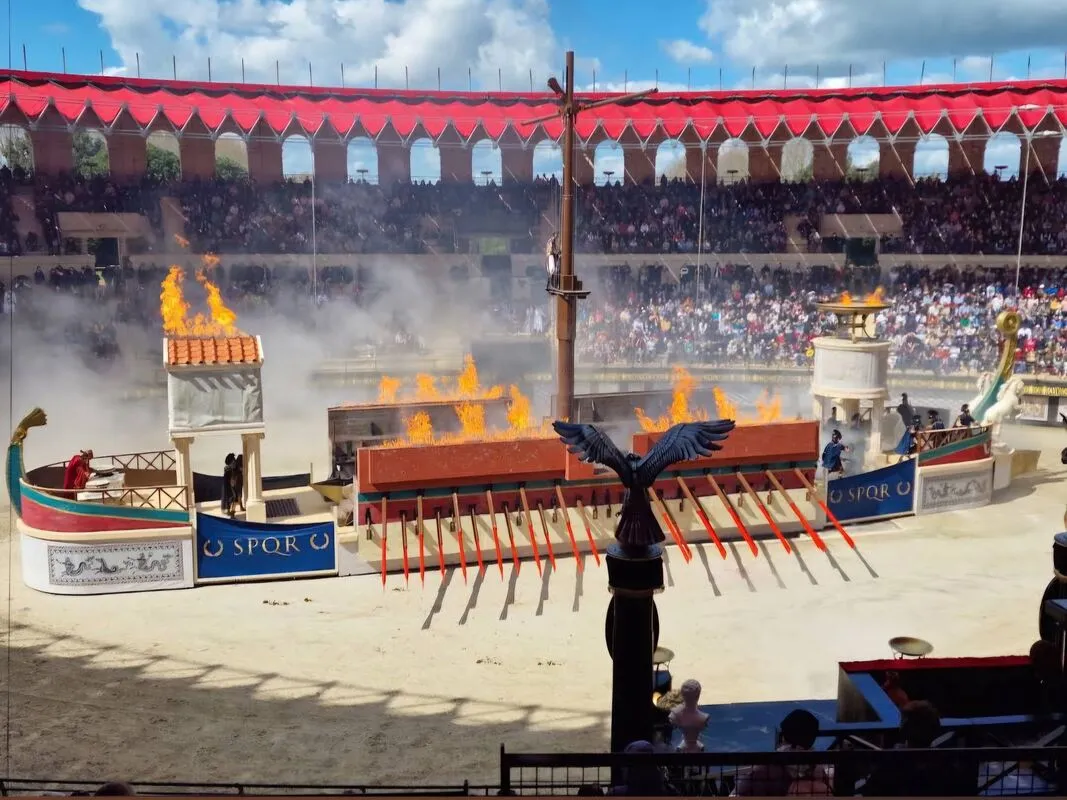
With more than 8 million spectators a year, the Puy du Fou is the most-awarded theme park in the world. But the Vendee does not live by its star attraction alone. On the coast, over 250 kilometres of sandy beaches welcome families, the ports of Saint-Gilles-Croix-de-Vie and Les Sables-d'Olonne keep the fishing tradition alive, and in the bocage, sunken lanes whisper memories of the turbulent Wars of the Vendee.
Puy du Fou: Total Spectacle
A Historical Theme Park Like No Other
The Puy du Fou is no ordinary theme park. Voted the world's best theme park on multiple occasions, it offers total immersion in history through live shows of breathtaking theatrical ambition. There are no thrill rides here, but full-scale historical re-enactments involving hundreds of actors, professional stunt performers, trained animals and cinema-quality special effects.
Among the must-sees: Les Vikings, a longship attack on a lakeside village with spectacular pyrotechnics; Le Signe du Triomphe, a gladiator combat in a reconstructed Roman arena; Le Secret de la Lance, a medieval jousting tournament on horseback; Le Dernier Panache, a show about the Vendée war featuring a 360-degree rotating auditorium. Each show lasts between 20 and 45 minutes, and the production values are constantly raised.
Tickets: approximately 45 EUR adult and 33 EUR child for a single day. The 2-day ticket (environ 72 EUR adult) is strongly recommended as it is impossible to see everything in one day. Book online to skip the queues.
La Cinéscénie
In the evening, La Cinéscénie takes the spectacle to an even grander scale. On a 23-hectare stage (the largest in the world), 2,400 volunteers retrace the history of a Vendéen family through the centuries, with fireworks, light shows, projections and orchestral music. The performance lasts approximately 1 hour 40 minutes and takes place on selected Friday and Saturday evenings in summer (environ 29 EUR). It is a rare emotional experience; book months in advance.
Themed Accommodation
The Puy du Fou offers several themed hotels within the park grounds: the Villa Gallo-Romaine, the Logis de Lescure (Renaissance), the Camp du Drap d'Or (Middle Ages), Les Îles de Clovis (Merovingian era). Expect to pay 150-350 EUR per night for a double room depending on the hotel and the season. The immersion is total, from the decor to the costumed welcome.
Les Sables-d'Olonne: Maritime Capital
The Grande Plage and the Remblai
Les Sables-d'Olonne is inseparable from its Grande Plage, a vast crescent of fine sand facing due south. The Remblai, a seafront promenade lined with Belle Époque villas, ice-cream parlours and seafood restaurants, is the resort's beating heart. The mood is family-friendly during the day and lively in the evening.
The town is also the start and finish port of the Vendée Globe, the solo non-stop round-the-world sailing race. Every four years, the start attracts hundreds of thousands of spectators to the quays. Between editions, the Vendée Globe Museum at Port Olona recounts the skippers' feats.
The La Chaume Quarter
Across the channel, the La Chaume quarter retains the atmosphere of a traditional fishing village. Narrow lanes, low whitewashed houses, a fortified church: it feels a world away from the Remblai's bustle. The Tour d'Arundel, a remnant of a medieval priory, provides a viewpoint over the harbour and the ocean. The ferry crossing (environ 1.50 EUR one way) is a small adventure in itself.
Wild Beaches
Beyond Les Sables, the Vendée coast reveals wilder beaches. The Plage de Sauveterre, between dunes and pine forest, is a surfers' paradise. Further south, the Plage de Longeville-sur-Mer extends for kilometres of golden sand bordered by protected dunes. Access is usually free and car parks are modest (environ 3-5 EUR in summer).
The Île de Noirmoutier
The Passage du Gois
The Île de Noirmoutier can be reached by a modern bridge or, far more dramatically, by the Passage du Gois, a submersible causeway of 4.5 kilometres that is passable only at low tide. Twice a day, the ocean retreats to reveal this unique road lined with refuge beacons. Check the tide times carefully before setting out: the water rises quickly and there is no turning back once the road is submerged.
Villages and Salt Marshes
The island charms with its gentle way of life. The Bois de la Chaise, a century-old pine wood edging small sandy coves, evokes the Mediterranean under Atlantic skies. The village of Noirmoutier-en-l'Île centres on its medieval castle (environ 5 EUR), its flower-filled lanes and its morning market where you can find the famous Noirmoutier potatoes, an early-season variety with a subtly sweet flavour, harvested from spring onwards (environ 4-6 EUR per kilo in season).
The salt marshes of Noirmoutier, more modest than those of Guérande but equally authentic, can be visited in the company of a paludier (environ 5 EUR). Salt and fleur de sel are sold directly from the huts at the edge of the salt pans.
Island Gastronomy
Noirmoutier is a food lover's paradise. Oysters raised in the island's claires, grilled sardines fresh off the boats, Noirmoutier sea salt on a simple garden tomato: these ingredients compose meals of sublime simplicity. Several starred or acclaimed restaurants have set up on the island, but the finest culinary moments often happen with your feet in the sand and a glass of Muscadet in hand.
The Marais Poitevin
The Green Venice
The Marais Poitevin, France's second-largest wetland, straddles the border between the Vendée, Deux-Sèvres and Charente-Maritime. Its most emblematic part, the Green Venice (Venise Verte), is a labyrinth of waterways shaded by pollarded ash trees and poplars, navigated in flat-bottomed boats (called plates or batais).
Embarkation points are scattered through the marshes, notably at Maillezais, Coulon (on the Deux-Sèvres side) and L'Île-d'Elle. A guided boat ride lasts around 1 hour 30 minutes (environ 10-14 EUR per person). The guides, often long-standing maraîchins (marsh dwellers), recount the history of the wetland, its wildlife (herons, otters, kingfishers) and the water-management techniques that have shaped the landscape since the Middle Ages.
Practical tip: for a more intimate experience, hire a boat without a guide (environ 15-20 EUR/hour for 2-4 people) and paddle at your own pace along the silent waterways. Early morning and late afternoon are the best times for wildlife watching.
The Abbey of Maillezais
In the heart of the marshes, the ruins of the Abbaye de Maillezais (environ 6 EUR) raise their Gothic arches above the damp meadows. Founded in the 10th century and serving as an episcopal cathedral in the Middle Ages, it was dismantled during the Wars of Religion. Rabelais stayed here and drew inspiration from it for his writings. The visit is striking, caught between past grandeur and the wild beauty of the surrounding marsh.
The Drained Marshes and the Southern Coast
Beyond the Green Venice, the drained marshes present a radically different landscape: vast flat expanses gridded by straight-line canals, where Maraîchine cattle and horses graze. This territory, reclaimed from the sea since the Middle Ages, is a paradise for migratory birds. The Réserve Naturelle de la Baie de l'Aiguillon, at the mouth of the marshes, hosts tens of thousands of birds in winter.
The Vendée Hinterland
The Bocage and Paths of Memory
The Vendée interior is a landscape of bocage: living hedgerows, sunken lanes, granite farmsteads. It is also a territory marked by the Wars of the Vendée (1793-1796), a peasant uprising against the Republic whose traces remain visible in the landscape and local memory. The Historial de la Vendée at Les Lucs-sur-Boulogne (environ 8 EUR) retraces this complex period in a modern, nuanced museum integrated into the bocage landscape.
Vouvant: A Medieval Village
Classified among the Most Beautiful Villages of France, Vouvant overlooks the Mère valley from ramparts attributed to the fairy Melusine. The medieval tower, the Romanesque church with its sculpted portal and the flower-lined lanes compose a harmonious ensemble. The village hosts resident artists and art galleries that enliven its cobbled streets.
Practical Information
Getting there: Les Sables-d'Olonne is reachable by TGV from Paris (environ 3 hours 30 minutes with a connection at Nantes or La Roche-sur-Yon). The Puy du Fou is near Cholet, about 1 hour from Nantes by car. Nantes-Atlantique airport is the main gateway.
Getting around: a car is strongly recommended. Distances between sites are significant and rural public transport is limited. Cycling is ideal for the Marais Poitevin and the coast (dedicated cycle paths).
Best time to visit: the Puy du Fou is open from April to October (Cinéscénie from June to September). The coast comes alive from June to September, but the shoulder season is mild and less crowded. The Marais Poitevin is superb in spring (lush greenery) and autumn (colours and low-angled light).
Budget: allow 45 EUR per adult for a day at the Puy du Fou, excluding accommodation. On the coast, seafood menus start at 18 EUR and can easily reach 35-50 EUR in well-regarded restaurants. Holiday rentals are plentiful and affordable outside July and August (environ 400-700 EUR per week for a 4-person gîte).
Don't miss: the Cinéscénie at the Puy du Fou on a summer night, crossing the Passage du Gois at low tide, a silent boat ride through the Green Venice, and sunset over the Grande Plage at Les Sables-d'Olonne.
Explore on the map
Map →📚 Related collections
Related guides
 Regions
Ain: Bresse, Dombes and Pays de Gex
Discover the Ain: world-famous Bresse poultry, the thousand ponds of the Dombes, Pays de Gex facing Mont Blanc and the emerald gorges of Nantua. Complete guide.
 Regions
Aisne: Laon's Medieval Citadel and the Chemin des Dames
Discover the Aisne département: Laon's hilltop medieval city, the Chemin des Dames battlefields, Soissons, the Familistère de Guise and Champagne vineyards. Complete travel guide.