From the citadel at Calvi, the eye reaches the snow-capped Monte Cinto, the highest point on Corsica. Upper Corsica is the northern half of the island, where high mountains meet the Mediterranean with a brutality that takes your breath away. From Bastia, a Baroque city facing Italy, to Corte, the historic capital nestled in its gorges, every valley tells a story of resistance and savage beauty.
Bastia: The Baroque City
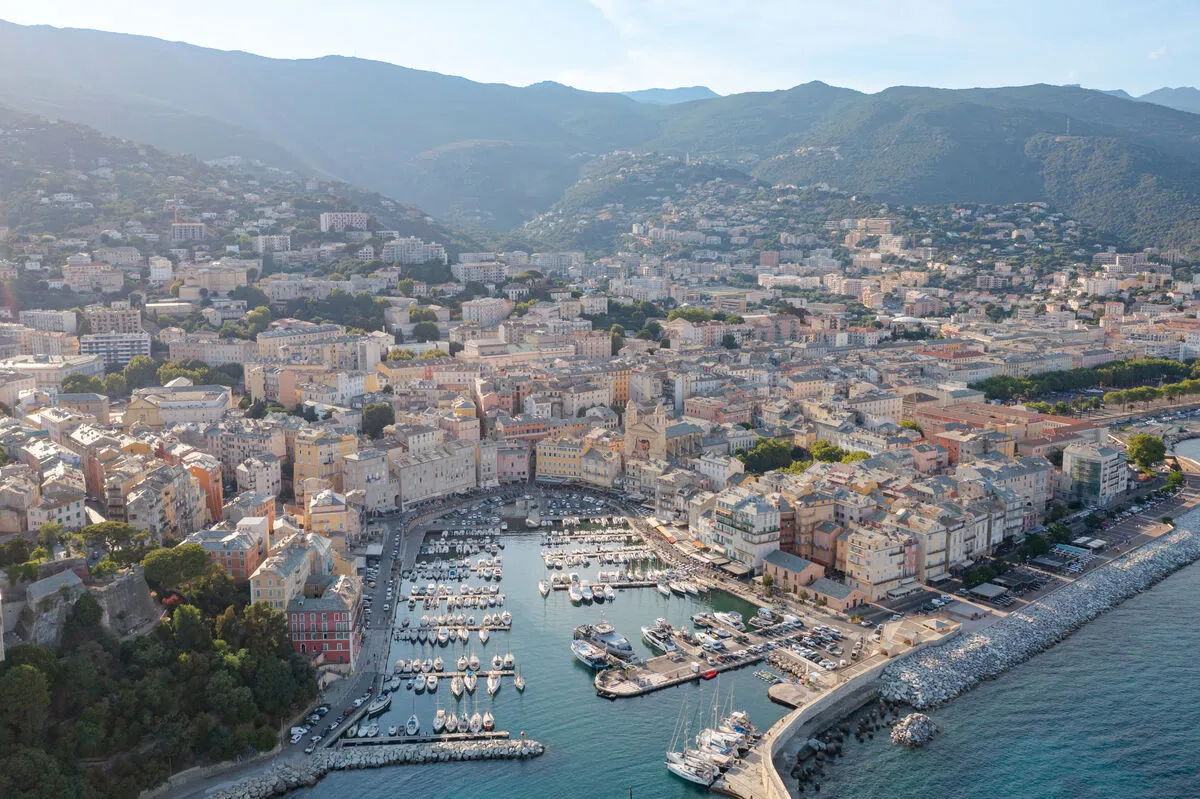
Bastia, the main town of Upper Corsica and the island's eastern gateway, is an authentically Mediterranean city whose old port is one of the most photogenic in Corsica.
The Old Port and Terra Vecchia
The Old Port, lined with tall colourful houses with green shutters and weathered façades, is the beating heart of Bastia. Restaurant and bar terraces enliven the quays where fishing boats gently rock. The Place Saint-Nicolas, a huge plane-tree-shaded esplanade open to the sea, is one of the largest squares in France and the meeting point of the Bastiais. The Terra Vecchia quarter, south of the old port, is a labyrinth of narrow lanes, staircases and vaulted passages dominated by the Church of Saint-Jean-Baptiste, the largest church in Corsica, whose twin Baroque bell towers are reflected in the harbour waters.
Terra Nova and the Citadel
Terra Nova, the Genoese citadel perched on the promontory above the old port, encloses within its ramparts a peaceful quarter of discreet palazzi. The Governors' Palace, a fourteenth-century fortress, houses the Bastia Museum, which traces the history of the town and of Corsica through paintings, costumes and art objects (entry about 5 euros, 1-hour visit). The Cathédrale Sainte-Marie, with its sumptuous Baroque interior of gold and marble, and the Oratory of the Holy Cross Confraternity, which shelters a miraculous black Christ found at sea, are the citadel's religious treasures. From the ramparts, the view across the old port, the Tyrrhenian Sea and the Tuscan archipelago is magnificent.
The Market and Bastia Food
The Bastia market, on Place de l'Hôtel-de-Ville, is a daily rendezvous (except Monday) with Corsican flavours: aged sheep's cheese, charcuterie smoked over chestnut wood, courgette fritters, canistrelli (almond or anise biscuits), olive oil and candied citron. The old-port restaurants serve remarkable seafood: fish soup, grilled red mullet, Centuri lobster. Allow 25 to 45 euros for a restaurant meal.
Cap Corse: The Wild Peninsula
Cap Corse, a peninsula 40 kilometres long and 15 wide north of Bastia, is a world apart: a finger of schist and serpentine pointing towards Genoa, punctuated by Genoese towers, marines (tiny harbours), terraced vineyards and perched villages.
The Cape Road
The D80, the coastal road that circles Cap Corse over roughly 120 kilometres, is one of the finest driving routes in France. On the eastern side, the road follows a rugged coast dotted with picturesque marines: Erbalunga, a fishing village of schist houses clustered around a tiny harbour; Macinaggio, a yachting port at the head of a peaceful bay and the starting point of the sentier des douaniers (customs path) that follows the northern coast to Centuri (6 hours of superb walking). On the western side, villages cling to slopes above a wilder shore. Centuri, the most picturesque fishing port in Corsica, is renowned for its lobster (allow 50 to 70 euros at a restaurant for a lobster dish).
Nonza and the Customs Path
Nonza, clinging to a cliff of green schist above a beach of black pebbles (former asbestos-mine tailings), is one of the most photogenic villages in Corsica. Its Paoline tower, crowning the village, offers a breathtaking panorama. Legend has it that a single man, Jacques Casella, defended this tower against the French in 1768 by making them believe a large garrison held it. The Church of Sainte-Julie contains a striking Baroque altarpiece. The village takes 1 hour to explore.
Cap Corse Wines
Muscat du Cap Corse, a golden fortified wine with aromas of honey, flowers and citrus, is one of the island's viticultural treasures. The Clos Nicrosi and Pieretti estates in Luri offer tastings in a magnificent setting (generally free). Patrimonio wine, the first AOC in Corsica, is produced on limestone slopes south of the Cape, with powerful reds (nielluccio grape) and elegant whites (vermentino).
Calvi: The Citadel and the Balagne
Calvi, a seaside resort on the north-west coast, is dominated by its spectacular Genoese citadel and fringed by 6 kilometres of fine sandy beach washed by turquoise waters.
The Citadel of Calvi
The Citadel of Calvi, built by the Genoese in the thirteenth century, crowns a rocky headland above the gulf. Access is via a rampart walkway from which the view across the bay, the pine groves and the snowy Balagne mountains is spectacular. Within the walls, cobbled lanes, the Governors' Palace, the Cathedral of Saint-Jean-Baptiste and the houses of notables form a remarkable medieval ensemble. A plaque marks the supposed birthplace of Christopher Columbus, Calvi claiming to be the navigator's home (a contested theory). Access to the citadel is free and the visit takes 1 to 2 hours.
The Beach and the Balagne
Calvi beach, an immense crescent of golden sand fringed by pines, is one of the finest in Corsica. The crystal-clear, shallow waters are ideal for families. In summer, Calvi on the Rocks, an electronic-music festival held on the beach and in the citadel, draws an international crowd (passes from 65 euros). The Balagne, Calvi's hinterland nicknamed "the garden of Corsica," is a landscape of hills clothed in olive, almond and vine, dotted with perched villages. Pigna, a restored artisan village, and Sant'Antonino, one of the oldest continuously inhabited villages in Corsica perched on a rocky pinnacle at 500 metres, are essential stops. The Balagne tramway, a small train running along the coast between Calvi and L'Île-Rousse, offers a scenic ride (about 8 euros).
Corte: The Capital of Corsica
Corte, at the geographical centre of the island, is the only inland town in Corsica and its historic capital, seat of Pascal Paoli's government during the brief period of Corsican independence (1755-1769).
The Citadel and the Museum of Corsica
The Citadel of Corte, perched on a rocky spur above the town and the converging valleys of the Tavignano and Restonica, is an impressive eagle's nest. It houses the Museu di a Corsica (Museum of Corsica), an excellent ethnographic museum exploring Corsican identity through agro-pastoral traditions, beliefs, crafts and music (entry about 7 euros, 1.5-hour visit). The climb to the citadel passes through the old town with its steep lanes and granite houses, culminating at the Belvedere, a platform offering an exceptional circular panorama.
The Restonica and Tavignano Gorges
The Restonica valley, reached by a narrow, winding 15-kilometre road from Corte, is one of the grandest natural sites in Corsica. The trail leads to the Lac de Melo (1.5-hour hike) and Lac de Capitello (2.5 hours), deep-blue glacial lakes cradled in a granite cirque at 1,700 metres. Swimming is possible but the water is very cold. In summer, road access is regulated (shuttles from Corte, about 7 euros return). The Tavignano valley, wilder and less visited, offers a 2-hour one-way hike along a turquoise river to idyllic swimming holes.
L'Île-Rousse and the Agriates Desert
L'Île-Rousse
L'Île-Rousse, founded by Pascal Paoli in 1758, is a lively resort with a fine sandy beach right in the town centre, an Art Deco covered market and a square shaded by century-old plane trees. The Île de la Pietra, a red-porphyry headland linked to the town, offers a walk with views of the Balagne mountains.
The Agriates Desert
The Désert des Agriates, between L'Île-Rousse and Saint-Florent, is a vast uninhabited tract of maquis hiding two of the finest beaches in the Mediterranean. Plage de Saleccia, a kilometre of white sand edged by pines, and Plage du Lotu, accessible by boat from Saint-Florent (about 25 euros return) or by a 12-kilometre 4x4 track from the D81, are wild paradises of crystalline water. In summer, maritime shuttles serve these beaches from Saint-Florent.
Practical Tips
Getting Around
Bastia-Poretta airport serves major French and European cities. Ferries link Bastia to Marseille, Nice and Toulon (from 40 euros per person). The Corsican railway (CFC) connects Bastia to Ajaccio via Corte and to Calvi, offering a scenic mountain journey (Bastia-Ajaccio about 25 euros, 3.5 hours). A car is however essential for Cap Corse, the gorges and the hinterland.
Best Time to Visit
May-June and September-October offer the best balance of weather, crowds and prices. Spring is the season of maquis in bloom, with intoxicating scents. Autumn brings a sea still warm enough for swimming and magnificent colours. July-August is very busy and prices soar. Winter, mild on the coast, reveals an authentic and peaceful Corsica.
Budget
This area is pricier than the French average, especially in high season. Expect to pay 70 to 110 euros per night for a decent hotel, 110 to 170 euros for a charming B&B or boutique hotel, and 170 to 300 euros for premium establishments. Meals range from 18 to 28 euros for lunch to 30 to 55 euros for dinner. To save money, book well in advance, stay slightly away from the most touristy zones (prices drop 20-30%), eat at markets and local food stalls rather than seafront restaurants, and take advantage of the many free activities: hiking, beaches, village walks, panoramic viewpoints.
Explore on the map
Map →📚 Related collections
Related guides
 Regions
Ain: Bresse, Dombes and Pays de Gex
Discover the Ain: world-famous Bresse poultry, the thousand ponds of the Dombes, Pays de Gex facing Mont Blanc and the emerald gorges of Nantua. Complete guide.
 Regions
Aisne: Laon's Medieval Citadel and the Chemin des Dames
Discover the Aisne département: Laon's hilltop medieval city, the Chemin des Dames battlefields, Soissons, the Familistère de Guise and Champagne vineyards. Complete travel guide.