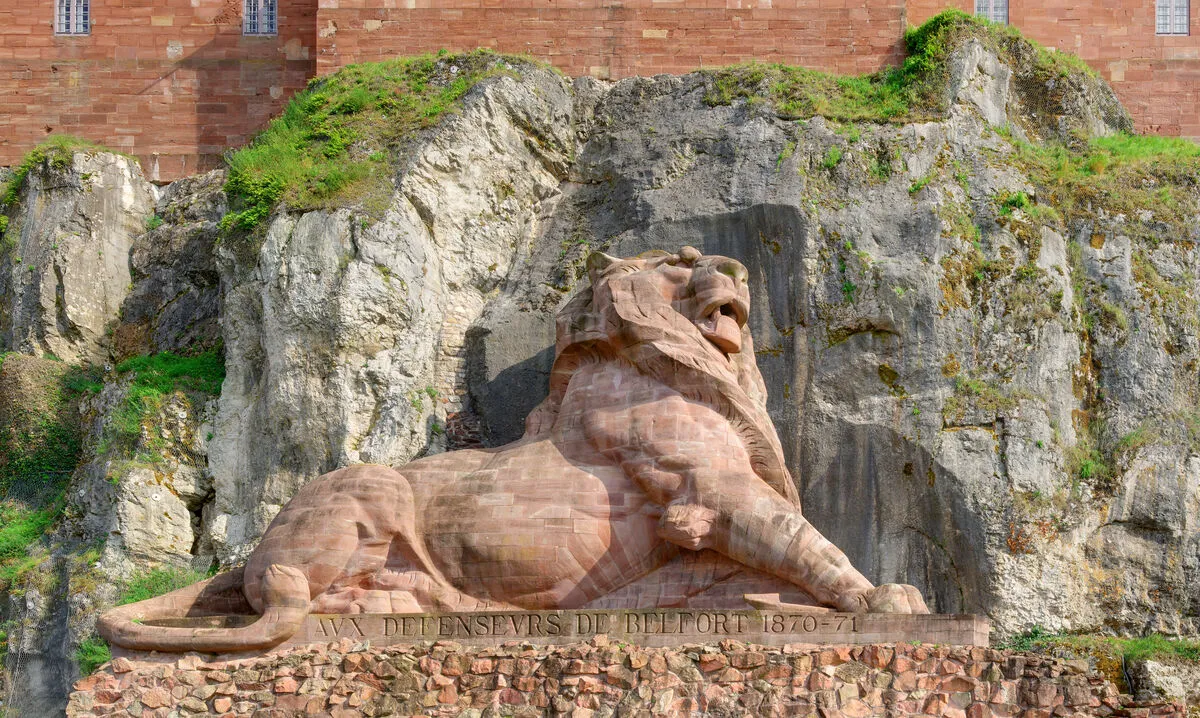
The Lion of Belfort, a colossal sculpture by Bartholdi -- the same artist who designed the Statue of Liberty -- has watched over the city since 1880, a symbol of the heroic resistance of 1870. The Territoire de Belfort, France's smallest metropolitan department, makes up for its size with bold character: wedged between the Vosges, the Jura and the Alsace plain, it offers mountain panoramas, a unique military heritage, and the Eurockéennes, one of Europe's largest music festivals.
Belfort, City of the Lion
The Lion of Belfort
The Lion of Belfort is one of the most iconic monuments in France. Sculpted by Frédéric Auguste Bartholdi — the creator of the Statue of Liberty — between 1875 and 1880, this colossus of pink sandstone measures 22 metres long and 11 metres high, set against the cliff face beneath the citadel. It commemorates the heroic resistance of the city during the siege of 1870-1871, when Colonel Denfert-Rochereau held out against 40,000 Prussian soldiers for 103 days.
The Lion is best contemplated first from the esplanade below, where its imposing mass and posture of defiance take on their full dimension. You can then climb to its base via a maintained path (free access). The smaller replica at Place Denfert-Rochereau in Paris is familiar to most visitors, but nothing replaces the confrontation with the original.
The Citadel of Belfort
The Citadelle de Belfort is an exceptional military work, fortified successively by Vauban in the seventeenth century and then by General Haxo in the nineteenth. Perched on its rocky spur above the old town, it delivers remarkable views over the rooftops of Belfort, the Belfort Gap and the first foothills of the Vosges. The visit (around 7 euros) allows exploration of the underground passages, casemates and the Grand Souterrain, an impressive network of galleries carved into the rock.
The History Museum housed within the citadel traces the successive sieges of Belfort and the military history of the Belfort Gap — that strategic corridor between the Vosges and the Jura through which armies have passed since antiquity. The Museum of Modern Art — Maurice Jardot Donation (around 5 euros), located in the town centre, completes the cultural visit with a remarkable collection including works by Picasso, Braque, Léger and Chagall.
The Old Town
The historic centre of Belfort is best explored on foot. The Place d'Armes, lined with colourful facades, is the beating heart of the city. The Cathedral of Saint-Christophe, classical in style with a Baroque interior, dominates the square. The pedestrianised streets nearby, lively with shops and cafes, lead to the Faubourg des Ancêtres, a working-class quarter with houses characteristic of the industrial era. The Saturday morning market on Place de la République is one of the finest in the region, with local producers offering specialities from both Franche-Comté and Alsace.
The Ballon d'Alsace, Summit of the Southern Vosges
An Exceptional Panorama
The Ballon d'Alsace rises to 1,247 metres and is the highest point in the Territoire de Belfort. Its rounded summit, covered in chaumes (high-altitude pastures), commands a 360-degree panorama of absolutely spectacular scope: on a clear day, the view stretches from the Vosges to the Black Forest, from the Jura to the Alps with Mont Blanc on the horizon. An orientation table at the summit helps identify the landmarks. Access by car is possible via a winding road, but the ascent on foot from Giromagny (approximately 3 hours, moderate difficulty) is far more rewarding.
Hiking and Nature
The Ballon d'Alsace is a paradise for hikers. The GR 5, the long-distance path linking the North Sea to the Mediterranean, crosses the summit. Numerous marked trails thread through beech and fir forests, peat bogs and high pastures. The gentian, the emblematic flower of the Ballon, carpets the mountain meadows in summer. Wildlife includes chamois, successfully reintroduced, and the capercaillie, a protected species.
In winter, the Ballon d'Alsace transforms into a modest but family-friendly alpine ski area (day pass around 20 euros) and, more notably, a destination for cross-country skiing and snowshoeing, with dozens of kilometres of groomed trails through snow-covered chaumes. The atmosphere is authentic and worlds away from the large resort crowds.
The Route des Crêtes
The Route des Crêtes, created during the First World War to shield French communications from German observation, links the Ballon d'Alsace to the Grand Ballon along the ridgeline of the Vosges. It is one of the most beautiful panoramic roads in France, offering alternating views over the Alsatian plain to the east and the Vosges valleys to the west. In autumn, the forests blaze with colour. The road is accessible from May to November (closed in winter due to snow).
Giromagny and the Savoureuse Valley
Mining Heritage
Giromagny, a small town at the foot of the Ballon d'Alsace, was an important mining centre from the fifteenth to the nineteenth century, extracting copper and silver from the Vosges veins. Fort Dorsner, perched above the town, is a work of the Séré de Rivières fortification system (1874-1885) open for visits during heritage days. The Maison de la Géologie et de l'Environnement (free entry) traces the mining and geological history of the area.
The Savoureuse Valley
The Savoureuse, the river that flows through Belfort, rises on the slopes of the Ballon d'Alsace. Its valley, narrow and wooded, is a green corridor ideal for hiking and mountain biking. The Malsaucy trail (approximately 8 kilometres, 2 hours) circles the Étang du Malsaucy, a protected natural site that each summer hosts the Eurockéennes de Belfort, one of the largest rock music festivals in France.
The Eurockéennes de Belfort
A Festival of International Renown
The Eurockéennes, founded in 1989, have become one of the most important music festivals in Europe. Held every first weekend of July on the Malsaucy peninsula, they welcome approximately 130,000 festival-goers over three days. The programme blends rock, pop, electronica, hip-hop and world music, with international headliners. Three-day passes cost around 120 euros. The natural setting — between lake, forests and meadows — is one of the festival's greatest assets and distinguishes it from urban rivals.
Industrial Heritage
Peugeot and Alstom
The Territoire de Belfort is inseparable from its industrial heritage. Alstom (formerly Alsthom) has manufactured turbines and railway equipment here since the nineteenth century. The Belfort factory produced France's first TGV in 1978. Although factory tours are not open to the public, the History Museum in the citadel dedicates a section to this industrial adventure. A few kilometres away, the Musée de l'Aventure Peugeot in Sochaux (in neighbouring Doubs, around 11 euros) is a compelling complementary visit for automobile enthusiasts, tracing the full history of the Peugeot marque from bicycles to concept cars.
Practical Information
Getting there: Belfort is served by TGV in 2 hours 20 minutes from Paris (Belfort-Montbéliard TGV station). Shuttle buses connect the TGV station to the city centre in 20 minutes. By car, the A36 motorway links Belfort to Mulhouse (45 minutes) and Besançon (1 hour).
Getting around: The city of Belfort is easily walkable or navigable by bus. For the Ballon d'Alsace and the surrounding area, a car is essential. Mountain roads are winding but well maintained. Cycling is excellent on the Coulée Verte, a cycle path that crosses the city and extends to the Étang du Malsaucy.
Best time to visit: May to October for hiking and outdoor activities. The first weekend of July for the Eurockéennes. Winter for cross-country skiing on the Ballon d'Alsace. Autumn is sublime on the Route des Crêtes, when the forest canopy blazes with copper and gold.
Budget: Belfort is a very affordable destination. City-centre restaurants offer set menus from 13 euros. Hotels provide rooms from 55 euros per night. Local specialities to taste: the boulette de Belfort (a sweet doughnut), Belflore (a local cheese), bretzels (pretzels, reflecting the Alsatian proximity) and craft beer from local microbreweries.
Explore on the map
Map →📚 Related collections
Related guides
 Regions
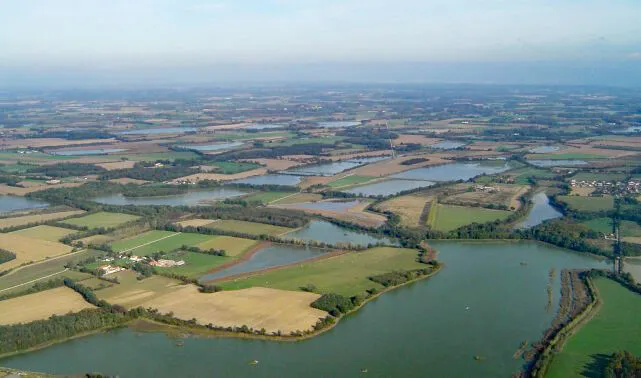
Ain: Bresse, Dombes and Pays de Gex
Discover the Ain: world-famous Bresse poultry, the thousand ponds of the Dombes, Pays de Gex facing Mont Blanc and the emerald gorges of Nantua. Complete guide.
 Regions
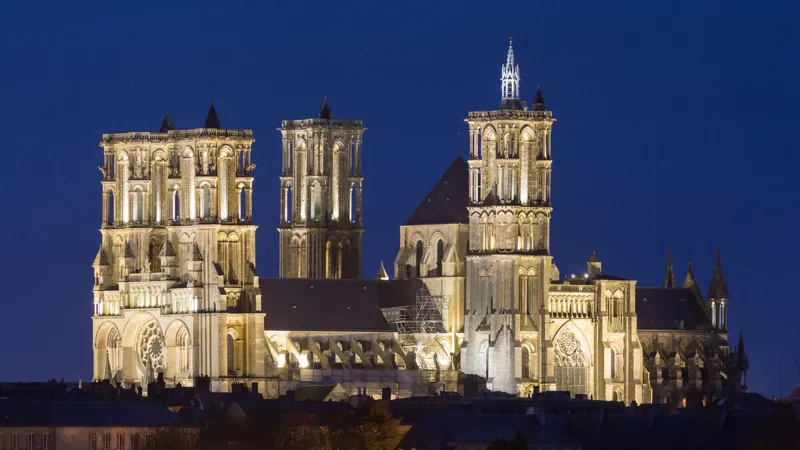
Aisne: Laon's Medieval Citadel and the Chemin des Dames
Discover the Aisne département: Laon's hilltop medieval city, the Chemin des Dames battlefields, Soissons, the Familistère de Guise and Champagne vineyards. Complete travel guide.