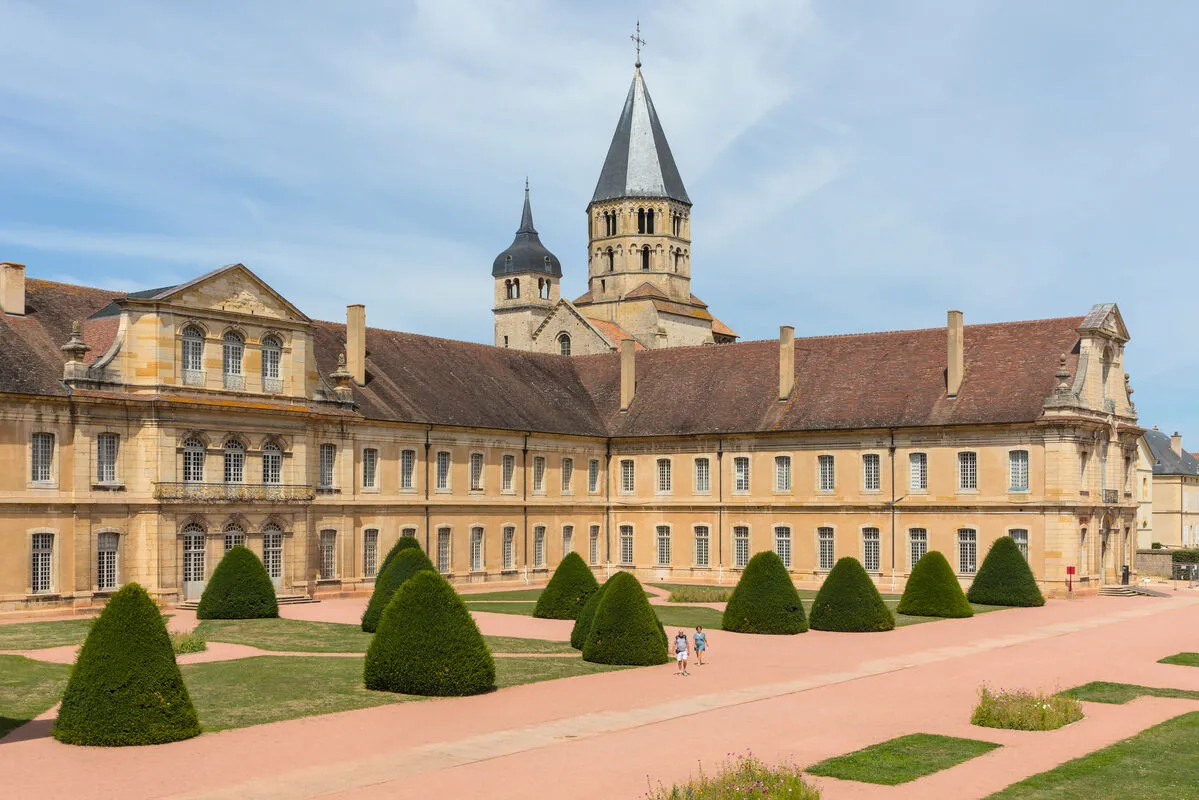
In the Middle Ages, the Abbey of Cluny was the most powerful in Western Christendom, and its church the largest in the world until the construction of St Peter's in Rome. Saone-et-Loire, Burgundy's largest department, preserves the memory of that grandeur alongside perfectly intact Romanesque churches, the renowned vineyards of the Cote Chalonnaise, and the Charolais, cattle country where the white-coated beef breed is king.
Cluny, Light of the Medieval World
The Abbey that Ruled the West
Cluny was, from the tenth to the twelfth century, the most powerful spiritual centre in Western Christendom. Its abbey, founded in 910 by Duke William of Aquitaine, governed a network of over 1,400 monasteries across Europe. The Abbey Church of Cluny III, begun in 1088, was the largest church in the world at 187 metres long — and remained so until Saint Peter's Basilica was built in Rome in the sixteenth century.
Largely destroyed after the French Revolution, the abbey nonetheless preserves impressive remains: the south arm of the great transept with its octagonal Eau Bénite bell tower, the farinier (granary) housing magnificent twelfth-century carved capitals, and the eighteenth-century monastic buildings now converted into an engineering school. The visit (around 11 euros) includes a 3D digital model that reconstructs the abbey church in its original splendour — a genuinely stirring experience.
The National Stud of Cluny
The Haras national de Cluny, founded in 1806 by Napoleon, occupies part of the former abbey buildings. It continues the French equestrian tradition and offers guided tours (around 7 euros) taking visitors through the stables, tack rooms and paddocks. In summer, equestrian shows are staged in the main courtyard.
The Medieval Town
The town of Cluny itself is a delight to explore on foot. Its Romanesque houses with facades adorned by colonnettes and blind arcading are among the finest in France. The Tour des Fromages (around 3 euros) offers a bird's-eye view over the rooftops and abbey ruins. The Saturday morning market, lively and colourful, is the occasion to sample local produce: goat's cheese, charcuterie and wines from the Mâconnais.
Tournus and Romanesque Art
The Abbey Church of Saint-Philibert
Tournus shelters one of the finest Romanesque buildings in France: the Abbatiale Saint-Philibert, built in stages from the tenth to the twelfth century. Its nave, covered by transverse barrel vaults — a system unique in Europe — is bathed in golden light that brings out the warm pink hue of the local stone. The crypt, one of the oldest in France, and the cloister add further layers of emotion. Admission is free.
Tournus and Gastronomy
Tournus is a town for food lovers. The restaurant Greuze, housed in a fifteenth-century building, is an institution of Burgundian cuisine. But it is the Saturday market on the Saône quays that best reveals local flavours: Bresse chicken, quenelles, Tournugeois goat's cheese and wines from the Mâcon coast. A full gastronomic meal at one of Tournus's fine restaurants starts from around 35 euros.
Autun, the Rome of Gaul
The Cathedral of Saint-Lazare
Autun was one of the most important cities of Roman Gaul, founded by Emperor Augustus to rival the great cities of the Empire. The Cathedral of Saint-Lazare is world-famous for its tympanum of the Last Judgement, carved by the master sculptor Gislebertus around 1130. The finesse and expressiveness of this work make it one of the high points of Romanesque sculpture. The nave and choir capitals, many of which are copies (the originals are displayed in the chapter house, around 6 euros), rival one another in narrative inventiveness.
Roman Remains
Autun preserves exceptional Roman vestiges: the Porte Saint-André and the Porte d'Arroux, two monumental first-century gates still standing; the Roman theatre, one of the largest in Gaul with a capacity of 20,000; and the Temple of Janus, a mysterious square tower standing alone in a meadow. All of these sites are freely accessible.
The Musée Rolin
The Musée Rolin (around 6 euros) is housed in the private mansion of Nicolas Rolin, Chancellor of Burgundy and founder of the Hospices de Beaune. It holds collections spanning Gallo-Roman art to medieval painting, including the remarkable Nativity by the Master of Moulins and the Temptation of Eve by Gislebertus, a masterpiece of Romanesque sensuality.
The Charolais, Land of Hedgerows and Cattle
An Iconic Landscape
The Charolais is a picture-postcard landscape: gently rolling hills, dense hedgerows enclosing intensely green meadows, blonde-stone farmhouses and, everywhere, the white silhouettes of Charolais cattle. This breed, born here in the eighteenth century, has become France's leading beef breed and one of the most renowned in the world. The landscape is so harmonious that it has been inscribed as intangible cultural heritage.
Charolles and the Maison du Charolais
Charolles, the small capital of the region, is threaded by canals that earn it the nickname "Venice of the Charolais". The Maison du Charolais (around 7 euros) offers an interactive, sensory journey through the history of the breed, from pasture to plate, concluding with a Charolais beef tasting. It is an original and gourmet experience.
Paray-le-Monial
Paray-le-Monial houses a twelfth-century Basilica of the Sacred Heart that is considered a miniature replica of the great abbey church of Cluny III. Its harmonious proportions and golden stone make it one of the finest examples of Cluniac Romanesque art — and what Cluny itself might have looked like before its destruction. The town is also a significant centre of Marian pilgrimage. Admission to the basilica is free.
The Mâconnais and Its Vineyards
Pouilly-Fuissé and Saint-Véran
The Mâconnais is the southern section of the Burgundy vineyard, the favoured territory of Chardonnay. The appellations Pouilly-Fuissé (promoted to premier cru status in 2020) and Saint-Véran produce generous, aromatic whites that rank among the best value in Burgundy. Tastings at the estates generally cost between 5 and 10 euros for a selection of four to five wines. A good bottle of Pouilly-Fuissé starts at around 15 euros.
The Rock of Solutré
The Roche de Solutré, a 493-metre limestone spur overlooking the vines, is one of the most photographed landscapes in Burgundy. The ascent (30 minutes, easy) rewards with a splendid panorama over the Mâconnais, the Beaujolais and, on clear days, Mont Blanc. At the foot of the rock, the Museum of Prehistory (around 5 euros) presents the major archaeological site that gave its name to the Solutrean culture — a key chapter in European prehistory.
Practical Information
Getting there: Mâcon is 1 hour 40 minutes from Paris by TGV. Chalon-sur-Saône is served by regional trains from Dijon (45 minutes) and Lyon (1 hour). The A6 motorway runs through the département from north to south.
Getting around: A car is recommended for exploring the Charolais and the scattered Romanesque sites. Cycling is excellent on the voie verte (greenway) between Cluny and Mâcon (30 kilometres, flat terrain). The Voie Bleue along the Saône offers a continuous cycling route running hundreds of kilometres.
Best time to visit: May to October. September and October are ideal for the grape harvest and autumn colours. Summer brings open-air festivals at Romanesque sites. Spring is magnificent in the Charolais hedgerow country, with wildflowers and newborn calves.
Budget: Saône-et-Loire offers excellent value. Set menus at local inns start from 15 euros. A Charolais steak at a good restaurant costs between 18 and 28 euros. Mâconnais wines remain very affordable, with whites starting from 8 euros per bottle.
Explore on the map
Map →📚 Related collections
Related guides
 Regions
Ain: Bresse, Dombes and Pays de Gex
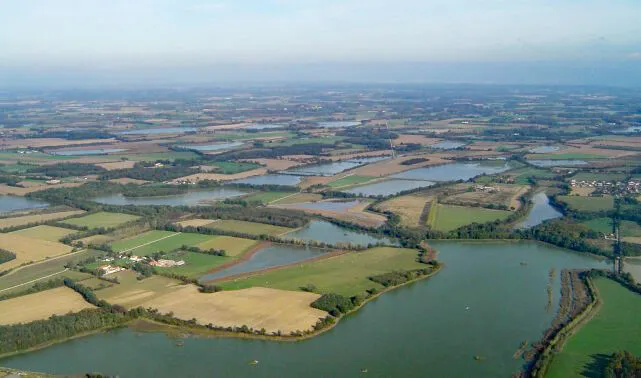
Discover the Ain: world-famous Bresse poultry, the thousand ponds of the Dombes, Pays de Gex facing Mont Blanc and the emerald gorges of Nantua. Complete guide.
 Regions
Aisne: Laon's Medieval Citadel and the Chemin des Dames
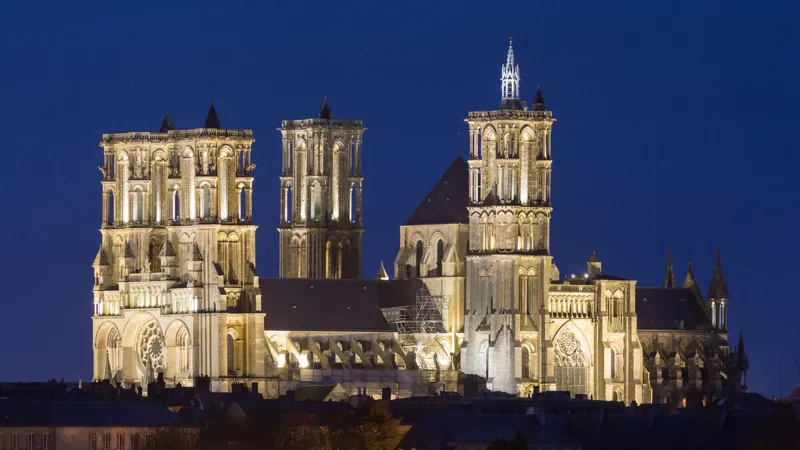
Discover the Aisne département: Laon's hilltop medieval city, the Chemin des Dames battlefields, Soissons, the Familistère de Guise and Champagne vineyards. Complete travel guide.