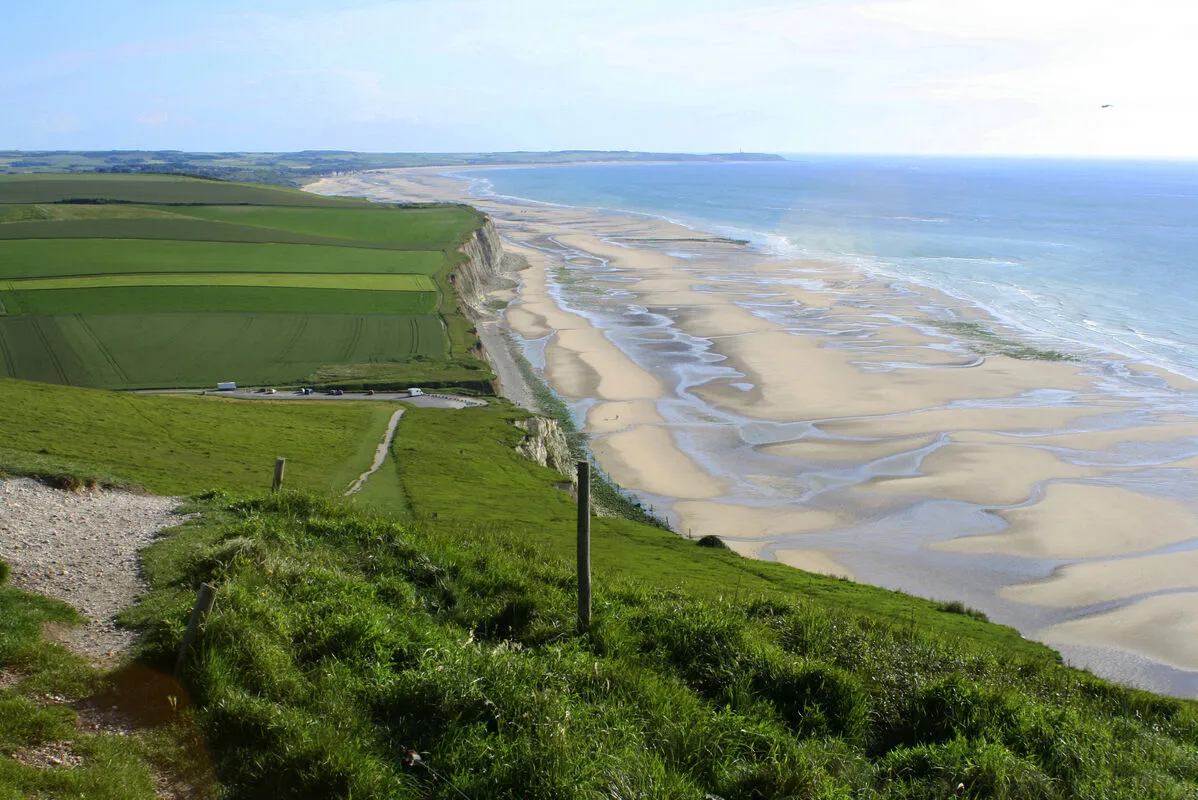
Standing on Cap Blanc-Nez, the wind in your face, the chalk cliffs falling sheer into the Channel and the English coast visible on the horizon, you begin to understand the Pas-de-Calais. This department rewards those who look beyond the ferry ports: immense beaches, spectacular Flemish town squares, the Louvre-Lens and its masterpieces, and a generous northern cuisine that warms you after the walk.
The Capes: Blanc-Nez and Gris-Nez
The Opal Coast takes its name from the ever-changing colours of the sea, which shifts from emerald to sapphire depending on the light. The most spectacular point is Cap Blanc-Nez, a sheer chalk cliff rising 134 metres above the Channel. On a clear day, the white cliffs of Dover are plainly visible just 34 kilometres away. The GR120 coastal path runs along the clifftop and the views are genuinely breathtaking. A few kilometres south, Cap Gris-Nez (45 metres) is the closest point on the French coast to England and the best vantage point for watching the non-stop procession of ferries and cargo ships through the strait. Access to both capes is free; bring sturdy shoes and a windproof jacket.
Between the two capes, the Grand Site des Deux Caps protects a landscape of dunes, close-cropped grassland, and small hidden valleys of austere, windswept beauty. The walk between the two capes (roughly 10 km, 3 hours) ranks among the finest coastal hikes in France.
Boulogne-sur-Mer and Nausicaá
Boulogne-sur-Mer is France's largest fishing port and a town of real substance. The fortified upper town, enclosed by 13th-century ramparts that you can walk around for free, overlooks the harbour. Inside, the basilica of Notre-Dame, one of the largest Romanesque crypts in France, and the castle museum all warrant exploration.
The headline attraction, however, is Nausicaá (around 27 euros), the largest aquarium in Europe. Located on the seafront, the National Sea Centre takes visitors on an immersive journey through the world's oceans. The main tank holds 10,000 cubic metres of seawater, with sharks, manta rays, and thousands of fish visible through a transparent tunnel. The high-seas extension, opened in 2018, features a 20-metre-wide viewing window that is mesmerising. Allow at least three hours, longer with children. Online booking is strongly recommended in summer.
Le Touquet: Seaside Elegance
Le Touquet-Paris-Plage has cultivated a refined seaside identity since the Belle Epoque. Anglo-Norman villas nestle among pine forests, a vast sandy beach stretches for miles (ideal for sand yachting), and the covered market and chic boutiques maintain an air of discreet luxury. The architecture alone is worth the trip — every villa seems to compete for the most inventive combination of gables, turrets, and half-timbering. The Art Deco seafront is striking, and the Saturday morning market is one of the best in the region.
Arras: Flemish Baroque Grandeur
Arras is arguably the most beautiful town in northern France. The Grand'Place and the Place des Héros are flanked by 155 gabled facades dating from the 17th and 18th centuries, forming one of the finest Flemish Baroque squares in Europe. The belfry of the Hôtel de Ville (UNESCO-listed) rises 75 metres above the square, offering panoramic views from the top.
Beneath the streets, the Carrière Wellington (around 8 euros) is an underground memorial of extraordinary power. In 1917, New Zealand tunnellers enlarged medieval quarries to create a subterranean network capable of sheltering 24,000 soldiers before the Battle of Arras. The 75-minute guided tour, conducted 20 metres underground, brings this extraordinary story to life with devastating emotional impact. Do not miss it. Tours are available in both English and French.
Vimy Ridge
The Canadian National Vimy Memorial (free admission) is one of the most powerful war memorials on the Western Front. Twin white pylons rise 30 metres above the ridge that Canadian troops captured in April 1917 at the cost of 3,598 dead. Canadian student guides offer free tours of the preserved and reconstructed trenches and underground tunnels, in both English and French. The site is maintained by the Canadian government with impeccable care and is a deeply moving place to visit, regardless of nationality.
Montreuil-sur-Mer: Victor Hugo's Fortress Town
Perched on a hill 30 kilometres inland, Montreuil-sur-Mer is a tiny fortified town of tremendous charm. Its ramparts (a complete circuit takes about 30 minutes, free), cobbled streets, and flower-filled stairways look like a film set — which is fitting, since Victor Hugo chose Montreuil as a key location in Les Misérables. Jean Valjean becomes mayor here under the name Monsieur Madeleine. The Vauban-designed citadel and an Elizabethan-style theatre (unique in France) complete the picture.
Louvre-Lens: A Museum Revelation
Louvre-Lens is the cultural revelation of the Pas-de-Calais. Designed by the Japanese architects SANAA and built on a former coal-mine site, this satellite of the Louvre displays masterpieces from the Paris collections in a luminous 120-metre gallery of glass and polished aluminium. The Galerie du Temps, a chronological journey through 5,000 years of art history, is free to enter — an astonishing gift. Temporary exhibitions (around 10 euros) are consistently excellent. The 20-hectare landscaped park, designed by Catherine Mosbach, is a model of post-industrial regeneration and a beautiful place to walk. Budget two to three hours minimum.
Practical Information
Arras and Lens are about 50 minutes from Paris by TGV. Boulogne-sur-Mer is reachable in around 2 hours 30 minutes. The Opal Coast is best explored by car, following the D940 coastal road. The weather is changeable and often windy — pack layers and waterproofs even in summer. For accommodation, Le Touquet is the priciest option (from around 100 euros per double room in season); Arras and Boulogne offer excellent value (60 to 80 euros). Seafood is the local speciality: mussels, tiny grey shrimps, and catch-of-the-day fish are best enjoyed at the harbour-side restaurants in Boulogne.
Explore on the map
Map →📚 Related collections
Related guides
 Regions
Ain: Bresse, Dombes and Pays de Gex
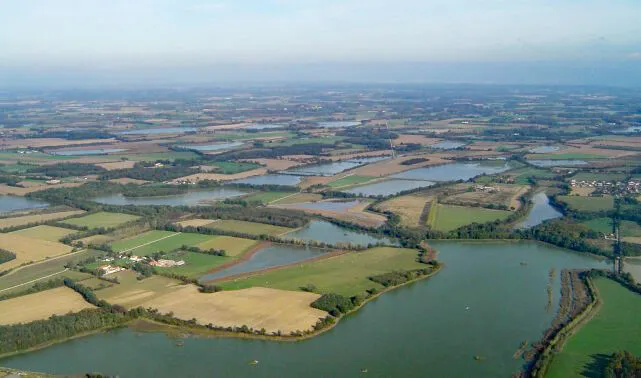
Discover the Ain: world-famous Bresse poultry, the thousand ponds of the Dombes, Pays de Gex facing Mont Blanc and the emerald gorges of Nantua. Complete guide.
 Regions
Aisne: Laon's Medieval Citadel and the Chemin des Dames
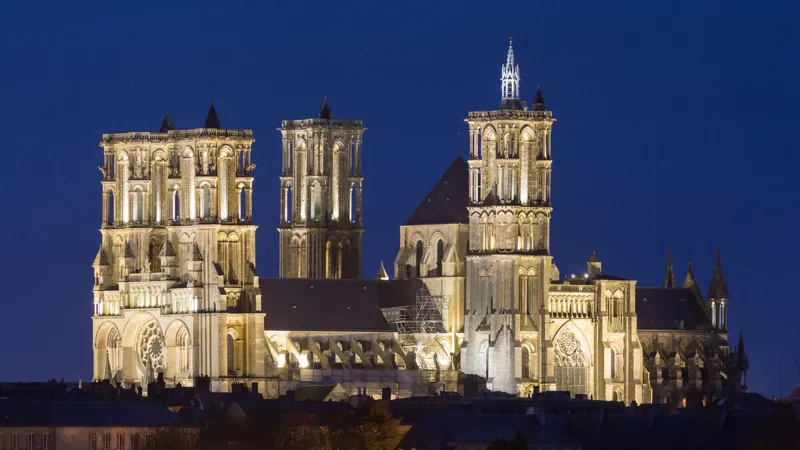
Discover the Aisne département: Laon's hilltop medieval city, the Chemin des Dames battlefields, Soissons, the Familistère de Guise and Champagne vineyards. Complete travel guide.