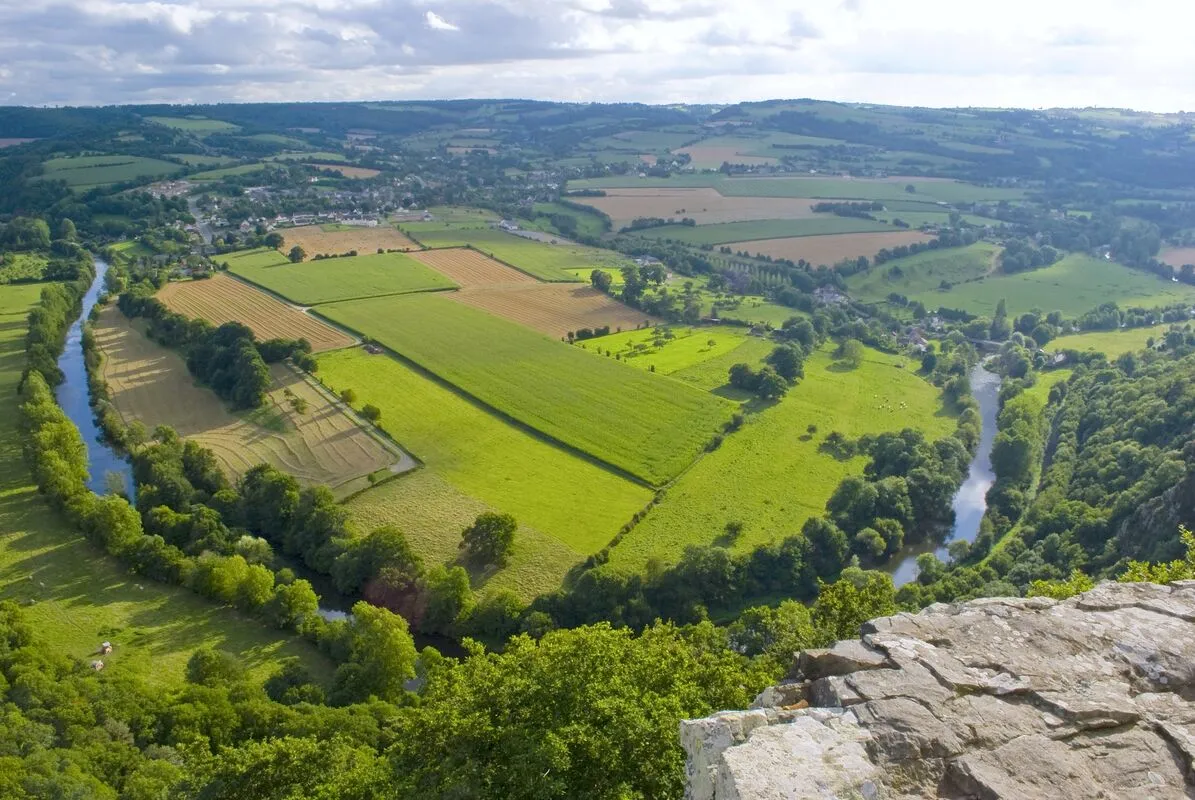
No cliffs, no beaches in the Orne. This Norman department, the farthest from the sea, offers instead wooded gorges nicknamed the Suisse Normande, green hills grazed by Percheron horses, and the Haras du Pin, the 'Versailles of the horse', which has been breeding thoroughbreds for three centuries across a 1,000-hectare estate.
The Suisse Normande: Gorges and Outdoor Adventure
The Suisse Normande is a geological anomaly: in a region known for its gentle flatness, steep gorges, rocky spurs, and incised valleys create an almost mountainous landscape. The name is admittedly an exaggeration — these are not the Alps — but the surprise is genuine, and the outdoor opportunities are excellent.
The iconic site is the Roche d'Oëtre, a rocky promontory rising 118 metres above the Rouvre gorges. The panorama is striking: below, the river winds between wooded cliffs, and on a clear day the view carries far into the Bocage countryside. A small interpretation centre (environ 5 euros) explains the local geology and wildlife. Several waymarked trails depart from the site, ranging from a gentle 30-minute loop to a challenging 3-hour descent into the gorges.
Canoeing and kayaking are the Suisse Normande's other signature activities. The descent of the Orne river between Pont-d'Ouilly and Clécy (around 2 to 3 hours, environ 15 to 20 euros per person) passes through beautiful scenery and is suitable for beginners as well as experienced paddlers. Clécy, the unofficial capital of the Suisse Normande, is the hub for outdoor pursuits: canoeing, rock climbing, mountain biking, and paragliding are all on offer.
For walkers, the Vire valley trail and the paths around Pont-d'Ouilly provide varied routes through wild, wooded countryside. In autumn, the forests that clothe the gorges blaze with colour.
Haras du Pin: The Versailles of the Horse
The Haras national du Pin is one of the most magnificent sites in the Orne. Founded in 1715 by Louis XIV, it is nicknamed the "Versailles of the Horse" — and the comparison is not overstated. The approach along a tree-lined avenue of centuries-old oaks, opening onto the château and its sweeping stable wings, is a genuinely grand moment.
The visit (environ 9 euros, allow 90 minutes) takes in the monumental stables, the saddlery, the forge, and collections of horse-drawn carriages. In summer, equestrian presentations on Thursdays (July to September) showcase the different Norman breeds at work: Percherons, trotters, and thoroughbreds. The show is included in the admission price.
The stud farm is also an ideal starting point for exploring the surrounding valleys on horseback. Several riding centres offer hacks and multi-day treks through the Orne's hedgerow-laced bocage.
Alençon: UNESCO Lace and Gothic Splendour
Alençon, the Orne's préfecture, is a discreet but heritage-rich town. Its fame rests above all on Alençon point lace, a needlework technique classified as UNESCO Intangible Cultural Heritage since 2010. It takes approximately 7 hours of painstaking labour to produce a single square centimetre of this incomparably fine lace.
The Museum of Fine Arts and Lace (environ 5 euros) traces the history of the craft and displays exceptional pieces, some dating from the 17th century. The national lace workshop, housed in the same building, keeps the tradition alive with a handful of lace-makers still working with needle and thread.
The town deserves a stroll through its historic centre: the Basilica of Notre-Dame, a Flamboyant Gothic masterpiece with a porch of extraordinary sculptural finesse, the Château des Ducs (14th–15th century, exterior only), and the old houses of the Saint-Léonard quarter all repay attention.
Alençon is also the birthplace of Saint Thérèse of Lisieux, and her family home is open to visitors free of charge.
Bagnoles-de-l'Orne: A Belle Époque Spa Town
Bagnoles-de-l'Orne is the only spa town in western France. Nestled in a wooded valley, it preserves a remarkable ensemble of Belle Époque architecture: turreted villas, a casino, a grand hotel, all surrounded by a landscaped park and a lake created by a small dam.
The thermal water, drawn at 25 degrees C, is reputed for its benefits on venous circulation. Even without taking a full cure, visitors can enjoy the Bains B'O wellness centre (from environ 20 euros) for a session of relaxation. The lake and the surrounding Andaines forest offer pleasant walks, and the Roc au Chien trail — a rocky viewpoint above the town — rewards a 20-minute climb with a fine panorama.
Bagnoles makes an excellent base for exploring the southern Orne. Its Tuesday morning market showcases local specialities: Vire andouille sausage, pommeau (apple aperitif), and Mortagne black pudding.
Camembert: The Village Behind the Cheese
The village of Camembert is tiny — a handful of houses and a church — but its name resonates worldwide. It was here that Marie Harel is said to have perfected the recipe for the celebrated cheese in the late 18th century. The Maison du Camembert (free) tells the story and explains the stages of production.
Surrounding farms offer visits and tastings. Seek out producers of farmhouse raw-milk Camembert, a world away from the industrial version: an irregular bloomy rind, a rich creamy paste, and a powerful, complex flavour. Vimoutiers, the nearby town, has a Camembert museum and a statue of Marie Harel on its main square.
Domfront and the Perche: Enchanting Borderlands
To the west, Domfront stands on a rocky spur with the ruins of an 11th-century castle and a magnificent view over the bocage. The medieval town retains its ramparts, granite houses, and narrow lanes. The church of Notre-Dame-sur-l'Eau, a 12th-century Romanesque gem, sits at the foot of the cliff beside the River Varenne and is one of Normandy's hidden treasures.
To the southeast, the Perche is a pays of fortified manors, hedgerow-bounded fields, and Percheron horses. This draught-horse breed, recognisable by its grey coat and powerful elegance, was born here. You can admire them on working farms and at local festivals. The manors of the Perche, built between the 15th and 17th centuries, dot the countryside — some are open to visitors, others have been converted into charming chambres d'hôtes.
Mortagne-au-Perche, the historic capital, is celebrated for its black pudding (an international competition is held every March). Bellême, perched on its hill, boasts a magnificent state forest rich in oaks and, in autumn, wild mushrooms.
Practical Information
- When to visit: May to June for lush greenery and long days; September to October for autumn colours and mushroom season
- Getting around: a car is absolutely essential in the Orne; the country roads are a pleasure in themselves
- Budget: a very affordable département — 55 to 85 euros for a charming chambre d'hôtes, 12 to 20 euros for a set lunch
- Suggested duration: 4 to 5 days for a complete tour; 2 days for the Suisse Normande and Haras du Pin
- Don't miss: a canoe descent through the Suisse Normande, a visit to the Haras du Pin on a presentation day, and a farmhouse Camembert tasted on the spot
Explore on the map
Map →📚 Related collections
Related guides
 Regions
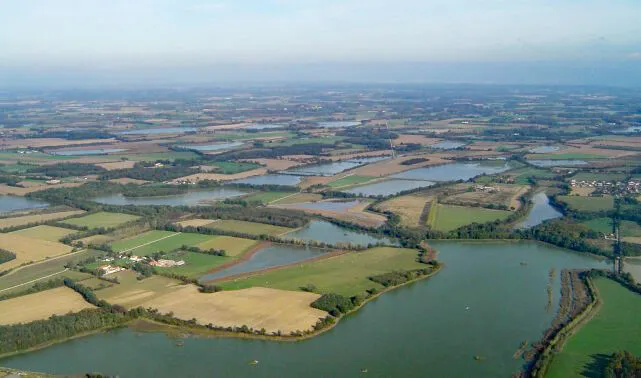
Ain: Bresse, Dombes and Pays de Gex
Discover the Ain: world-famous Bresse poultry, the thousand ponds of the Dombes, Pays de Gex facing Mont Blanc and the emerald gorges of Nantua. Complete guide.
 Regions
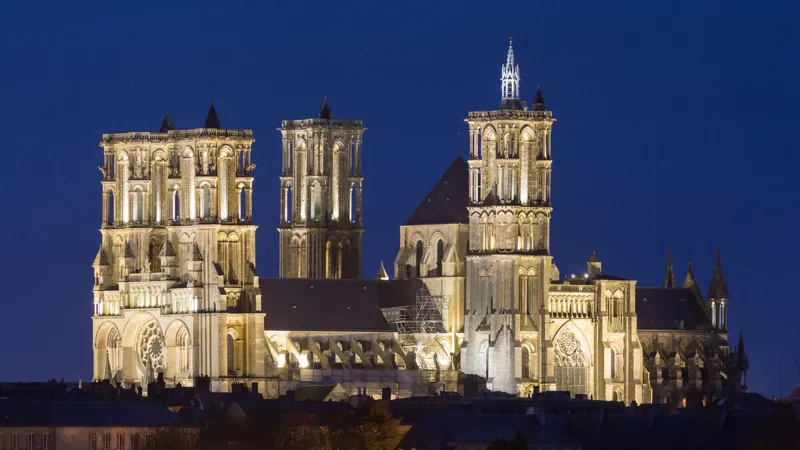
Aisne: Laon's Medieval Citadel and the Chemin des Dames
Discover the Aisne département: Laon's hilltop medieval city, the Chemin des Dames battlefields, Soissons, the Familistère de Guise and Champagne vineyards. Complete travel guide.