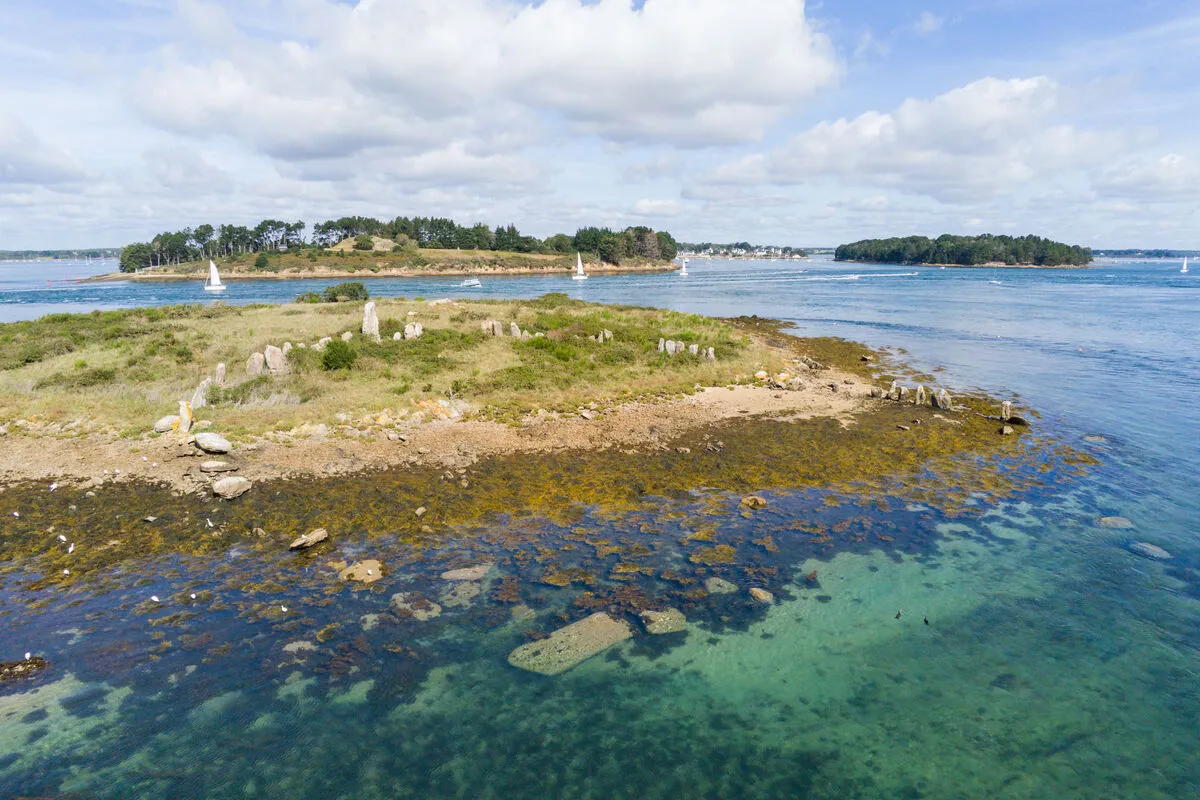
Near Carnac, almost 3,000 standing stones march in rows across a windswept hillside, testimony to a Neolithic civilisation about which we know almost nothing except that it built big. Morbihan is the Breton department where the sea and deep history collide most spectacularly: a sheltered gulf scattered with islands, a wild Atlantic coast, and the forest of Broceliande still whispering Arthurian legends.
The Carnac Alignments
The Carnac alignments are the largest collection of standing stones on Earth. Nearly 3,000 menhirs, arranged in parallel rows stretching over 4 kilometres, were erected between 4500 and 3300 BC by Neolithic communities whose motives remain a mystery. Were they astronomical observatories, ritual processional paths, or something else entirely? Theories abound, but certainty eludes us -- and that is part of what makes them so compelling.
The three main sites -- Le Ménec, Kermario, and Kerlescan -- can be visited freely and without charge from October through March. During summer, the Ménec and Kermario sites are fenced off to protect the fragile vegetation, and access is by guided tour only (around 9 euros; advance booking recommended). Start at the Maison des Mégalithes, opposite the Ménec alignments, which offers a free interactive exhibition and helpful context before you explore.
The Gavrinis Cairn
To go deeper into Morbihan's Neolithic heritage, take a boat from Larmor-Baden to the island of Gavrinis (about 18 euros including boat and guided tour). Inside a 6,000-year-old burial cairn, nearly every stone slab is covered in intricate carvings -- spirals, chevrons, concentric arcs -- that rank among the masterpieces of European prehistoric art. Group sizes are small, so book ahead in peak season.
The Gulf of Morbihan
In Breton, mor bihan means "little sea," and that is exactly what the Gulf of Morbihan is: a vast tidal lagoon of about 12,000 hectares linked to the Atlantic through a narrow channel between Locmariaquer and Port-Navalo. Around 40 islands dot its waters, and the interplay of tides, light, and low-lying shores creates a landscape of quiet, luminous beauty.
The best way to experience the gulf is by boat. Several operators run 2-hour cruises departing from Vannes, Port-Navalo, or Locmariaquer (from about 16 euros). Two inhabited islands make excellent stops.
Île-aux-Moines
The largest island in the gulf is a gentle place of camellia-lined paths, sheltered coves, and fishermen's cottages. You can walk around it in a few hours. The ferry from Port-Blanc takes just 5 minutes (about 5 euros return).
Île d'Arz
Quieter and more rural than its neighbour, Île d'Arz charms with its restored tidal mill, salt marshes, and coastal footpaths. It is the perfect half-day escape for those seeking solitude and birdsong. Ferries run from Vannes and Conleau.
Vannes: Pearl of the Gulf
Vannes is the kind of city that makes you want to linger. Its remarkably intact medieval ramparts, among the best preserved in Brittany, enclose a web of cobblestone lanes, half-timbered houses, and lively café squares. The Cathédrale Saint-Pierre, a blend of Romanesque and Gothic styles, presides over a quarter where every turning reveals an architectural detail worth pausing for.
The rampart gardens, laid out in terraces at the foot of the walls, are a lovely spot for a quiet break. On Wednesday and Saturday mornings, the market on the Place des Lices is a feast: gulf oysters, farmhouse cider, buttery kouign-amann, and buckwheat crêpes. The marina, just below the old town, is the departure point for gulf island cruises and makes for a pleasant evening stroll.
Belle-Île-en-Mer
Brittany's largest island lives up to its name -- "Beautiful Island in the Sea." The crossing from Quiberon takes about 45 minutes by ferry (around 32 euros return), and from the moment you step ashore you understand why Claude Monet came here and stayed for weeks.
The côte sauvage (wild coast) on the island's western side is the star attraction. The Aiguilles de Port-Coton -- jagged sea stacks rising from crashing surf -- are the rock formations that Monet painted more than thirty times, and they remain breathtaking, especially in rough weather. The GR34 circles the entire island over roughly 80 kilometres (4 to 5 days of walking), but you can sample its finest sections in a half-day hike.
Each of Belle-Île's four communes has its own personality. Le Palais is the main port, dominated by a Vauban citadel (around 9 euros to visit). Sauzon, with its pastel-painted harbour houses, is one of the most photographed villages in Brittany. Bangor sits at the heart of the wild coast. Locmaria, the quietest corner, has some of the island's best beaches. Plan at least two days for Belle-Île, and consider renting a bicycle to cover ground at your own pace.
The Quiberon Peninsula
A thin strip of sand -- a tombolo -- tethers the Quiberon peninsula to the mainland. Its west-facing côte sauvage is a wall of wind-battered cliffs and inaccessible coves; its east-facing shore is all sheltered sandy beaches. The town of Quiberon at the peninsula's tip is the departure port for Belle-Île. While you wait for your ferry, indulge in grilled sardines on the quayside and pick up a bag of salted-butter caramels from the Maison d'Armorine (free workshop tour).
Josselin and the Forest of Brocéliande
Inland Morbihan holds two treasures that should not be missed. The Château de Josselin rises from the banks of the River Oust like a granite fairytale, its intricate Flamboyant Gothic facade mirrored in the water below. Still inhabited by the Rohan family, the castle is open for visits from March to October (around 9 euros). The interior offers a window into Breton aristocratic life spanning nine centuries.
Further west, the Forest of Brocéliande (centred on the village of Paimpont) is the legendary setting of the Arthurian romances. The Val sans Retour (Valley of No Return), the Tomb of Merlin, and the Fountain of Barenton are all real places woven through with Celtic myth. The forest trails are beautiful and accessible to walkers of all levels. The Centre de l'Imaginaire Arthurien at the Château de Comper (around 9 euros) brings the legends to life through exhibitions and live performances -- a hit with children and adults alike. Allow a full day to explore the forest on foot.
Practical Information
- Getting there: TGV from Paris to Vannes in about 2 hours 30 minutes, to Lorient in about 3 hours. Lorient-Bretagne Sud Airport has flights from Paris.
- Best time to visit: May to September. The gulf is lovely from spring onward. Belle-Île is most enjoyable outside July and August, when ferry queues are shorter and the island feels less crowded.
- Getting around: a car is essential for inland sites like Josselin and Brocéliande. Maritime shuttles around the gulf run frequently in season.
- Food budget: a crêperie meal costs 9 to 16 euros per person; a seafood platter starts at about 28 euros; a dozen gulf oysters from a producer run about 7 euros.
- Booking ahead: in peak season, reserve the Belle-Île ferry and the Gavrinis tour at least a week in advance to avoid disappointment.
Explore on the map
Map →📚 Related collections
Related guides
 Nature
Ardennes: Meuse Valley and Forests
Discover the French Ardennes, from the Meuse Valley and Europe's largest medieval fortress at Sedan to Charleville-Mezieres's puppet festival and the wild forests of the Ardenne.
 Nature
Corsica: The Island of Beauty
Discover Corsica: paradise beaches, GR20, Bonifacio, Porto and Scandola, hilltop villages. Complete guide with itineraries and Corsican flavours.