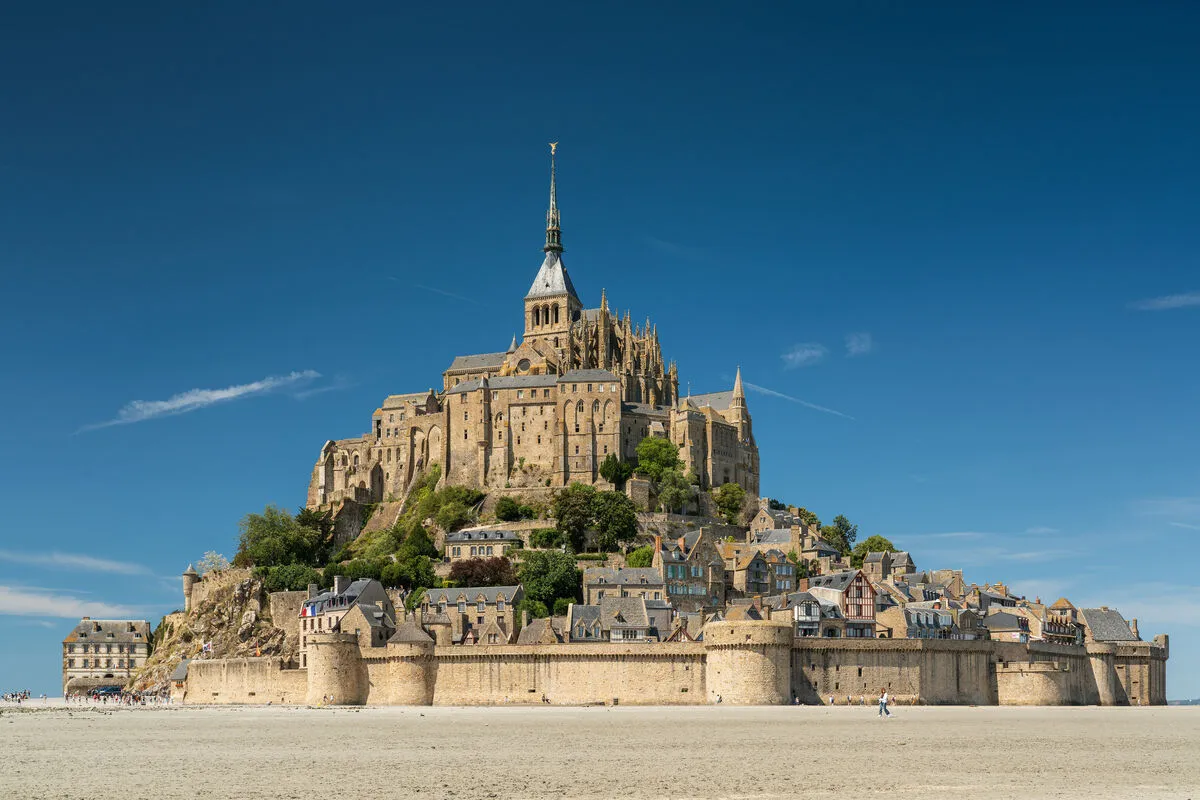
When the tide retreats, Mont-Saint-Michel stands alone on its sandflat, and the spectacle is as breathtaking as it was on the first day. The Manche is a department at the end of the world, bordered by the sea on three sides thanks to the Cotentin peninsula, where wild maritime scenery meets an exceptional heritage and an iodine-rich gastronomy -- Saint-Vaast oysters, salt-marsh lamb, Isigny butter.
Mont-Saint-Michel: The Marvel of the Western World
No introduction needed for Mont-Saint-Michel. This granite island crowned by a thousand-year-old abbey is one of the most recognisable silhouettes on Earth, and the experience of watching it emerge from the vast tidal flats remains genuinely thrilling.
The abbey (~11 euros) takes about 90 minutes to explore. Highlights include the cloister suspended between sky and sea, the Knights' Hall, and the Romanesque abbey church with its soaring nave. Arrive early in the morning or after 4pm to avoid the worst crowds. Free shuttle buses run from the mainland car park (~14.90 euros per day) to a point 400 metres from the gates.
A guided bay crossing (~25 euros per person, 2.5 to 3 hours) is one of the most memorable experiences in Normandy. You walk barefoot across quicksand and tidal channels with a certified guide who explains the ecosystem, the dangers, and the history. Book ahead in peak season — slots fill quickly. Bring a windbreaker even in summer; the bay funnels cold gusts.
The West Coast: Wild Dunes and Hidden Harbours
The western shore of the Cotentin peninsula is a revelation. Long sandy beaches stretch from Barneville-Carteret southward, backed by dunes and barely touched by mass tourism. The Côte des Havres — a string of natural estuaries where rivers fan into the sea — creates an otherworldly landscape of shifting sandbanks and wading birds.
Granville, perched on a rocky headland, calls itself the "Monaco of the North" with a wink. Its fortified upper town, working fishing harbour, and the Christian Dior Museum (the designer was born here) make it a worthwhile stop. From Granville, ferries cross to the Chausey Islands, a wild archipelago where extreme tides expose kilometres of rock pools — paradise for anyone who loves beachcombing.
Cap de la Hague: Normandy's Land's End
At the north-western tip of Cotentin, the Cap de la Hague feels closer to Ireland than to Paris. Heather-covered headlands drop into the churning sea, tiny harbours shelter behind granite breakwaters, and the light shifts dramatically with the weather.
The Nez de Jobourg, at 128 metres the highest cliff on the coast, delivers vertigo-inducing views. The GR 223 coastal path runs the length of the Hague and ranks among France's finest long-distance walks. You can tackle day-long sections, such as the stretch from Goury — where a lifeboat station clings to the rocks — to Port Racine, officially the smallest harbour in France.
In the hamlet of Omonville-la-Petite, the poet Jacques Prévert spent his final years. His house is now a small museum (~5 euros), tucked in a garden that feels a world away from the windswept coast nearby.
Barfleur and the East Coast: Granite and Oysters
The eastern seaboard has a different character — sheltered, more intimate, and rich with culinary traditions. Barfleur, classified among France's Most Beautiful Villages, is a tiny granite fishing port where boats bob in a tidal harbour and the quayside restaurants serve superb Barfleur mussels, famous for their size and flavour.
Nearby, the Gatteville Lighthouse (75 metres tall, 365 steps, ~3 euros) rewards the climb with a 360-degree panorama across the Channel. On a clear day, you can see the coast of England.
South along the coast, Saint-Vaast-la-Hougue is Normandy's oyster capital. The town's oyster beds are visible at low tide, and several producers offer dockside tastings. A dozen oysters with a glass of chilled muscadet, eaten on a bench overlooking the Vauban towers (UNESCO-listed) — it simply does not get more Norman than this. Budget about 10 to 15 euros for a generous platter.
Utah Beach and Sainte-Mere-Eglise: The Airborne Story
Manche has its own D-Day chapter. Utah Beach was the westernmost landing beach, and the assault here, though less costly than at Omaha, was a pivotal part of the invasion. The Utah Beach Museum (~8 euros) stands right on the sand and houses an authentic B-26 Marauder bomber, one of very few surviving examples.
A few kilometres inland, Sainte-Mere-Eglise became famous when paratrooper John Steele's parachute caught on the church steeple. A dummy with a parachute still hangs there in tribute. The Airborne Museum (~10 euros) tells the story of the American airborne troops through immersive displays, including a Waco glider flight simulator that puts you in the co-pilot's seat.
Coutances and Cherbourg: Culture and Discovery
Coutances owns one of the most harmonious Gothic cathedrals in France. Its octagonal spire rises above the Cotentin countryside, and the lantern tower floods the crossing with light. In early summer, the Jazz sous les Pommiers festival transforms the town for a week of world-class performances.
At the peninsula's northern tip, Cherbourg-en-Cotentin is home to the Cite de la Mer (~19 euros), housed in the Art Deco former transatlantic terminal. The star attraction is Le Redoutable, a decommissioned nuclear submarine and the largest visitable submarine in the world. The complex also includes aquariums and deep-sea exploration exhibits. Allow 3 to 4 hours for the full visit.
Practical Tips
- Best time to visit: May to June for spectacular spring tides at Mont-Saint-Michel and wildflowers on the Hague; September for oyster season and thinner crowds
- Getting around: A car is essential — public transport in the Cotentin is limited. Cherbourg has ferry connections to Ireland and England
- Budget: Accommodation is more affordable than in neighbouring Calvados; expect 70 to 100 euros for a quality B&B
- Suggested duration: 5 to 7 days to circle the peninsula and visit Mont-Saint-Michel thoroughly; 2 days minimum for the Mont alone
- Pack wisely: Windproof and waterproof layers are non-negotiable — weather in the Manche changes fast, even in high summer
Explore on the map
Map →📚 Related collections
Related guides
 Regions
Ain: Bresse, Dombes and Pays de Gex
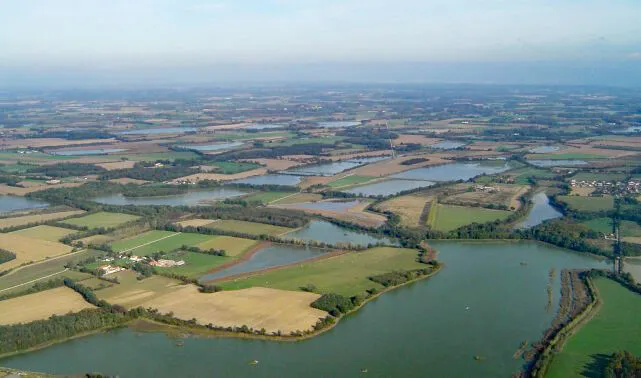
Discover the Ain: world-famous Bresse poultry, the thousand ponds of the Dombes, Pays de Gex facing Mont Blanc and the emerald gorges of Nantua. Complete guide.
 Regions
Aisne: Laon's Medieval Citadel and the Chemin des Dames
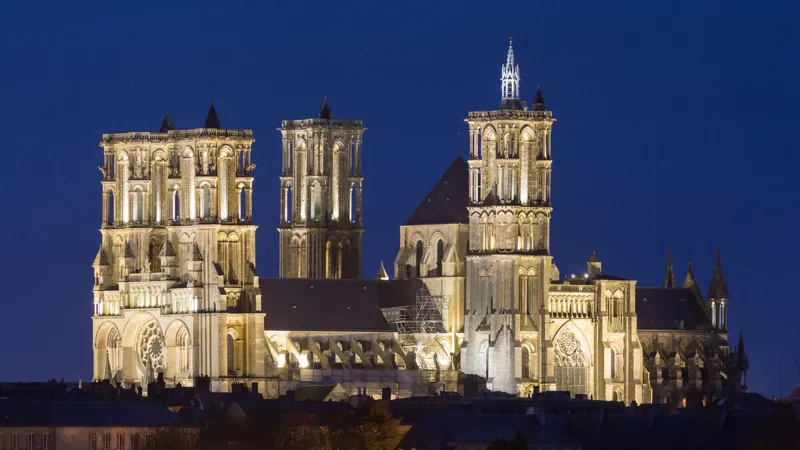
Discover the Aisne département: Laon's hilltop medieval city, the Chemin des Dames battlefields, Soissons, the Familistère de Guise and Champagne vineyards. Complete travel guide.