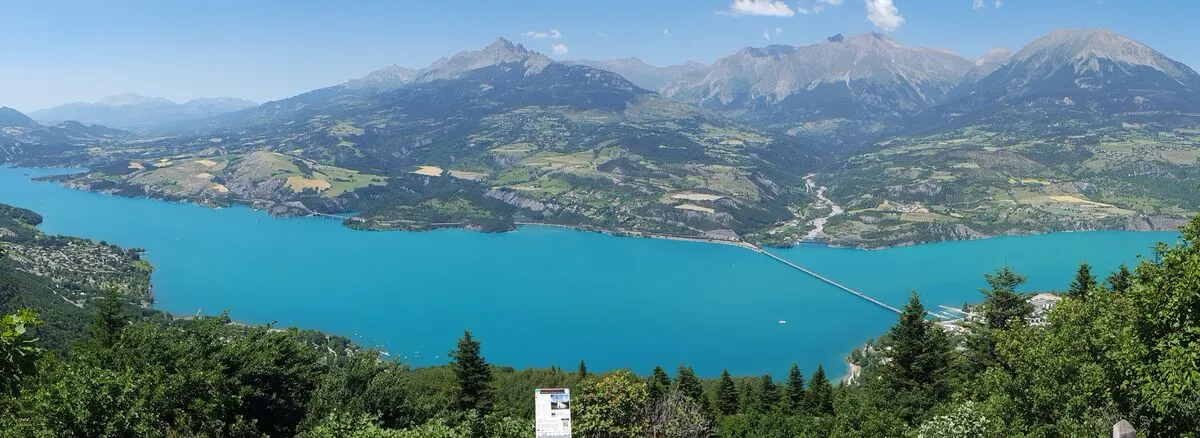
A turquoise giant set in the heart of the Southern Alps, with the Ecrins peaks as backdrop: Lake Serre-Poncon is one of the largest artificial lakes in Europe and one of the most beautiful. With its 20 kilometres of length, hidden coves and surprisingly warm summer waters, it has become the mountain riviera of the Hautes-Alpes, drawing sailors, paddleboarders, swimmers and sunbathers alike.
The dam and the lake's history
A titanic construction project
The Serre-Ponçon Dam is an earth-fill structure standing 123 metres high and 600 metres long at its crest. Its construction, which began in 1955 and was completed in 1960, required thousands of workers over five years. The dam holds back the waters of the Durance and the Ubaye, controlling the devastating floods that had ravaged lower Provence for centuries. It also supplies water to the whole of Provence via the Canal de Provence and generates electricity through its hydroelectric power station (720 GWh per year).
The drowned villages
The filling of the lake submerged several villages and hamlets. The most famous is Savines, whose inhabitants were relocated to the new town of Savines-le-Lac built on higher ground. During low winter water levels, the foundations and ruins of the old village sometimes reappear, creating a poignant spectacle. The Muséoscope du Lac, located on the lakeside at Rousset, tells this story through films, scale models and testimonies from former residents. The visit lasts about 1.5 hours (admission: around €7).
Beaches and swimming
The best beaches
The lake offers numerous sand and pebble beaches, supervised in summer from mid-June to early September. Water temperatures reach 22–24°C in July and August, ideal for swimming.
- Savines-le-Lac Beach: the largest and best-equipped, with a playground, snack bar and pedal boat hire. Free access.
- Chanteloube Beach: on the peninsula of the same name, in a wild setting facing the mountains. Stunning scenery, few facilities.
- Saint-Vincent-les-Forts Beach: on the south shore (Alpes-de-Haute-Provence), a renowned paragliding spot with lake-side landings.
- Boscodon Beach: accessible from Boscodon Abbey, at the foot of larch forests. Peaceful atmosphere.
- Chorges Recreation Area: at the northern tip of the lake, set up with children's play areas, ideal for families.
Practical tip
Lake levels vary by season. In summer, the lake is at its highest and all beaches are accessible. In late summer and autumn, levels drop and some beaches end up far from the water. The best months for swimming are July and August.
Water sports
Serre-Ponçon is an exceptional playground for water activities, thanks to its size, reliable winds and warm waters.
Sailing and windsurfing
The lake benefits from regular thermal breezes that pick up in the early afternoon, offering ideal conditions for sailing, windsurfing and kitesurfing. Several water sports centres offer lessons and equipment hire:
- Savines-le-Lac Water Sports Centre: hire of dinghies, catamarans, windsurfers and stand-up paddleboards. Group lessons from around €35 per session.
- Chanteloube Nautique: sailing school in a preserved setting.
- Saint-Vincent Kite: kitesurfing spot on the south shore, catching the evening winds.
Paddle, kayak and canoe
Stand-up paddleboarding is the lake's most popular activity. The calm morning waters, before the breeze sets in, offer perfect conditions for exploring coves and cliffs from the water. Hire from €15 per hour at most beaches. Sea kayaking and canoeing allow you to explore the shoreline and discover beaches inaccessible by road.
Tubing and water skiing
For thrill-seekers, operators offer inflatable tubing, water skiing and wakeboarding on the lake. Expect to pay around €20–30 per session.
Hiking around the lake
The lake circuit
The lake circuit on foot is a long-distance trail of around 80 kilometres, achievable in 4–5 days. It follows waymarked paths alternating between larch forests, panoramic viewpoints and passages through lakeside villages. The route can also be done by mountain bike or road bike.
Saint-Michel Chapel
Perched on a rocky pinnacle emerging from the water, Saint-Michel Chapel is the lake's iconic image. This 12th-century Romanesque building, once on top of a hill, now sits on an islet since the lake was filled. It can be reached on foot when the water level is low, or by kayak or paddleboard at other times. The sight is magical at sunset.
Boscodon and the forest
Boscodon Abbey, founded in 1142, is a jewel of Provençal Romanesque art nestled in a forest of centuries-old firs and larches. Visiting the abbey (around €5) and walking through the Boscodon Forest (2-hour loop) make for an unmissable excursion. The waymarked botanical trail passes through a majestic fir forest with trees over 40 metres tall.
The Demoiselles Coiffées
At Théus, a few kilometres from the lake, the Demoiselles Coiffées (capped ladies) are spectacular fairy chimneys: columns of earth topped with large boulders, sculpted by erosion. An easy 45-minute trail allows you to observe them up close. It is a unique geological site in the Alps.
Villages around the lake
Embrun, the Nice of the Alps
Embrun, perched on a rock overlooking the lake, is the area's main town. Its nickname "Nice of the Alps" reflects its exceptional sunshine. The Notre-Dame du Réal Cathedral (12th century), with its pink marble porch supported by stone columns, is a masterpiece of alpine Romanesque art. The Archbishop's Garden, suspended above the lake, offers one of the finest panoramas in the region. The Tuesday and Friday market is one of the liveliest in the Southern Alps.
Chorges and the lake road
Chorges, at the northern end, is a charming Provençal village with fountains, shaded squares and a Romanesque church. It is the starting point of the lake road (D3), which follows the eastern shore with spectacular viewpoints.
Savines-le-Lac
Savines-le-Lac is the lake's resort town, rebuilt in the 1960s after the old village was submerged. Its central location, facing Saint-Michel Chapel, makes it an ideal base for exploring the lake. The Savines bridge, 924 metres long, is the longest prestressed concrete bridge in France.
Practical information
Getting there
- By car: A51 motorway from Marseille/Aix-en-Provence (2.5 hours), then N85 and N94 to Embrun or Chorges. From Grenoble, N85 via the Col Bayard (2 hours).
- By train: Embrun station on the Alpine line (Briançon–Marseille), with direct regional trains from Marseille (3 hours) and Grenoble (3.5 hours).
- By air: Marseille (200 km) or Grenoble (150 km) airports.
When to visit
- Summer (June–September): main season, swimming, water sports, temperatures of 25–32°C. Peak crowds in July–August.
- Spring (April–May): hiking, lake at its lowest but blossoming landscapes, few tourists.
- Autumn (October–November): exceptional autumn colours, reflections on the lake, absolute tranquillity.
- Winter: the ski resorts of Réallon, Les Orres and Crévoux are less than 30 minutes from the lake.
Accommodation
Lakeside campsites (from €15 per night), rural gîtes, hotels in Embrun and Savines-le-Lac. Booking strongly recommended in July–August.
Explore on the map
Map →📚 Related collections
Related guides
 Nature
Ardennes: Meuse Valley and Forests
Discover the French Ardennes, from the Meuse Valley and Europe's largest medieval fortress at Sedan to Charleville-Mezieres's puppet festival and the wild forests of the Ardenne.
 Nature
Corsica: The Island of Beauty
Discover Corsica: paradise beaches, GR20, Bonifacio, Porto and Scandola, hilltop villages. Complete guide with itineraries and Corsican flavours.