The Jura produces a wine found nowhere else on earth: vin jaune, aged for six years under a veil of yeast, developing aromas of walnut and spice impossible to reproduce under any other sky. But this discreet department, often overshadowed by its Alpine neighbours, also conceals waterfalls tumbling down limestone cliffs, intensely blue lakes, and reculees -- dead-end valleys -- that rank among the most beautiful landscapes in the Jura.
The Hérisson Waterfalls
A Grand Natural Spectacle
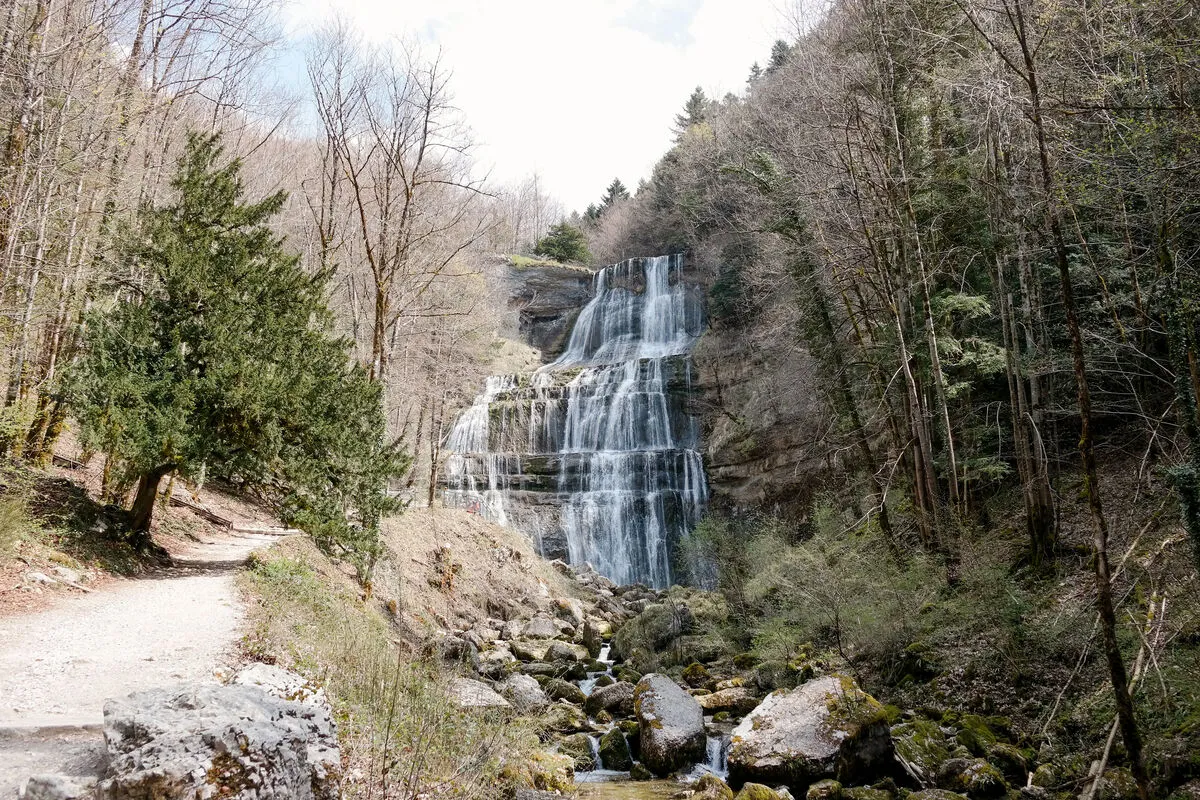
The Cascades du Hérisson are the most visited natural site in the Jura, and with good reason. Over a course of 3.7 kilometres, the Hérisson river drops 280 metres in a succession of 31 leaps and 7 major waterfalls. The marked trail that runs alongside the cascades is accessible to any walker in reasonable fitness (allow 3 to 4 hours return).
The two most spectacular falls are the Éventail (65 metres), a great curtain of water fanning out across a rock wall, and the Grand Saut (60 metres), a sheer vertical plunge. The path winds between the two, crossing wooden footbridges and offering plunging viewpoints over the gorges. Parking at the Maison des Cascades costs around 5 euros per vehicle. In summer, arrive early in the morning to beat the crowds.
The Maison des Cascades
Located at the trailhead, the Maison des Cascades (around 5 euros entry) offers an interactive exhibition explaining the karst geology of the site, the formation of tufa deposits and the aquatic wildlife. It is an excellent starting point for understanding the landscape you are about to explore.
The Reculées: Natural Cathedrals of the Jura
Baume-les-Messieurs
The Reculée de Baume-les-Messieurs is arguably the most iconic landscape in the Jura. This natural amphitheatre, flanked by cliffs 200 metres high, shelters at its base one of the oldest Benedictine abbeys in France, founded in the sixth century by the Irish monk Saint Columban. The imperial abbey can be visited freely, and its Romanesque buildings, fifteenth-century Flemish altarpiece and cloister form an ensemble of profound serenity.
Continuing to the far end of the valley, you reach the Grottes de Baume, an underground network of galleries adorned with stalactites and spectacular rock formations (guided tour around 8 euros, duration 45 minutes). The tufa waterfall gushing at the cave entrance adds a touch of enchantment.
Les Planches-près-Arbois
Less well known but equally impressive, the Reculée des Planches-près-Arbois offers a vertiginous setting of cliffs framing a resurgent spring. The Petite and Grande Source are accessible via a maintained path. The Grotte des Planches (around 7 euros) allows you to venture into the heart of the plateau and discover an underground river.
Arbois, Capital of Jura Wines
A Small Town with Grand Character
Arbois is the beating heart of the Jura wine region. This charming small town of ochre stone houses and limestone-slab roofs possesses a singular atmosphere, at once rural and sophisticated. It was here that Louis Pasteur spent part of his childhood and conducted some of his experiments on fermentation. His house, now the Musée Pasteur (around 7 euros), preserves intact the laboratory where he worked, notably on the diseases of wine — a fitting tribute in the capital of Jura viticulture.
Vin Jaune, a Unique Treasure
Vin Jaune (Yellow Wine) is the crown jewel of Jura winemaking. Produced from the Savagnin grape variety, it ages for a minimum of 6 years and 3 months in oak barrels beneath a film of yeast (the voile) that protects it from oxidation while imparting incomparable aromas of walnut, curry and spice. It is bottled in the clavelin, a distinctive 62-centilitre bottle that represents what remains of one litre of must after the long ageing process.
The Percée du Vin Jaune, an annual festival held in early February in a different village each year, is the great gathering of enthusiasts. Over 40,000 visitors come to taste the freshly released vintage. Outside this event, Arbois estates willingly open their doors for tastings (generally free to 10 euros for a full selection). Do not miss the Vin de Paille (Straw Wine), another Jura speciality made from grapes dried on straw mats before pressing, yielding an intensely sweet and complex dessert wine.
Comté, King of Cheeses
Comté is the most produced AOC cheese in France, and the Jura is its birthplace. Made exclusively from the raw milk of Montbéliarde or Simmental cows, it matures from 4 to over 36 months in the caves of specialist affineurs. Each 40-kilogram wheel is unique. The Maison du Comté in Poligny (free admission) traces the history and production of this exceptional cheese. Visit a fruitière (cooperative dairy) to watch the morning cheesemaking process — the spectacle begins at 8 am.
The Lakes of the Jura
Lac de Vouglans
The Lac de Vouglans, the third-largest artificial lake in France, stretches its 35 kilometres of turquoise shoreline through a setting of dense forest. Its clear, calm waters are ideal for swimming, kayaking and stand-up paddleboarding. Three supervised beaches welcome families in summer. Camping by the lake is an unforgettable experience, with pitches from 15 euros per night.
Lac de Chalain
More intimate, Lac de Chalain is the oldest inhabited lake-dwelling site in Europe, with remains of Neolithic stilt villages listed by UNESCO. Today, its crystalline blue-green waters make it one of the most beautiful swimming lakes in France. Lakeside campsites offer direct access to the water and a wonderfully relaxed atmosphere.
Salins-les-Bains and Salt — UNESCO
The Grande Saline de Salins-les-Bains, a UNESCO World Heritage Site, bears witness to over 1,200 years of salt production. The guided tour (around 9 euros) descends into underground galleries where brine was pumped to the surface, then into the evaporation halls where it was boiled down. The subterranean atmosphere, among stone vaults and ancient machinery, is striking. The visit pairs perfectly with the Royal Saltworks at Arc-et-Senans in neighbouring Doubs.
Practical Information
Getting there: Lons-le-Saunier, the Jura's préfecture, is approximately 2 hours 30 minutes from Paris by TGV (via Bourg-en-Bresse). Arbois is reachable by regional train from Besançon (45 minutes). By car, the A39 motorway serves the département from both Lyon and Dijon.
Getting around: A car is essential for exploring the reculées, waterfalls and vineyards. Roads are often narrow and winding but offer exceptional panoramas. Cycling is excellent on the greenways (voies vertes) built along former railway lines, offering flat, traffic-free routes through the valleys.
Best time to visit: May to October for hiking and the waterfalls. February for the Percée du Vin Jaune festival. Winter for cross-country skiing on the Haut-Jura plateaus (Les Rousses resort). Autumn bathes the vineyards in golden light and marks the grape harvest.
Budget: The Jura is a remarkably affordable destination. Set menus in village inns cost between 14 and 22 euros for starter, main and dessert. A bottle of Vin Jaune starts at around 20 euros; an 18-month-aged Comté costs approximately 18 euros per kilogram.
Explore on the map
Map →📚 Related collections
Related guides
 Regions
Ain: Bresse, Dombes and Pays de Gex
Discover the Ain: world-famous Bresse poultry, the thousand ponds of the Dombes, Pays de Gex facing Mont Blanc and the emerald gorges of Nantua. Complete guide.
 Regions
Aisne: Laon's Medieval Citadel and the Chemin des Dames
Discover the Aisne département: Laon's hilltop medieval city, the Chemin des Dames battlefields, Soissons, the Familistère de Guise and Champagne vineyards. Complete travel guide.