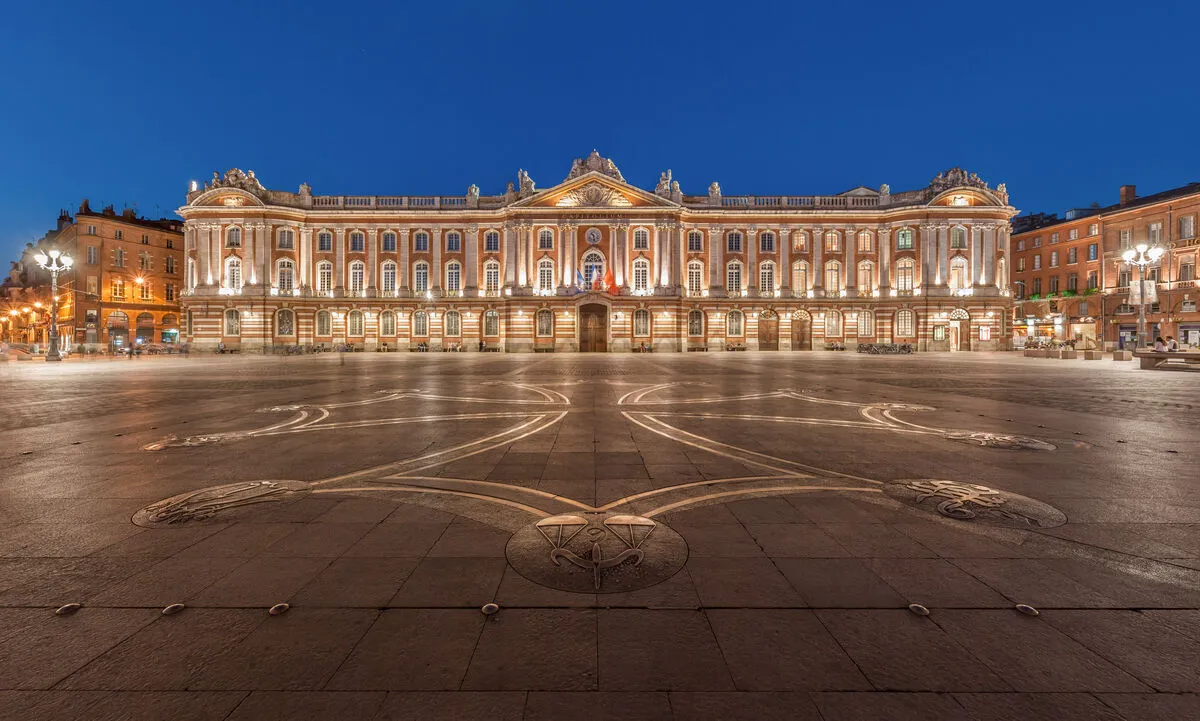
Toulouse is pink. Pink like the brick of its facades, pink like the sunset over the Garonne, pink like the life lived in its Place du Capitole cafes. But the Haute-Garonne stretches far beyond its lively capital. To the south, the Comminges unfolds Pyrenean valleys where Romanesque churches hide in grey-stone villages, and where the basilica of Saint-Bertrand-de-Comminges looks down on a sleeping Roman amphitheatre.
Toulouse: Occitan Capital
Toulouse charms visitors with its warm light, rosy brick, lilting accent and a cultural vitality fuelled by its student population and aerospace industry.
Place du Capitole
The Place du Capitole is the beating heart of Toulouse. This vast esplanade, flanked on one side by the neoclassical facade of the Capitole (city hall and theatre), is where Toulousains gather daily. Beneath the arcades on the opposite side, ceiling paintings by Raymond Moretti tell the city's story in twenty-nine panels. The Wednesday market fills the square with regional produce stalls, while the café terraces buzz from morning to night. The Capitole interior is free to visit: do not miss the Salle des Illustres, a gallery of monumental paintings that rivals the decorative splendour of the Paris Opera.
Basilique Saint-Sernin
The Basilique Saint-Sernin, inscribed on the UNESCO World Heritage List as part of the Routes of Santiago de Compostela, is the largest Romanesque church in the western world. Its octagonal brick-and-stone bell tower rises above the student quarter. The interior, 115 metres long, impresses with its double-aisled nave and a crypt housing sacred relics. Entry is free (crypt about 3 euros). Allow 45 minutes for a full visit. The surrounding neighbourhood, with its bookshops, record stores and student eateries, rewards extended wandering.
The Couvent des Jacobins
The Couvent des Jacobins is a masterpiece of southern Gothic architecture. Its single-nave church houses the famous "Jacobins palm tree," a 28-metre column whose ribs fan out into a vault of rare elegance. The cloister, a haven of calm in the city centre, hosts temporary exhibitions. Cloister entry costs about 5 euros. The convent holds the relics of Saint Thomas Aquinas. Tip: visit in the late afternoon to enjoy the light filtering through the stained glass.
The Canal du Midi and the Garonne
The Canal du Midi crosses Toulouse from east to west, offering one of the finest urban walks in France. From the Port de l'Embouchure, where it meets the Canal de Brienne and the Garonne, follow the plane-tree-shaded banks past locks and houseboats. Toulousains gather here to run, cycle or simply stroll. The Garonne itself offers fine viewpoints, notably from the Pont Neuf (the city's oldest bridge, dating from the sixteenth century) and the Promenade Henri-Martin. At sunset, the pink brick facades take on a golden glow that alone justifies the nickname "the Pink City."
The Cité de l'Espace
The Cité de l'Espace, a theme park dedicated to space exploration and astronomy, is one of Toulouse's headline attractions, befitting Europe's aerospace capital. The site features a full-scale replica of the Ariane 5 rocket, a module from the Mir space station, an IMAX planetarium and interactive exhibits on space missions. Entry costs about 25 euros for adults. Allow at least half a day, or a full day if you are a space enthusiast. The exhibitions are engaging for children and adults alike. To extend the aviation theme, also visit Aeroscopia at Blagnac (about 15 euros), a museum where you can step aboard a Concorde and an Airbus A380.
Saint-Bertrand-de-Comminges
Saint-Bertrand-de-Comminges, listed among the Most Beautiful Villages in France, is an exceptional site perched on a promontory above the Garonne valley at the foot of the Pyrenees, roughly 90 minutes' drive south of Toulouse.
The Cathedral and Cloister
The Cathedral of Sainte-Marie, blending Romanesque and Gothic architecture, is the village's jewel. Its Romanesque cloister, open to sweeping Pyrenean views, is one of the finest in southwest France. Inside, the Renaissance choir stalls carved in oak are a masterpiece of intricate craftsmanship. Entry to the cloister and choir costs about 6 euros. At the foot of the village, the remains of the Roman city of Lugdunum Convenarum attest to the site's ancient importance: baths, a temple, a forum and a theatre are freely accessible.
The Festival du Comminges
Each summer, the Festival du Comminges (July to August) stages classical and baroque concerts in the cathedral and cloister, an acoustically and visually outstanding setting. Tickets are affordable (from 15 euros) and the atmosphere is intimate.
Bagnères-de-Luchon
Bagnères-de-Luchon, commonly known simply as "Luchon," is the most elegant spa town in the Pyrenees, set in the Pique valley at 600 metres above sea level.
Spa and Hiking
The Luchon spa, fed by sulphurous springs known since Roman times, offers a wellness centre with pools, a hammam and treatments. Entry to the Luchon Forme area costs about 20 euros for 2 hours. The town is also an outstanding hiking base: the Lac d'Oô, reached in about 90 minutes on foot, is a glacial lake beneath a 275-metre waterfall, one of the most beautiful natural sites in the Pyrenees. More demanding peaks such as the Pic de la Mine or the Pic du Céciré reward with exceptional panoramas of the border ridge.
Skiing at Superbagnères
In winter, the resort of Superbagnères, reached by a panoramic road from Luchon, offers a modest but sunny ski area (28 runs) facing a wall of snow-capped peaks above 3,000 metres. A day pass costs about 35 euros. The family atmosphere and reasonable prices make it a pleasant alternative to the big resorts.
Revel: A Lauragais Bastide Town
Revel, founded in 1342, is one of the finest bastide towns in the Lauragais, the rolling countryside between Toulouse and Carcassonne once nicknamed the "Land of Plenty" for the wealth generated by the medieval woad trade. Its central covered market square, one of the best preserved in southwest France, hosts a large market every Saturday morning, drawing local producers from across the region. Revel is also the capital of fine furniture-making, heir to a centuries-old tradition of cabinet work. The Museum of Wood and Marquetry (about 5 euros) showcases this craft. Nearby, the lake at Saint-Ferréol, the historic reservoir that feeds the Canal du Midi, offers swimming and walks in a wooded setting.
Practical Tips
Getting Around
Toulouse-Blagnac airport, the fourth-busiest in France, serves numerous French, European and international destinations. Matabiau station connects to Paris in 4 hours 15 minutes by TGV. The metro and tram cover the city efficiently. A car is necessary for the Comminges, Luchon and the Lauragais.
Best Time to Visit
Toulouse is a year-round destination thanks to its mild climate. Spring (April to June) is ideal for terraces and Pyrenean hiking. Summer is hot but enlivened by festivals. Autumn brings truffle markets and the colours of the Lauragais. Winter opens the ski season at Superbagnères and the spa season at Luchon.
Budget
Accommodation ranges from 50 to 80 euros per night for a budget hotel, 80 to 130 euros for a B&B or charming hotel, and 130 to 220 euros for upscale options. A restaurant lunch runs 14 to 22 euros, dinner 25 to 40 euros. Local farmers' markets provide excellent produce for picnics at reasonable prices. Hiking, village exploration and most churches are free. Paid sites and museums cost 6 to 15 euros per person. To keep costs in check, look for weekday set-lunch menus, stay in rural gites or quality campsites, and enjoy the free tastings many local producers offer.
Explore on the map
Map →📚 Related collections
Related guides
 Road trips
The Alsace Wine Route: Vineyards and Charming Villages
Explore the Alsace Wine Route from Marlenheim to Thann. Picturesque villages, wine tastings and tips for an unforgettable road trip.
 Road trips
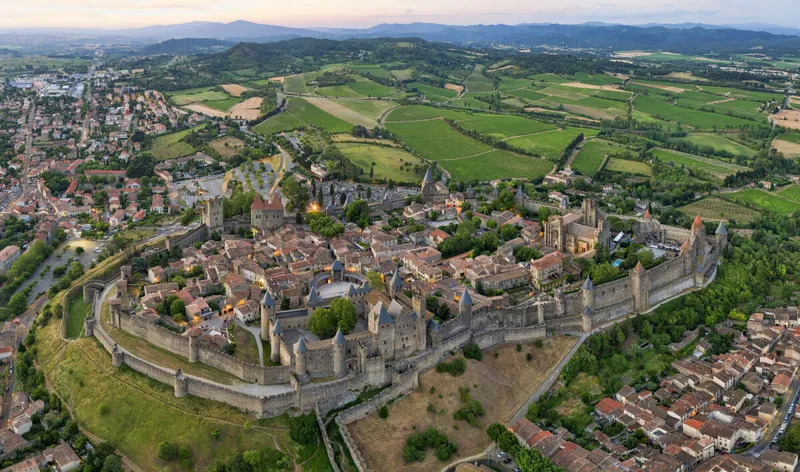
Aude: Carcassonne and Cathar Country
Guide to the Aude: Carcassonne citadel, Cathar castles, Canal du Midi, Narbonne, Fontfroide Abbey. Vertiginous fortresses and Languedoc vineyards.