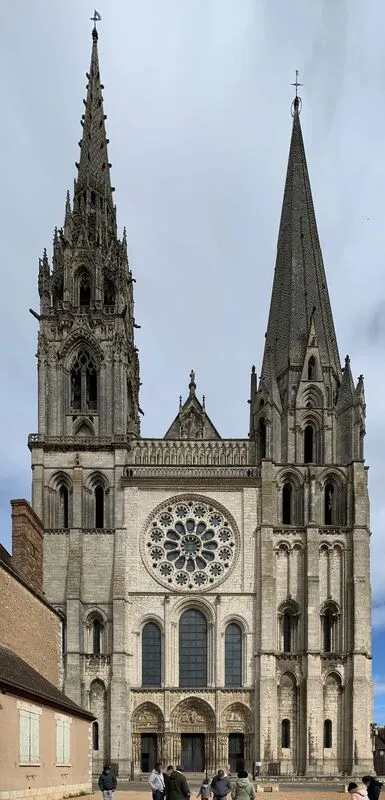
When light passes through the stained glass of Chartres Cathedral, it projects a spectacle on the flagstones that has not changed in eight centuries. This department is anchored by that masterpiece, but reveals many other faces: to the north, the vast grain plains of the Beauce under a painter's sky; to the south, the rolling hedgerows of the Perche, land of manors and the mighty Percheron horse.
Chartres: The Cathedral of Light
Notre-Dame de Chartres has been a UNESCO World Heritage Site since 1979, and a single upward glance explains why. Its two asymmetric spires — one Romanesque, sober and slender; the other Flamboyant Gothic, carved like lacework — are visible from tens of kilometres across the Beauce plain. But the real treasure lies inside.
The stained glass of Chartres is considered the finest collection of medieval windows in existence. Dating mostly from the 13th century, they cover 2,600 square metres and bathe the interior in a deep, luminous blue — the legendary "Chartres blue" — unlike anything else in the world. The nave, the choir with its sculpted screen, the labyrinth set into the floor (one of the few to survive intact), and the Romanesque crypt, among the largest in Europe, demand at least 90 minutes of attentive visiting. Entry to the cathedral is free; the crypt tour and north tower climb cost a few euros each.
Chartres en Lumieres
Every year from April to October, Chartres en Lumieres turns the city into a spellbinding nighttime spectacle. More than twenty-four sites — the cathedral, churches, bridges, wash-houses, medieval houses — are illuminated by artistic projections that tell the city's story in colour and motion. The light trail is entirely free, takes two to three hours on foot, and offers a complete rediscovery of the city after dark.
The cathedral illumination is the highlight: the facades come alive with biblical scenes, geometric patterns and cascading colours that reveal architectural details invisible by daylight. Visit on a weeknight to enjoy the show without the weekend crowds.
The Old Town of Chartres
Around the cathedral, the old town tumbles downhill towards the banks of the River Eure. Cobbled lanes, half-timbered houses and staircases spilling down the slope form a remarkably well-preserved medieval ensemble. The Bords de l'Eure quarter is especially charming: restored wash-houses, stone bridges, mills and terraced gardens compose a picture-postcard landscape.
The Musée des Beaux-Arts, housed in the former bishop's palace, contains a painting collection (including works by Zurbarán and Chardin) and enamels worth a detour (~5 euros). Also worthwhile is the Centre International du Vitrail, set in a medieval granary, which explains stained-glass techniques and displays contemporary creations (~7 euros).
The Saturday morning market on Place Billard is essential: Beauce and Perche produce, pâté en croûte, goat cheese, honey and farmhouse cider.
Château d'Anet: Diane's Love Story
The Château d'Anet (~9 euros), about forty kilometres north of Chartres, is one of the masterpieces of the French Renaissance. Built by Philibert Delorme for Diane de Poitiers, favourite of King Henry II, it is a love story written in stone. Although much of the château was destroyed during the Revolution, what survives is extraordinary: the monumental gateway crowned by a bronze stag and an automaton clock, the funerary chapel of Diane with its floor of dizzying geometric complexity, and gardens that are gradually being restored to their former glory.
Allow about one hour for the guided visit. The château is open only on certain days of the week, so check the schedule before making the trip.
The Perche: Hedgerows, Manors and Quiet Living
The Perche covers the south-western part of the département and spills into neighbouring Orne. This land of gentle hills, thick hedgerows and meadows grazed by the famous Percheron horses is the antithesis of the flat Beauce. The Perche has attracted Parisians seeking greenery and tranquillity in recent years, yet it retains an authenticity that resists fashion.
Nogent-le-Rotrou
Nogent-le-Rotrou is the historic capital of the Perche. Its Château Saint-Jean (~5 euros), a medieval fortress overlooking the town, offers superb views over the rooftops and surrounding countryside. The museum inside traces the history of the Perche and the noble families who emigrated as far as New France. Many present-day Quebecois can trace their ancestry to this corner of France.
The old town at the foot of the castle preserves Renaissance town houses and timber-framed buildings. The Saturday morning market is a concentrated display of Perche terroir.
The Manors of the Perche
The Perche contains an exceptional concentration of manor houses from the 15th and 16th centuries. These modest seigneurial dwellings, built of limestone under flat-tile roofs, are tucked into wooded hollows or discovered along sunken lanes. Some, like the Manoir de Courboyer, which serves as the headquarters of the Perche Regional Natural Park (free entry), are open to visitors and offer a glimpse of rural noble life.
The back roads of the Perche, bordered by centuries-old hedgerows, are a joy for cyclists and unhurried motorists alike.
Thiron-Gardais and the Abbey
The Abbey of Thiron-Gardais (~6 euros) was founded in 1114 by Saint Bernard of Tiron and became the mother house of a monastic order that spread across Europe. The abbey church, reconstructed medieval gardens and adjacent royal college are well worth a stop. The village itself, with its pond and old houses, has a quiet charm.
The Beauce: France's Breadbasket
The Beauce covers the northern half of the département. This immense plain, one of the most fertile in Europe, is France's leading cereal-growing area. The landscape, dominated by wheat, rapeseed and sugar beet, may seem monotonous at first glance, but it possesses an austere grandeur, especially at sunrise or sunset when the raking light sets the ears of grain ablaze.
The Beauce is punctuated by compact villages clustered around their church spires and by large Beauce farms whose massive buildings are arranged around enclosed courtyards. Some offer visits and direct sales of farm produce.
Food and Drink in Eure-et-Loir
The département straddles two culinary influences: the Beauce, a land of cereals, and the Perche, a land of livestock and orchards.
- Pâté de Chartres, a puff pastry filled with game, has been an institution since the 18th century
- Cochelin, a brioche twisted into a human shape, has been eaten in Chartres for centuries
- Perche cider, farmhouse and artisanal, rivals the best of Normandy
- Poiré, cider's cousin made from pears, is a rare and delicate local speciality
- Beauce lentils and goat cheeses round out a simple but flavourful table
A meal at a Perche inn costs between 15 and 25 euros; gastronomic restaurants in Chartres offer menus between 30 and 55 euros.
Practical Tips
- Best time to visit: April to October for Chartres en Lumieres; May to June for the Perche in bloom; summer for the Beauce harvest
- Getting there: Chartres is 1 hour from Paris by train from Montparnasse. A car is essential for the Perche and Château d'Anet
- Visit budget: Expect 20 to 30 euros per person for a full day (cathedral free, 2 to 3 paid sites)
- Suggested duration: 2 to 3 days for Chartres and surroundings, 2 extra days for the Perche
- Don't miss: the stained glass in the morning when sunlight streams through, Chartres en Lumieres on a weeknight, and a wander along the sunken lanes of the Perche
Explore on the map
Map →📚 Related collections
Related guides
 Regions
Ain: Bresse, Dombes and Pays de Gex
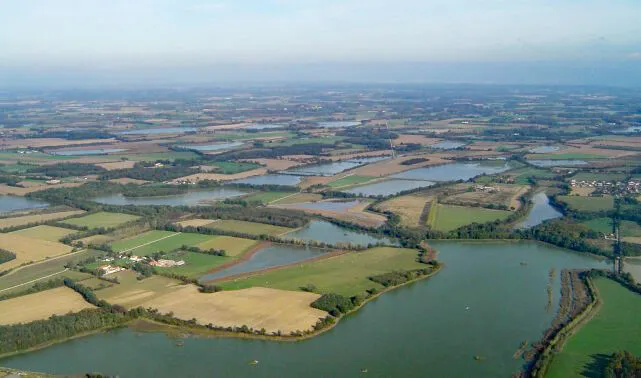
Discover the Ain: world-famous Bresse poultry, the thousand ponds of the Dombes, Pays de Gex facing Mont Blanc and the emerald gorges of Nantua. Complete guide.
 Regions
Aisne: Laon's Medieval Citadel and the Chemin des Dames
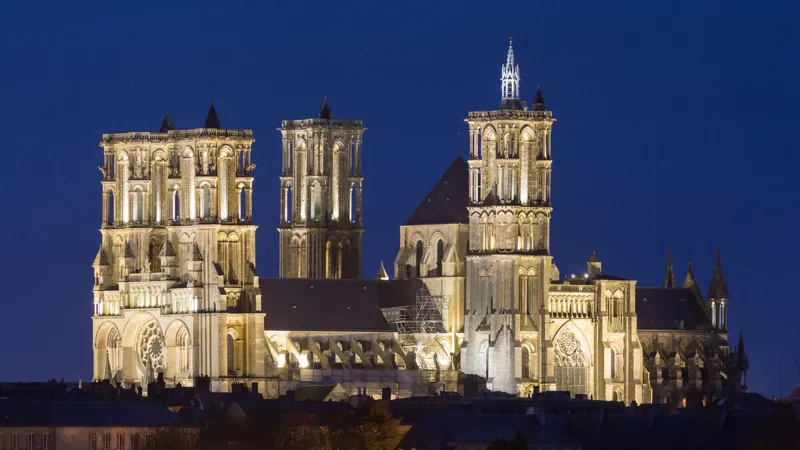
Discover the Aisne département: Laon's hilltop medieval city, the Chemin des Dames battlefields, Soissons, the Familistère de Guise and Champagne vineyards. Complete travel guide.