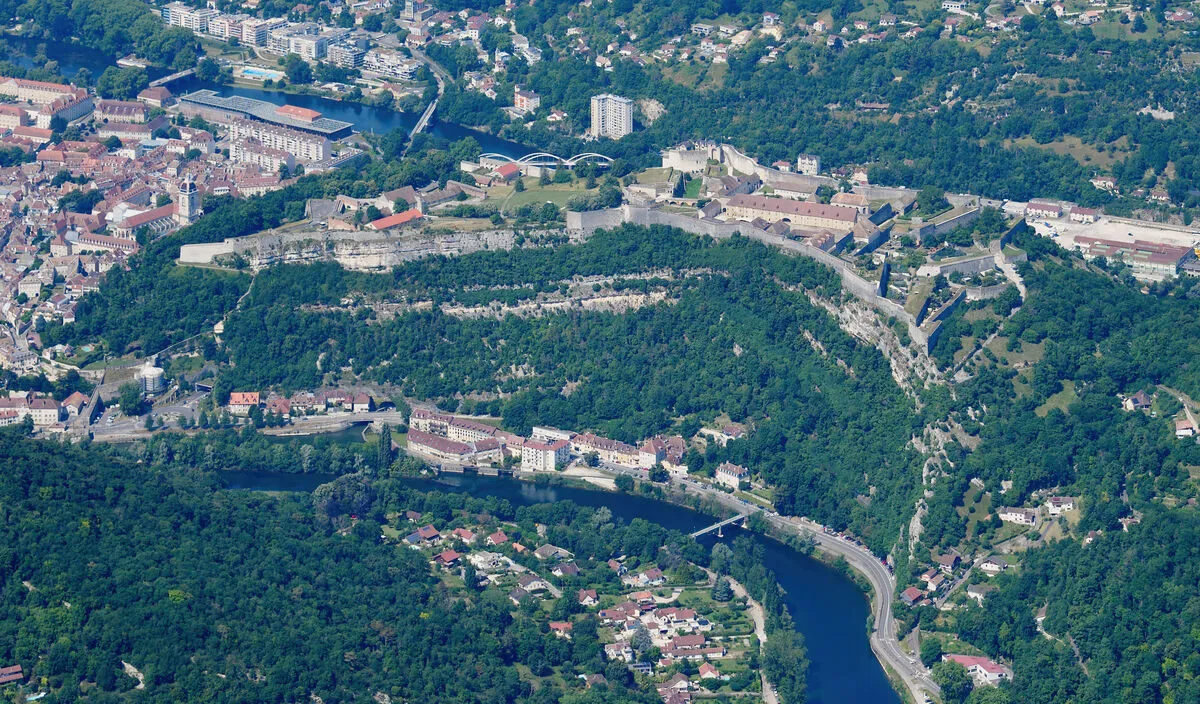
Besancon, cradled in a meander of the Doubs and protected by a UNESCO-listed Vauban citadel, is one of the most quietly beautiful cities in France. The department that shares the river's name must be sought out: accept the winding roads, the deep gorges, the wind-swept limestone plateaux and the proximity to Switzerland, and you will discover a land of Comte cheese, Morteau sausage and spectacular waterfalls.
Besançon, a City of Art and Time
The Vauban Citadel — UNESCO World Heritage
Commanding the city from its rocky promontory, the Citadelle de Besançon is the masterpiece of military engineer Sébastien Le Prestre de Vauban. Listed as a UNESCO World Heritage Site since 2008, it sprawls across more than eleven hectares and delivers breathtaking views over the river loop and surrounding hills. The visit (around 12 euros for adults) includes three museums: the Museum of Resistance and Deportation, sober and deeply moving; the Natural History Museum with a zoological garden housing over 300 species; and the Noctarium, a unique space dedicated to nocturnal animals. Allow half a day to explore everything.
The Doubs Loop and the Old Town
Besançon is built inside an almost-closed meander of the river, forming a natural amphitheatre of rare beauty. The historic centre brims with treasures: the Cathedral of Saint-Jean, home to an astronomical clock with 30,000 components dating from 1860; the Palais Granvelle, a superb Renaissance mansion now converted into the Museum of Time; and pedestrianised streets lined with blue-grey stone facades distinctive to the region. The Quai Vauban offers one of the finest riverside walks in France, especially at sunset when the citadel glows amber above the water.
Besançon, Capital of Watchmaking
Besançon's watchmaking tradition stretches back to the eighteenth century. The Musée du Temps (Museum of Time), housed in the Palais Granvelle, traces this fascinating history through collections of watches, clocks and time-measuring instruments spanning several centuries. Admission is free on the first Sunday of each month. Enthusiasts can extend the experience by visiting the workshops of Utinam, a contemporary manufacture that continues the Bisontine watchmaking tradition with bold modern designs.
The Saut du Doubs and the Bassins du Doubs
A Spectacular Waterfall
The Saut du Doubs is the département's greatest natural wonder. This 27-metre-high waterfall marks the border between France and Switzerland, set within a theatre of wooded cliffs. To reach it, take a boat from the village of Villers-le-Lac (cruise approximately 14 euros return, duration 1h30), which follows the sinuous course of the Doubs between gorges with vertiginous walls. The spectacle is at its most dramatic in spring, when snowmelt swells the cascade to a thundering torrent.
The Bassins du Doubs
Upstream of the waterfall, the Bassins du Doubs form a chain of natural lakes whose waters glow deep emerald green, hemmed in by limestone cliffs. Marked trails run alongside these basins, offering spectacular viewpoints at every turn. The full hike from Villers-le-Lac to the Saut du Doubs via the cliff paths takes approximately 3 hours return (moderate difficulty). Bring sturdy shoes and plenty of water — facilities along the route are minimal.
The Haut-Doubs: Plateaus and Forests
Métabief and the Mont d'Or
The Mont d'Or rises to 1,463 metres and commands the finest panorama in the département: on a clear day, the view stretches to Lake Geneva, the Swiss Jura and, in the distance, the Alps with Mont Blanc itself. The resort of Métabief is the ideal base for exploring this summit. In winter, it offers 40 kilometres of alpine ski runs (day pass around 32 euros) and 200 kilometres of cross-country trails. In summer, downhill mountain biking and a summer luge take over.
Mont d'Or Cheese
The Mont d'Or (also called Vacherin du Haut-Doubs) is one of the most distinctive cheeses in France. Produced only between 15 August and 15 March, encircled by a strip of spruce bark that imparts its characteristic woody aroma, it is traditionally eaten warm, baked in its box in the oven. Fromageries across the Haut-Doubs offer visits and tastings, notably the Fruitière de Métabief and the Maison du Mont d'Or in Longevilles-Mont-d'Or. Expect to pay between 5 and 8 euros per cheese.
Pontarlier and Absinthe
Pontarlier, sub-prefecture of the Haut-Doubs, was the world capital of absinthe in the nineteenth century before the spirit was banned in 1915. Since its re-legalisation in 2011, several distilleries have revived production. The Musée municipal de Pontarlier dedicates a section to the fabled green fairy, and the Guy and Armand Guy distilleries offer free tours followed by tastings. The town is also the gateway to the Défilé de Joux, a narrow natural gorge guarded by the spectacular Château de Joux (around 8 euros admission), a military fortress where Toussaint Louverture was imprisoned.
The Loue Valley
Ornans, the Little Venice of the Comté
The Loue Valley is one of the most poetic landscapes in Franche-Comté. The river winds between moss-covered cliffs and villages clinging to rocky hillsides. Ornans, birthplace of the painter Gustave Courbet, is its jewel. The town's overhanging houses reflected in the Loue compose a living painting that Courbet himself depicted many times. The Musée Courbet, installed in the artist's birth house and adjacent buildings, holds a remarkable collection of his works (around 8 euros).
The Source of the Loue
A few kilometres from Ornans, the Source de la Loue bursts from the base of a 100-metre cliff inside a rocky amphitheatre of striking beauty. It is in fact a resurgence of the Doubs river, a karst phenomenon that Courbet immortalised in several celebrated paintings. Access is free and the site is reached via a short trail from the car park (15 minutes' walk). The sheer volume of water emerging from the cliff face is mesmerising, particularly after heavy rain.
The Royal Saltworks of Arc-et-Senans — UNESCO
In the western part of the département, the Saline royale d'Arc-et-Senans is a visionary masterpiece by the architect Claude-Nicolas Ledoux. Built between 1775 and 1779 on the orders of Louis XV, this salt manufactory is one of the earliest examples of utopian industrial architecture. A UNESCO site since 1982, it now houses exhibitions, gardens and a cultural centre. Admission is approximately 10 euros. The gardens, redesigned each year around a different theme, are particularly spectacular from June to September.
Practical Information
Getting there: Besançon is connected to Paris by TGV in 2 hours 10 minutes via the Besançon Franche-Comté TGV station. Regional trains (TER) then link the TGV station to the city centre in 15 minutes. By car, the A36 motorway crosses the département from east to west.
Getting around: A car is virtually essential for exploring the Haut-Doubs and the Loue Valley. Roads are winding but well maintained. In summer, the mountain passes offer magnificent scenic routes. Cycling is excellent along the river valleys, with the EuroVelo 6 route following the Doubs.
Best time to visit: Summer (June–September) is ideal for hiking and water activities. Winter (December–March) draws cross-country skiers and snowshoers. Autumn paints the forests in blazing colour and marks the start of Mont d'Or cheese season. Spring brings waterfalls at their maximum flow — the Saut du Doubs is most impressive in April and May.
Budget: The Doubs remains a very affordable destination. Campsites and rural gîtes offer nights from 15 to 40 euros. Restaurants in the Haut-Doubs serve hearty Comtois specialities — fondue, raclette with Mont d'Or, morel mushroom croûte — for 15 to 25 euros per set menu.
Explore on the map
Map →📚 Related collections
Related guides
 Regions
Ain: Bresse, Dombes and Pays de Gex
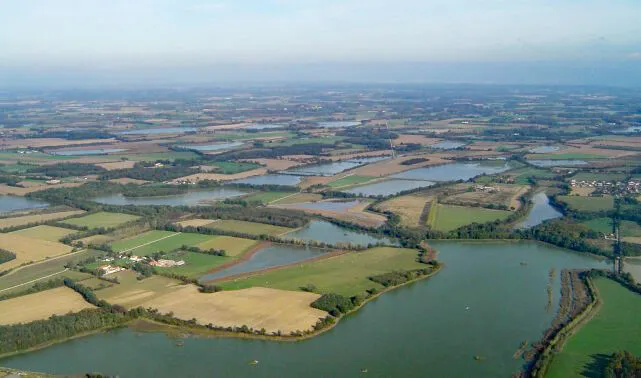
Discover the Ain: world-famous Bresse poultry, the thousand ponds of the Dombes, Pays de Gex facing Mont Blanc and the emerald gorges of Nantua. Complete guide.
 Regions
Aisne: Laon's Medieval Citadel and the Chemin des Dames
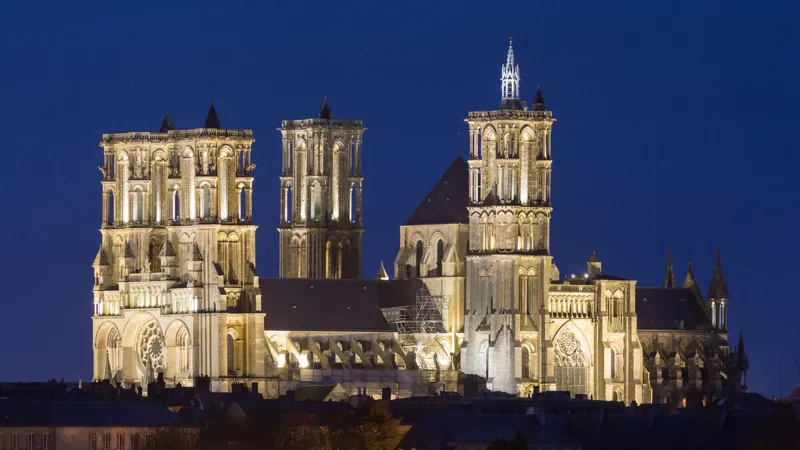
Discover the Aisne département: Laon's hilltop medieval city, the Chemin des Dames battlefields, Soissons, the Familistère de Guise and Champagne vineyards. Complete travel guide.