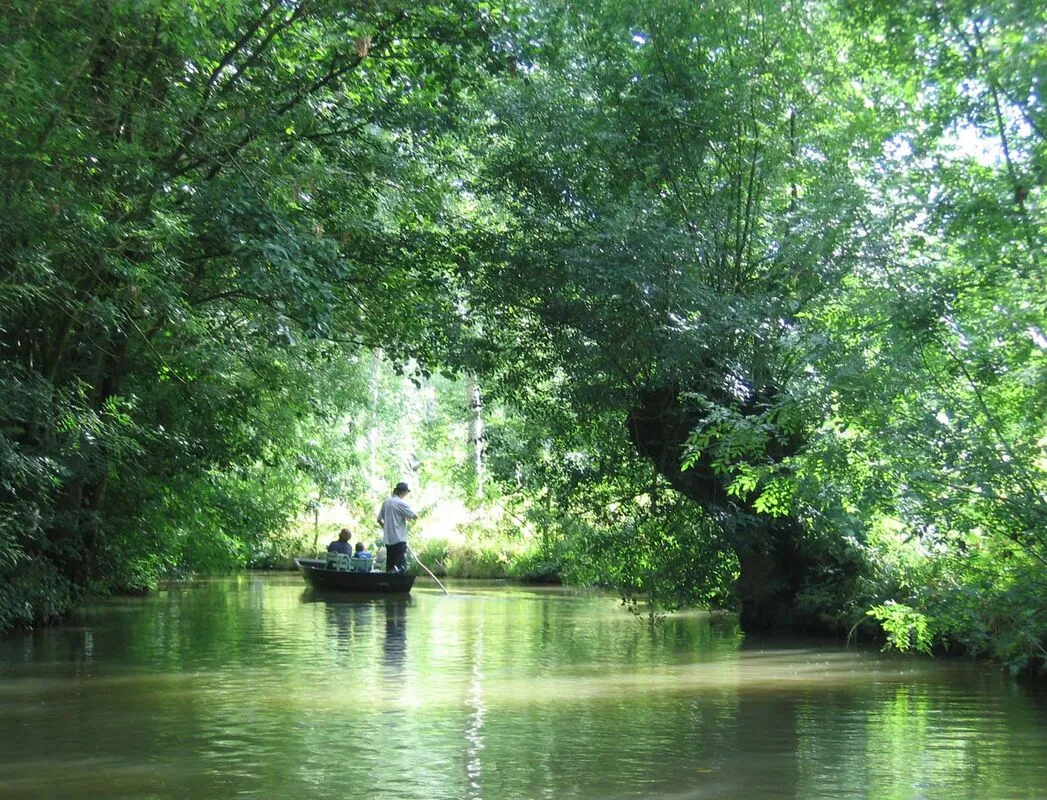
They call it the Green Venice, and with good reason. In the Marais Poitevin, flat-bottomed boats glide between pollarded ash trees along canals shaded in deep green, in a silence broken only by birdsong. Deux-Sevres, a discreet department well off the main tourist trails, guards this unique aquatic labyrinth along with medieval towns, rolling vineyards and Romanesque churches you can discover almost entirely alone.
The Marais Poitevin: Green Venice
Discovering the Marsh by Boat
The Marais Poitevin is the second-largest wetland in France, covering nearly 100,000 hectares across three départements. The most spectacular section, the Venise Verte (Green Venice), lies within Deux-Sèvres around the landing stages of Coulon, Arçais and La Garette. Visitors glide through the watery maze in flat-bottomed boats (called plate or batai in local dialect), guided by a boatman who poles the vessel with a pigouille and knows every channel and ditch of this aquatic labyrinth.
Boat trips last between 1 and 2 hours and cost approximately 8 to 15 euros per person. The boatman pushes in silence beneath a canopy of pollarded ash trees whose branches form arches over the green water. The filtered light, the birdsong and the soft splash of the pole create an almost dreamlike atmosphere. In spring, duckweed blankets the surface in a carpet of emerald green. It is an experience of absolute stillness, a world away from everyday life.
Coulon: Gateway to the Marsh
Coulon is the most popular village in the Marais Poitevin and the busiest starting point for boat trips. Its Romanesque church, low-slung houses along the Sèvre Niortaise and flower-lined quays form a picturesque scene. The Maison du Marais Poitevin (admission about 6 euros) offers an interactive exhibition on the marsh ecosystem, its wildlife (otters, grey herons, kingfishers) and the history of its drainage by monks in the Middle Ages.
Exploring the Marsh by Other Means
Beyond the traditional boat, the marsh can also be explored by bicycle along a network of flat cycle paths running beside the canals (rental about 12 euros per day), by canoe or kayak for the more athletic (about 15 to 20 euros per half-day), or on foot along the towpaths. Birdwatchers will appreciate the observation hides set up in the marais desséché, the more open, agricultural part of the marsh, where marsh harriers, lapwings and white storks nest.
Niort: Medieval Fortress and Mutual Insurance City
The Keep and the Old Town
Niort is a dynamic mid-sized town whose identity rests on two pillars: a rich medieval past and a unique mutual insurance tradition. The Donjon de Niort, consisting of two rectangular towers linked by a central building, is one of the most imposing keeps in Europe. Built by Henry II Plantagenet and Richard the Lionheart in the twelfth century, it dominates the Sèvre Niortaise and now houses an archaeological museum (admission about 4 euros).
The old town, with its pedestrian streets, timber-framed houses and Renaissance townhouses, is a pleasant walk of 1 to 2 hours. The covered market (Halles), lively and well-stocked, is the best place to sample local specialties: Chabichou du Poitou goat cheese, candied angelica from Niort and farci poitevin.
Niort: Mutual Insurance Capital
Niort is the headquarters of several major French mutual insurance companies (MAIF, MAAF, Macif), giving it an economic prosperity and quality of life above average for a town its size. This translates into quality cultural facilities, well-maintained green spaces and a vibrant community life. The Pilori, a former medieval town hall, hosts contemporary art exhibitions (free admission).
Tumulus de Bougon: Neolithic Memory
The Tumulus de Bougon is one of the most important and oldest megalithic sites in Europe. This necropolis, dating from 4700 BCE — two millennia before the pyramids of Egypt — comprises five tumuli containing stone-built burial chambers of impressive size. The largest measures 72 meters long.
The Musée des Tumulus (admission about 7 euros), modern and engaging, explains the context of these structures and the life of Neolithic communities in Poitou. Reconstructions of dwellings, flint-knapping workshops and children's activities complement the visit. The archaeological park, laid out around the tumuli in an oak wood, takes about 90 minutes to explore. It is a place that invites meditation on the depth of human time.
Melle and the Silver Mines
A UNESCO Heritage Site
Melle, a small town of 3,500 inhabitants, possesses a heritage out of all proportion to its size. Its silver mines, worked from the seventh to the tenth century to mint Merovingian and Carolingian coinage, are the oldest visitable silver mines in Europe. They are inscribed on the UNESCO World Heritage List as part of the Routes of Santiago de Compostela.
The guided mine tour (about 8 euros, lasting 1 hour) takes visitors down into galleries hand-hewn more than a thousand years ago. The constant underground temperature of 14 degrees Celsius provides welcome coolness in summer. An outdoor trail traces the history of silver extraction and coin minting.
The Romanesque Churches of Melle
Melle boasts three Romanesque churches of note for such a small town: Saint-Hilaire (UNESCO-listed), Saint-Pierre and Saint-Savinien. The church of Saint-Hilaire impresses with its sculpted portal and enigmatic horseman on the north facade, a figure still debated by historians. All three churches can be visited freely and without charge.
The Sèvre Niortaise and the Bocage
Walking and Nature
The Sèvre Niortaise, one of the two rivers that give the département its name, meanders through a lush bocage landscape before losing itself in the channels of the Marais Poitevin. Its banks offer fine walking, notably the path linking Niort to Coulon (about 20 km, manageable by bike in half a day).
The bocage of Deux-Sèvres, with its living hedgerows, wet meadows and sunken lanes, is a traditional agricultural landscape of great ecological richness. The Réserve naturelle du Toarcien, near Thouars, reveals fossiliferous cliffs dating back 180 million years, accessible free of charge.
Parthenay and Romanesque Art
Parthenay, in the north of the département, is a fortified medieval town whose quarter of Saint-Jacques preserves an atmosphere from another age. The Porte Saint-Jacques, an imposing thirteenth-century gatehouse, and the rue de la Vau-Saint-Jacques, lined with medieval houses, form one of the finest urban medieval ensembles in western France. Parthenay is also known for its Wednesday market, one of the oldest livestock markets in France.
Deux-Sèvres Gastronomy
The table in Deux-Sèvres draws on both Poitevin and Charentais traditions. Chabichou du Poitou, a truncated-cone-shaped goat cheese with AOP status, is the local star — enjoyed fresh, semi-dry or fully aged. Tourteau fromager, a goat-cheese cake with a black, domed crust, surprises with its scorched appearance but delights with its soft texture and delicate flavor. Angélique de Niort, a candied aromatic plant, has flavored cakes and liqueurs since the eighteenth century.
A meal at a local inn costs between 15 and 24 euros for a set menu. The markets at Niort (Thursday and Saturday), Melle (Friday) and Parthenay (Wednesday) are the best places to taste local produce.
Practical Tips
- When to go: April to June for the Marais Poitevin at its greenest, September for calm and autumn colors. Avoid July and August if you prefer to escape the crowds at Coulon
- Getting around: Niort is 2 hours 15 minutes from Paris by TGV. A car is needed for the Marais Poitevin, Bougon and Melle. Cycling is excellent along the canals
- Accommodation budget: Expect 55 to 100 euros per night in a chambre d'hôtes or small hotel — very reasonable compared to neighboring départements
- How long: 3 to 4 days. 1 day for the Marais Poitevin by boat and bike, 1 day for Niort, 1 day for Bougon and Melle, 1 day for Parthenay and the bocage
- Do not miss: A boat ride through the Green Venice at dawn, the silver mines of Melle, the Tumulus de Bougon, and a tourteau fromager from the Niort market
Explore on the map
Map →📚 Related collections
Related guides
 Regions
Ain: Bresse, Dombes and Pays de Gex
Discover the Ain: world-famous Bresse poultry, the thousand ponds of the Dombes, Pays de Gex facing Mont Blanc and the emerald gorges of Nantua. Complete guide.
 Regions
Aisne: Laon's Medieval Citadel and the Chemin des Dames
Discover the Aisne département: Laon's hilltop medieval city, the Chemin des Dames battlefields, Soissons, the Familistère de Guise and Champagne vineyards. Complete travel guide.