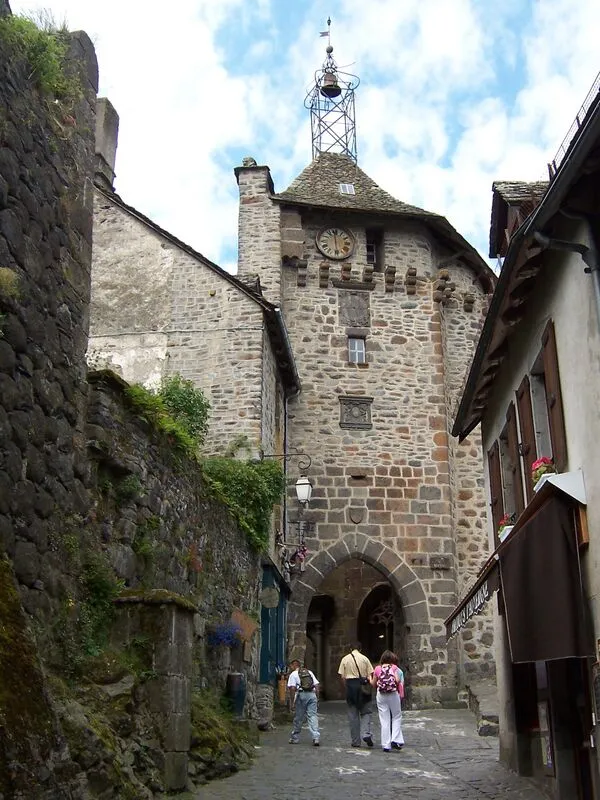
No big cities, no crowded landmarks: the Cantal is Auvergne's most discreet department, and that is exactly why you should come. The largest volcano in Europe has sculpted a landscape of radiating valleys, wind-swept plateaux and stone burons where cheese is still made the old way. Salers, Aurillac, the snow-dusted Cantal mountains in winter -- everything here promises radical change of scenery.
Salers: Lava Stone and Cheese
Listed among the Plus Beaux Villages de France, Salers is a fortified hilltop town sitting at 950 metres on a basalt plateau above the Maronne valley. Its dark lava-stone houses, capped with slate roofs and punctuated by Renaissance turrets, have barely changed in five hundred years.
Walking the Village
The central Place Tyssandier-d'Escous is framed by turreted houses from the fifteenth and sixteenth centuries. The church of Saint-Mathieu holds a polychrome Entombment from the fifteenth century of exceptional quality. Wander the cobbled lanes and you will find carved doorways, mullioned windows and flower-filled inner courtyards at every turn. Salers is a village to be explored slowly, camera in hand, pausing at every corner.
Salers Cheese
Salers cheese is a pressed, uncooked cheese made exclusively between 15 April and 15 November from the raw milk of Salers-breed cows grazing on volcanic highland pastures. It is still produced in the gerle, a traditional wooden vessel that imparts unique fermenting cultures to each wheel. Do not confuse Salers (artisanal, small-batch) with Cantal cheese, its cousin made on a larger scale. The village shops offer comparative tastings — the best way to understand the difference. A wheel of aged Salers, with its earthy, complex flavour, makes a memorable souvenir.
The Salers Cow
With its deep mahogany coat and long lyre-shaped horns, the Salers cow is the emblem of the département. A hardy breed perfectly adapted to harsh Cantal winters, it grazes on mountain pastures from May to October, producing the rich milk used for the cheese. You will encounter them constantly on the plateau roads — slow down and give way; they have priority here.
Puy Mary: Grand Site de France
The heart of the Cantal volcano, Puy Mary (1,787 metres) is the département's most iconic natural landmark and holds the Grand Site de France label. From the Pas de Peyrol (1,589 metres), the highest road pass in the Massif Central, a well-maintained path reaches the summit in 30 to 45 minutes.
A 360-Degree Panorama
From the top, the view is staggering. Glacial valleys radiate outward from the volcano's core like the spokes of a wheel, separated by sharp ridgelines. On clear days you can pick out the Plomb du Cantal to the south-east, the Sancy massif to the north and, on the best days, even a faint line of the Alps on the horizon. It is one of the finest viewpoints in the entire Massif Central.
Hiking from Puy Mary
Puy Mary sits at the junction of many hiking trails. The Puy Mary circuit (roughly 4-hour loop) explores different faces of the volcano. Experienced walkers should consider the ridge traverse to Puy de Peyre Arse (1,806 metres), a spectacular high-altitude route with constantly changing views. The road to the Pas de Peyrol is generally open from May to October — check conditions before setting out.
Plomb du Cantal
The département's highest point at 1,855 metres, the Plomb du Cantal is made accessible by the Lioran cable car (about 10 euros return), which eliminates most of the climbing. From the upper station, an easy 20-minute walk reaches the broad, rounded summit. In winter, the Lioran resort offers a family-friendly ski area at very reasonable prices — a relaxed alternative to the big Alpine stations.
Aurillac
The quiet préfecture of Aurillac deserves a visit, especially in August when the International Street Theatre Festival — the largest street performance event in Europe — turns the city into an open-air stage for four days (free entry). The rest of the year, stroll the old centre, visit the Château Saint-Étienne and the Maison des Volcans, a small educational museum explaining how the Cantal volcano formed — a helpful primer before heading into the landscape.
The Saturday morning market is a feast of local flavours: Cantal cheese at various stages of ageing, tripoux (stuffed tripe parcels), pounti (a terrine of prunes and herbs), and mountain charcuterie.
The Garabit Viaduct
In the southern reaches of the département, the Viaduc de Garabit spans the Truyère valley with its red iron arch. Built by Gustave Eiffel between 1882 and 1884, five years before his famous Parisian tower, it was the highest viaduct in the world when inaugurated. Even today, its 122-metre height and elegant curve impress. The best vantage point is from the shore of the reservoir below, where a dedicated viewpoint lets you photograph the structure in its full splendour.
Château d'Anjony
At Tournemire, the Château d'Anjony raises its four red-basalt towers against a postcard landscape of green hills. Built in the fifteenth century, it preserves remarkable Renaissance frescoes including a cycle of the Life of Christ and scenes of the Nine Worthies. The guided tour (about 7 euros, lasting 45 minutes) is led by descendants of the family that has lived here for six centuries — a rare encounter with living history.
The Burons: Pastoral Memory
Scattered across the high pastures, the burons are the old stone shepherds' huts where cheese was made during the summer months. Most are now in ruins — melancholy silhouettes in the windswept grasslands — but a handful have been restored and converted into mountain restaurants. The Buron de Niercombe and the Buron du Ché serve hearty local meals (aligot, truffade, melted Salers cheese) in unforgettable highland settings. Book ahead; tables are coveted.
Gentiane: The Volcano Liqueur
The yellow gentian, which flowers on the highland pastures between 800 and 1,500 metres, is the Cantal's signature plant. Its roots are harvested by hand by specialists called gentianaires, then transformed into an aperitif liqueur with bitter, herbal notes. The best known is Avèze, distilled in Riom-ès-Montagnes. Several distilleries welcome visitors — a chance to taste this unique drink, traditionally served chilled with local lemonade in what locals call an "Auvergnat spritz."
Practical Information
Getting there: Aurillac is about 2.5 hours from Clermont-Ferrand by car and 6 hours from Paris by train (via Brive). Aurillac airport has limited flights to Paris-Orly. A car is essential for exploring the département.
Best season: June to September for hiking and active mountain pastures. The Pas de Peyrol road is closed from November to April. Autumn (September to October) brings spectacular colours.
Suggested duration: 4 to 5 days for a full tour — Salers and Puy Mary (2 days), Aurillac and Château d'Anjony (1 day), Garabit and the south (1 day), ridge hiking (1 day).
Budget: The Cantal is very affordable. A couple can expect to spend 50 to 75 euros per day on guesthouse accommodation, meals at country inns and admission fees. Self-catering in a rural gîte brings costs down further.
Explore on the map
Map →📚 Related collections
Related guides
 Regions
Ain: Bresse, Dombes and Pays de Gex
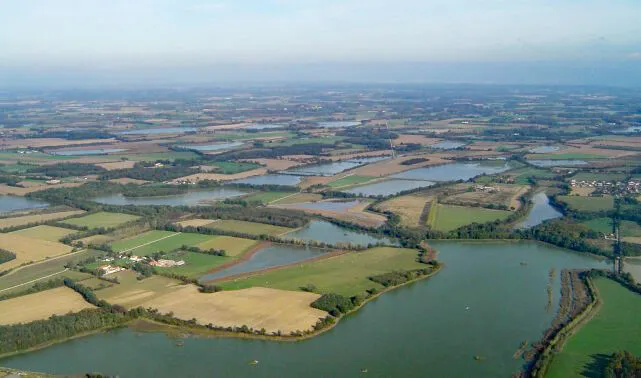
Discover the Ain: world-famous Bresse poultry, the thousand ponds of the Dombes, Pays de Gex facing Mont Blanc and the emerald gorges of Nantua. Complete guide.
 Regions
Aisne: Laon's Medieval Citadel and the Chemin des Dames
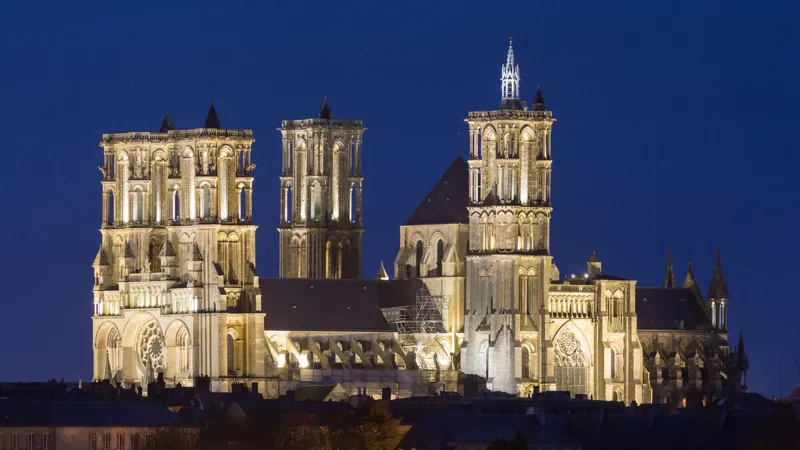
Discover the Aisne département: Laon's hilltop medieval city, the Chemin des Dames battlefields, Soissons, the Familistère de Guise and Champagne vineyards. Complete travel guide.