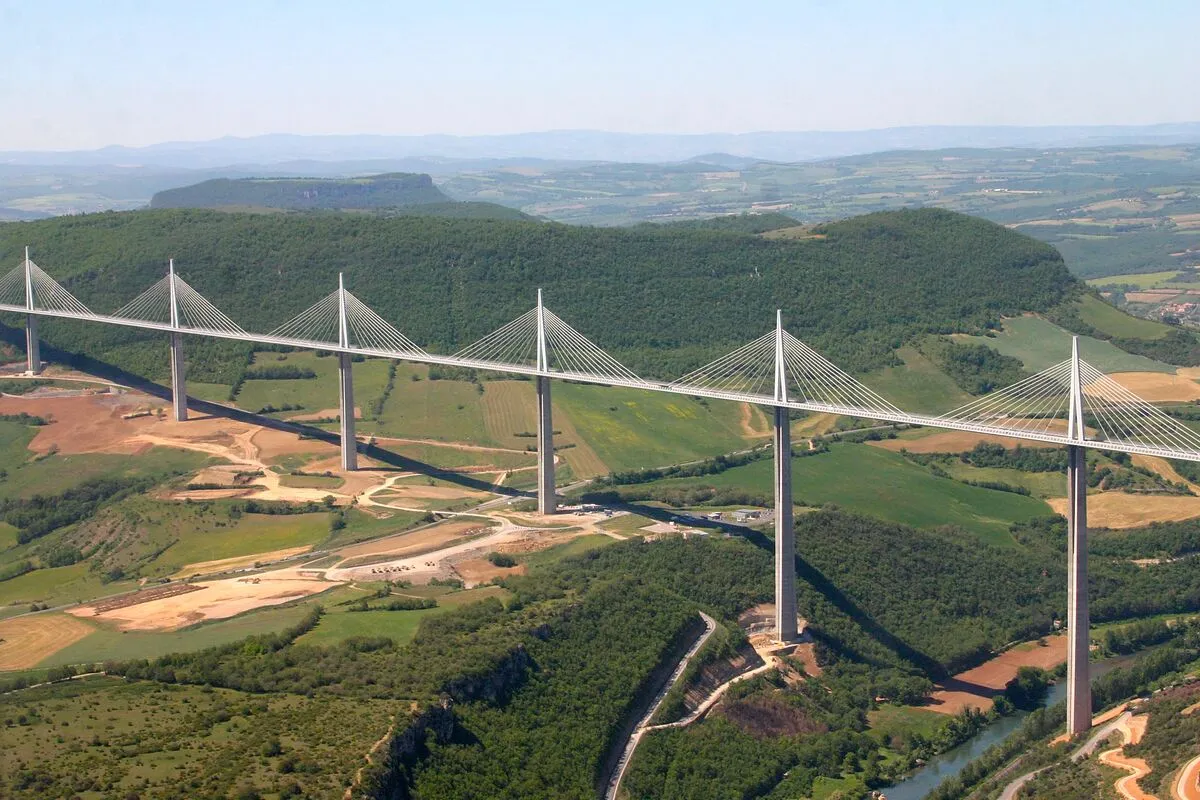
Vast, wild, and planted at the heart of the Massif Central, the Aveyron is a world apart. Limestone plateaux have been carved into vertiginous gorges, medieval villages cling to cliff faces, and rural traditions -- from Roquefort aged in natural caves to transhumance festivals -- are upheld with quiet pride. The Millau Viaduct, an engineering marvel suspended above the Tarn, sums up this department well: one foot in the past, the other in the future.
Rodez: Cultural Capital
Rodez, the préfecture of the Aveyron, is a pink-sandstone town dominated by its cathedral spire. Long considered remote, it has undergone a spectacular renewal since the opening of the Musée Soulages in 2014.
The Musée Soulages
The Musée Soulages, designed by Catalan architects RCR Arquitectes (2017 Pritzker Prize), is a Corten-steel building whose rectangular volumes engage in dialogue with the surrounding hills. It houses the world's largest collection of works by Pierre Soulages, a Rodez native, master of outrenoir and a major figure in abstraction. More than 500 pieces trace his career, from the earliest walnut-stain works to immense black polyptychs where light plays across the surface. Entry costs about 11 euros and the visit takes 2 hours. The museum also hosts high-quality temporary exhibitions. It is one of the most visited contemporary-art museums in France outside Paris.
Notre-Dame Cathedral
The Notre-Dame Cathedral, built between the thirteenth and sixteenth centuries in pink sandstone, impresses with its fortified west front, a true wall with no portal, and its Flamboyant bell tower reaching 87 metres, one of the finest in southern France. Inside, a Renaissance rood screen and remarkable carved choir stalls await. Admission is free and the visit takes about 30 minutes. From the parvis, the view across the old-town rooftops is superb.
The Old Town
The historic centre of Rodez deserves at least an hour's stroll through medieval lanes, Renaissance townhouses and lively squares. The Place du Bourg and the Place de la Cité, once divided by rivalries between religious and civil power, are now linked by picturesque passages. Café terraces come alive pleasantly in the evening.
Conques: A Romanesque Jewel on the Compostela Trail
Conques, listed among the Most Beautiful Villages in France, is a medieval settlement clinging to the wooded slopes of the Ouche gorge and a major stop on the Way of Saint James (Via Podiensis).
The Abbey Church of Sainte-Foy
The Abbey Church of Sainte-Foy, an eleventh-century Romanesque masterpiece, is celebrated for its Last Judgement tympanum, one of the largest and best preserved in Romanesque art. Its 124 figures carved in limestone depict the separation of the saved and the damned with striking realism. The contemporary stained-glass windows by Pierre Soulages, installed in 1994, bathe the interior in a unique translucent light achieved through specially developed opalescent glass. Admission to the church is free. Guided tours are available for about 6 euros.
The Treasury and the Village
The Treasury of Conques, displayed in a modern museum space, is one of the richest collections of medieval goldwork in France. The centrepiece, the Majesty of Sainte Foy, a ninth-century reliquary covered in gold, precious stones and antique cameos, fascinates with its mysterious presence. Entry costs about 7 euros. The village itself, with its half-timbered houses, stone-slab roofs and sloping lanes, takes 1 hour to explore. At dusk, when pilgrims arrive and the light turns the stone to gold, Conques achieves a timeless beauty.
The Millau Viaduct
The Millau Viaduct, designed by engineer Michel Virlogeux and architect Norman Foster, is the tallest cable-stayed bridge in the world, its highest pylon reaching 343 metres, taller than the Eiffel Tower. Inaugurated in 2004, it spans the Tarn valley in a gesture of striking architectural elegance.
Viewpoints and Visiting
The viaduct is crossed by car on the A75 (toll about 11 euros in summer). To admire it, several free viewpoints have been set up: the northern belvedere at the Brocuéjouls rest area offers the most spectacular view, especially in the morning when mist fills the valley and the pylons emerge like masts. The Espace Viaduc de Millau, an interpretation centre at the foot of the structure, tells the story of its construction with models and films (entry about 7 euros). Guided tours offer behind-the-scenes access.
Millau and Outdoor Sports
Millau, at the foot of the viaduct, is an outdoor-sports paradise. The Tarn gorges and Dourbie gorges draw kayakers (hire from 25 euros per half-day), climbers and hikers. Paragliding from the causses offers flights above the valley with viaduct views (from 90 euros for a tandem flight). Millau is also the French capital of glove-making, an ancestral craft linked to the sheep farming of the causses.
The Causse du Larzac
The Causse du Larzac, a vast wind-swept limestone plateau at about 800 metres, is a unique landscape of steppe grassland, lavognes (pastoral ponds), dolmens and fortified villages.
La Couvertoirade and the Templars
La Couvertoirade, a settlement fortified by the Knights Templar and then the Hospitallers, is one of the Most Beautiful Villages in France. Its intact ramparts, medieval lanes and Romanesque church deliver a vivid journey back in time. Village entry is free but the rampart walk costs about 5 euros. Sainte-Eulalie-de-Cernon, with the best-preserved Templar commandery on the Larzac, completes the discovery of the warrior-monks' legacy.
Roquefort-sur-Soulzon
Roquefort-sur-Soulzon, clinging to the Combalou cliff, is home to the natural caves where Roquefort, the king of blue cheeses, ripens in the fleurines (rock fissures) that maintain constant temperature and humidity. Several caves are open to visitors, including the Société caves and the Papillon caves. Guided tours, free or about 5 euros, last 45 minutes to 1 hour and include a tasting. The sight of thousands of cheese wheels lined up on oak shelves inside natural cavities is mesmerising.
Tarn Gorges and Jonte Gorges
The Tarn gorges, which form the département's northern boundary, are among the most spectacular in France. Over 50 kilometres, the river has carved a canyon 400 to 600 metres deep between the Sauveterre and Méjean causses.
Sainte-Énimie and the Gorge Road
Sainte-Énimie, listed among the Most Beautiful Villages in France, is the ideal starting point for exploring the gorges. Its stepped lanes descend to the emerald-green Tarn. The gorge road (D907) offers 50 kilometres of bends between cliffs and river, punctuated by perched villages and vertiginous viewpoints. The parallel Jonte gorges are home to the Maison des Vautours, where griffon, black and Egyptian vultures can be observed via cameras installed in the cliffs (entry about 8 euros).
Aveyron Gastronomy
The Aveyron is a land of peasant gastronomy raised to an art form. Aligot, mashed potatoes beaten with fresh Aubrac tome cheese until it forms long elastic ribbons, is the signature dish, served with a Toulouse sausage. Fouace, a traditional brioche flavoured with orange blossom, accompanies dessert. Farçou, a herb fritter, and truffade are other specialities not to be missed. Roquefort, naturally, crowns every cheese board. The wines of Marcillac, robust reds made from the fer-servadou grape (locally called mansois), are the perfect match for the local cuisine. Allow 20 to 35 euros for a full meal in a good inn.
Practical Tips
Getting Around
Rodez airport offers daily flights to Paris-Orly. Rodez station is served by trains from Toulouse (2.5 hours). The A75, a toll-free motorway, crosses the département from north to south. A car is essential for exploring the gorges, the causses and the remote villages.
Best Time to Visit
May to October is ideal. Summer is hot on the causses but pleasant in the gorges. Spring and autumn bring the finest light and quieter trails. Winter, harsh on the plateaux, lends an austere charm to the landscape and the certainty of having the sites to yourself.
Budget
Accommodation ranges from 50 to 80 euros per night for a budget hotel, 80 to 130 euros for a B&B or charming hotel, and 130 to 220 euros for upscale options. A restaurant lunch runs 14 to 22 euros, dinner 25 to 40 euros. Local farmers' markets provide excellent produce for picnics at reasonable prices. Hiking, village exploration and most churches are free. Paid sites and museums cost 6 to 15 euros per person. To keep costs in check, look for weekday set-lunch menus, stay in rural gites or quality campsites, and enjoy the free tastings many local producers offer.
Explore on the map
Map →📚 Related collections
Related guides
 Regions
Ain: Bresse, Dombes and Pays de Gex
Discover the Ain: world-famous Bresse poultry, the thousand ponds of the Dombes, Pays de Gex facing Mont Blanc and the emerald gorges of Nantua. Complete guide.
 Regions
Aisne: Laon's Medieval Citadel and the Chemin des Dames
Discover the Aisne département: Laon's hilltop medieval city, the Chemin des Dames battlefields, Soissons, the Familistère de Guise and Champagne vineyards. Complete travel guide.