Fifteen thousand years of history gaze back at you from the painted caves of the Ariege. Step outside and the eye is drawn upward to Cathar fortresses perched on rocky pinnacles that seem to defy gravity. Between unspoilt pastoral valleys and spa towns nestled at the foot of the peaks, this Pyrenean department offers total immersion far from the crowds of the Mediterranean coast.
Foix: The Ariège Capital
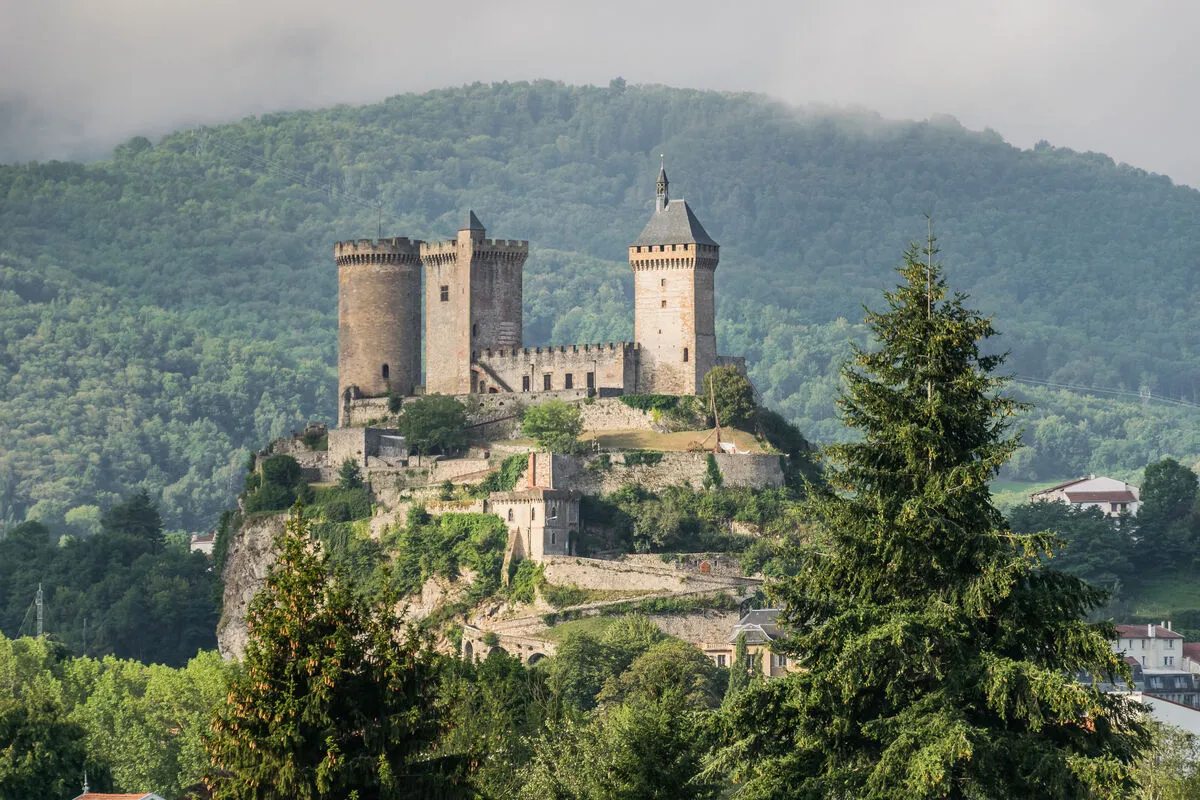
Foix is a small and charming préfecture dominated by its three-towered castle, the symbol of the département. Tucked at the confluence of the Ariège and Arget rivers, the town blends medieval heritage with southern French joie de vivre.
The Château des Comtes de Foix
The Château des Comtes de Foix, rising from its rocky spur above the town, is one of the finest fortified castles in the Pyrenees. Its three towers, the tallest reaching 42 metres, command a 360-degree panorama across the Pyrenees, the Plantaurel hills and the Ariège plain. The castle houses the departmental museum, which traces the history of the Ariège from prehistory through the Cathar era, with scale models, medieval weapons and period documents. Entry costs about 8 euros and the visit takes 1.5 to 2 hours. The Counts of Foix, including the famous Gaston Fébus, a great hunter and man of letters in the fourteenth century, made this one of the most powerful lordships in southern France.
The Old Town and Markets
The old town of Foix, with its medieval lanes, half-timbered houses and shaded squares, is a pleasant 1-hour stroll. The Friday market, one of the oldest in Occitanie, fills the town centre with local produce: mountain cheese, artisanal charcuterie, fir honey and gâteau à la broche, a Pyrenean speciality cooked over an open flame before your eyes. The covered market offers Ariège produce year-round.
The Niaux Cave
The Niaux Cave, 15 kilometres south of Foix in the Vicdessos valley, is one of the jewels of European cave art. Its Magdalenian paintings, approximately 14,000 years old, rank among the best preserved in the world.
The Salon Noir
The heart of the visit is the Salon Noir, a vast chamber where bison, horses, ibex and deer are painted with astonishing mastery on the limestone walls. Unlike Lascaux, here the paintings are authentic and you truly walk in the footsteps of prehistoric artists. The guided tour, which is compulsory, lasts about 1.5 hours in small groups of 20 people maximum, lamp in hand, along an 800-metre underground route. It is essential to book in advance, especially in summer, as numbers are limited to protect the paintings. Entry costs about 15 euros per adult.
The Prehistory Park
Nearby, the Prehistory Park in Tarascon-sur-Ariège complements the visit with full-scale reconstructions, cave-art workshops and flint-knapping demonstrations. It is an excellent activity for families. Allow about 14 euros for adult entry and half a day for the visit. The park also hosts quality temporary exhibitions.
Montségur: The Cathar Symbol
Montségur is arguably the most emblematic site in Cathar history. Perched at 1,207 metres on a vertiginous rocky pog, the castle is inseparable from the tragedy of 1244, when more than 200 Cathars were burned at the foot of the mountain after a ten-month siege.
The Climb and the Castle
The ascent from the village takes about 30 to 45 minutes on a steep but well-marked path. Good footwear is essential. At the top, the ruins of the pentagonal castle offer a sweeping panorama across the Ariège Pyrenees and the Hers valley. Entry to the site costs about 7 euros. The memorial stele at the Prat dels Cremats (field of the burned), at the base of the pog, marks the collective pyre of 16 March 1244. The place radiates a unique atmosphere, somewhere between contemplation and wild grandeur.
The Montségur Museum
The archaeological museum in the village, housed in a period building, displays objects uncovered during excavations of the castle: ceramics, coins, jewellery, arrowheads. It sheds light on the daily life of the besieged and the context of the Albigensian Crusade. Entry is about 5 euros and the visit takes 45 minutes. Combined with the castle climb, allow a full half-day for Montségur.
Ax-les-Thermes and Pyrenean Spa Culture
Ax-les-Thermes, nestled at 720 metres in the upper Ariège valley, has been a renowned spa town since Roman times. Its sulphurous waters, gushing at over 70 degrees, feed several establishments.
The Bassin des Ladres and the Baths
The Bassin des Ladres, an open-air hot-water basin in the town centre, is freely accessible at no charge: a simple, authentic pleasure in summer and winter alike. The Bains du Couloubret, a modern spa complex, offers wellness circuits including whirlpool baths, hammam, sauna and thermal-water pools, for about 18 to 25 euros per 2-hour session. Traditional thermal cures treat rheumatism and respiratory conditions.
The Ski Areas
In winter, Ax-les-Thermes doubles as a ski resort with the Ax 3 Domaines area, peaking at 2,400 metres and offering 80 kilometres of varied runs. A day pass costs about 40 euros. The unique appeal of Ax is the ability to combine skiing and thermal bathing in the same day, a rare luxury in the Pyrenees. In summer, the chairlifts remain open for hikers and mountain bikers.
The Ariège Valleys and Mountains
The Ariège harbours unspoilt valleys where nature and pastoral traditions hold sway.
The Vicdessos Valley and Montcalm
The Vicdessos valley, wild and deeply cut, leads to the Pic de Montcalm (3,077 m), the highest point in the Ariège. Experienced hikers climb this summit in two days with an overnight at the Pinet refuge. For less seasoned walkers, the Bassiès lakes, reachable in a 2.5-hour hike, offer a high-mountain setting of glacial lakes cradled in granite. The valley also shelters orris, ancient dry-stone shepherd huts that bear witness to the herding life of centuries past.
The Couserans and Saint-Lizier
The Couserans, a historic province in the western part of the département, is a land of green hills and quiet villages. Saint-Lizier, listed among the Most Beautiful Villages in France (within the Grand Site of Saint-Bertrand-de-Comminges), possesses a Romanesque cathedral with remarkably preserved twelfth-century frescoes and a Romanesque cloister with views of the Pyrenees. The former bishop's palace overlooks the village. The ensemble takes 1.5 hours to visit and cloister entry costs about 5 euros. Saint-Lizier is also the gateway to hikes in the Parc naturel régional des Pyrénées Ariégeoises, created in 2009 to protect the exceptional biodiversity of these mountains.
Mirepoix: The Bastide with Covered Arcades
Mirepoix, in the eastern part of the département, is a medieval bastide founded in 1289 whose main square with wooden arcades (galeries of carved timber) is one of the finest in south-west France. The sculpted beams, notably the famous "Maison des Consuls" adorned with grimacing heads, testify to medieval prosperity. The Cathedral of Saint-Maurice boasts the widest Gothic nave in France (21.40 m). The Monday morning market, held beneath the arcades, has been an institution since the Middle Ages. Mirepoix can be explored in 1 to 2 hours and makes a delightful gourmet stop.
Ariège Gastronomy
Ariège cuisine is mountain cooking, generous and hearty. Azinat, the Ariège pot-au-feu with cabbage and beans, is the signature dish of the département. Mounjetado, a local cousin of cassoulet, showcases white beans and sausages. Mountain cheeses, notably Bethmale and Moulis, are produced in the Couserans valleys. Gâteau à la broche, slowly cooked in front of a wood fire, is the unmissable pastry of Ariège festivities. For drinks, hypocras, a medieval spiced wine, is enjoying a revival thanks to local producers. A full meal in a village inn costs between 18 and 30 euros.
Practical Tips
Getting Around
The Ariège is accessible via the A66 motorway from Toulouse (1 hour to Foix). The Toulouse-La Tour-de-Carol railway serves Foix, Tarascon-sur-Ariège and Ax-les-Thermes. A car is however essential for exploring the valleys and remote sites. Mountain roads are well maintained but winding.
Best Time to Visit
May to October is ideal for hiking and sightseeing. Summer (July-August) is peak season with pleasant temperatures at altitude. Spring brings flower-filled meadows and waterfalls swollen by snowmelt. Autumn clothes the forests in magnificent colours. Winter is the season for skiing, spa bathing and snowy landscapes.
Budget
Accommodation ranges from 40 to 70 euros per night for a budget hotel or quality campsite, 70 to 120 euros for a B&B or boutique hotel, and 120 to 200 euros for high-end establishments. A restaurant lunch costs 12 to 20 euros, dinner 20 to 35 euros. Local markets and picnics are an excellent way to eat well while keeping costs down. Many activities are free: hiking, village strolls, markets, churches. Paid museums and sites average 5 to 12 euros per person. To save money, book rural gites by the week, opt for weekday lunch menus, and take advantage of free tastings at local producers.
Explore on the map
Map →📚 Related collections
Related guides
 Regions
Ain: Bresse, Dombes and Pays de Gex
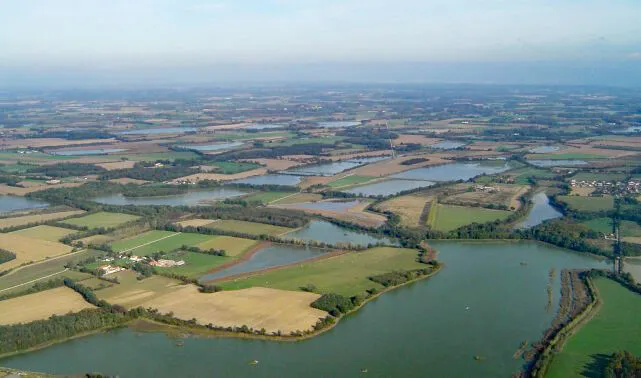
Discover the Ain: world-famous Bresse poultry, the thousand ponds of the Dombes, Pays de Gex facing Mont Blanc and the emerald gorges of Nantua. Complete guide.
 Regions
Aisne: Laon's Medieval Citadel and the Chemin des Dames
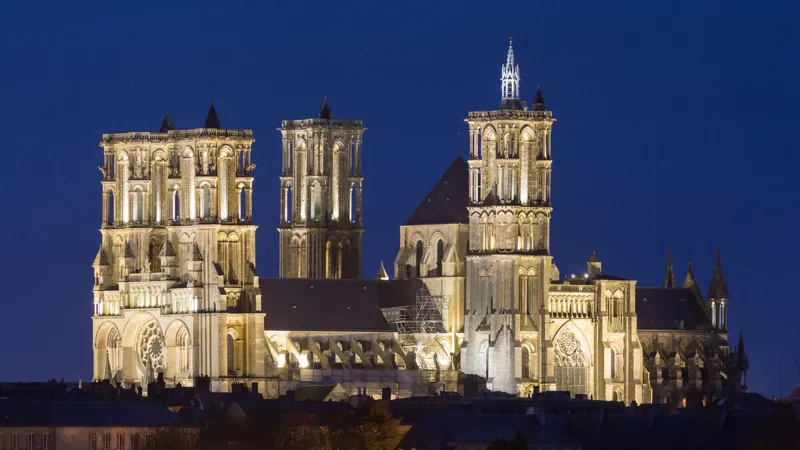
Discover the Aisne département: Laon's hilltop medieval city, the Chemin des Dames battlefields, Soissons, the Familistère de Guise and Champagne vineyards. Complete travel guide.