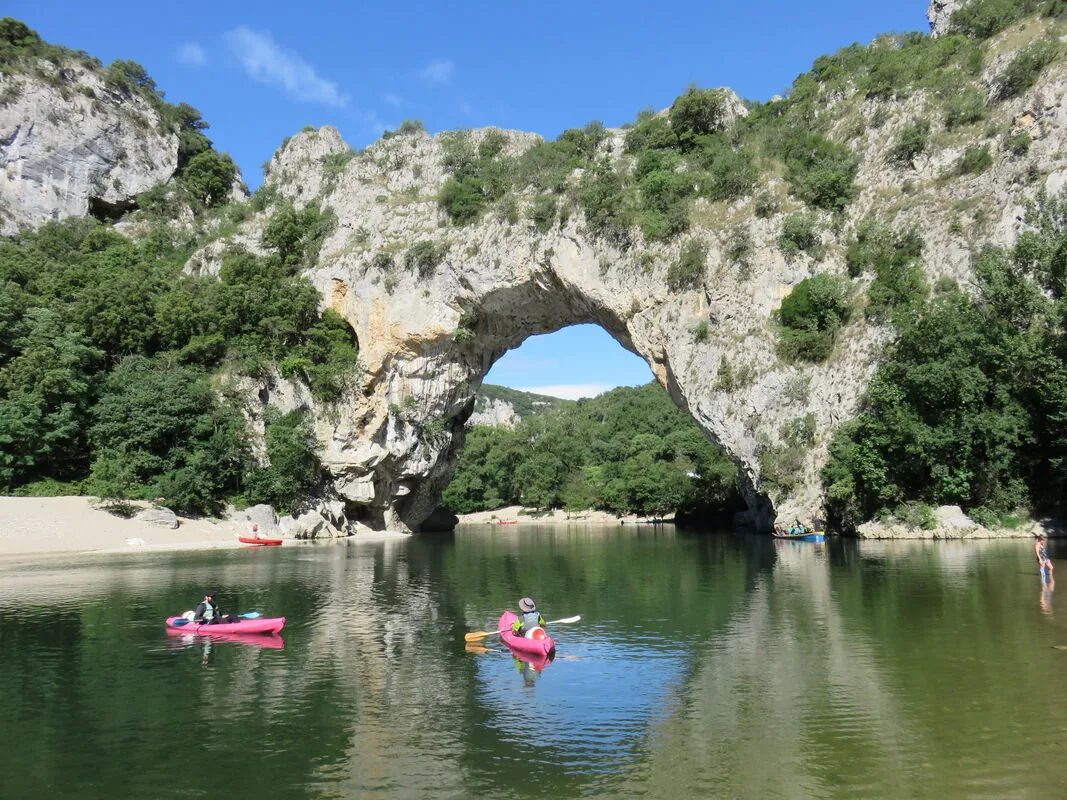
No motorway, no big city: in the Ardeche, nature sets the pace. This department in southern Auvergne-Rhone-Alpes is raw adventure territory, where turquoise rivers have carved spectacular gorges through limestone, where anonymous artists painted lions and mammoths 36,000 years ago, and where chestnut trees still blanket the hillsides as they did in centuries past.
The Gorges de l'Ardèche
Canoeing the Canyon
The Gorges de l'Ardèche form a 30-kilometre canyon carved through limestone, with cliffs reaching 300 metres in places. Paddling through them by canoe or kayak is the defining Ardèche experience. Two options await:
The mini descent (around 8 km, 2-3 hours) departs from Vallon-Pont-d'Arc and passes beneath the famous Pont d'Arc — ideal for families and beginners. The full descent (24 to 32 km depending on start point, 1 to 2 days) runs the entire length of the gorges to Saint-Martin-d'Ardèche, with the option of wild camping on designated beaches.
Expect to pay from around 25 € per person for a canoe rental on the mini descent. Outfitters provide all equipment and shuttle you back to your starting point. Booking ahead is essential in July and August.
Pont d'Arc, a Monumental Natural Arch
The Pont d'Arc is a natural stone arch 54 metres high spanning the Ardèche river — the largest natural arch in Europe. Formed over hundreds of thousands of years, it marks the entrance to the gorges. The beach at its base is a hugely popular swimming spot in summer. Arrive early in the morning to enjoy it before the crowds.
The Scenic Gorges Road
For those who prefer to admire the gorges from above, the Route panoramique des Gorges (D290) follows the canyon rim for 30 km with a dozen signposted viewpoints. The Serre de Tourre, Balcon des Templiers and Cathédrale lookouts are the most dramatic. Allow at least 2 hours, more if you stop for short walks.
Grotte Chauvet 2
The World's Oldest Cave Paintings
The Grotte Chauvet, discovered in 1994, contains the oldest known cave paintings, dating back 36,000 years. A UNESCO World Heritage Site, the original cave is sealed to preserve this fragile treasure. Instead, Grotte Chauvet 2 (formerly Caverne du Pont d'Arc), a full-scale replica opened in 2015, faithfully reproduces the paintings inside a purpose-built cavern.
The lions, mammoths, woolly rhinoceroses and horses painted by our distant ancestors display an astonishing artistic mastery. The guided tour (around 18 €, 1 hour) is a moving journey into deep prehistory. The site also includes a museum and an Aurignacian gallery exploring life 36,000 years ago. Booking is strongly recommended in season.
Character Villages
Balazuc, Clinging to the Cliff
Listed among France's Plus Beaux Villages, Balazuc tumbles down a cliff face above the Ardèche river. Its twisting medieval lanes, vaulted passages and Romanesque church compose a striking picture. The village is especially photogenic viewed from the opposite bank. Swimming in the river at the foot of the village is a simple, free pleasure.
Vogüé, Mirrored in the Water
Vogüé, another classified village, lines its stone houses along the Ardèche beneath an imposing 12th-to-16th-century castle (visit around 5 €). The village reflected in the calm river is one of Ardèche's most iconic images. In summer, contemporary art exhibitions take over the castle and lanes.
Alba-la-Romaine, Ancient Vestiges
Alba-la-Romaine was the capital of the Gaulish Helvii tribe and later a prosperous Roman town. The archaeological site preserves the remains of a Roman theatre, baths and houses (free access). The medieval village that grew over the ruins, with its striking chequerboard of black basalt and white limestone houses, is architecturally unique.
Mont Gerbier de Jonc
At the Source of the Loire
The Mont Gerbier de Jonc (1,551 m) is a volcanic plug with an unmistakable pointed profile. More importantly, it is the mythical spot where the Loire, France's longest river, rises. Three springs compete for the title of the "true" source — the geographical, the authentic and the agricultural. The climb to the summit takes about 30 minutes and rewards with a sweeping panorama across the Ardèche highlands.
Vals-les-Bains and Thermal Waters
Vals-les-Bains has the unique distinction of possessing 145 natural springs within its boundaries, each with a different mineral composition. This spa town, tucked into a green valley, offers thermal treatments and wellness stays. The intermittent geyser, a spring that shoots 16 metres into the air roughly every 6 hours, is a rare natural spectacle.
Chestnuts, the Brown Gold of Ardèche
Castanide, the Autumn Festival
The chestnut tree is Ardèche's emblematic tree. For centuries, the chestnut fed local populations and it remains central to the cuisine. In autumn, castanide festivals bring villages to life: chestnuts are roasted in giant perforated pans, and visitors sample chestnut cream, marrons glacés and chestnut-flour cakes.
Be sure to try the caillette ardéchoise (a herby pork pâté), bombines (a potato stew) and picodon, a small goat's cheese with a wrinkled rind. Wines from the Côtes du Vivarais appellation are the natural match for these rustic dishes.
Practical Tips
When to Visit
April to June and September are best for canoeing without the crowds. July and August for swimming (but book early). October for castanide festivals and autumn colours. Southern Ardèche enjoys a Mediterranean climate with over 2,500 hours of sunshine a year.
Getting Around
Ardèche is one of the few French départements with no railway station and no motorway. A car is essential. From Lyon (2 hours) or Montpellier (2 hours), embrace the winding roads — they are part of the journey's charm.
Budget
Accommodation ranges from 50 to 80 euros per night for a budget hotel or quality campsite, 80 to 130 euros for a B&B or charming hotel, and 130 to 200 euros for high-end options. A restaurant lunch costs 14 to 22 euros, dinner 22 to 35 euros. Canoe rental for the mini-descent starts at around 25 euros per person. Hiking, village strolls and gorge viewpoints are all free. To keep costs down, make the most of the Ardeche's excellent campsites, buy provisions at local farmers' markets for picnics, and enjoy free tastings at Cotes du Vivarais wine producers.
Explore on the map
Map →📚 Related collections
Related guides
 Regions
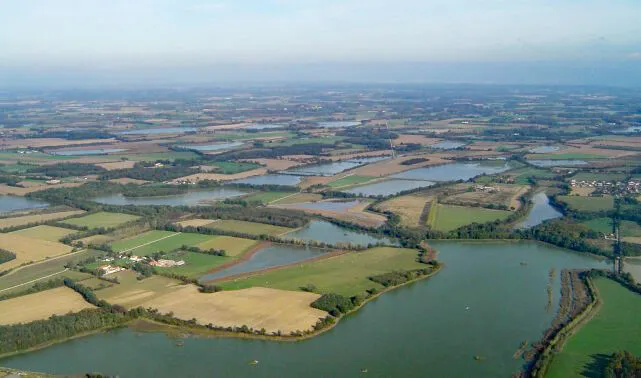
Ain: Bresse, Dombes and Pays de Gex
Discover the Ain: world-famous Bresse poultry, the thousand ponds of the Dombes, Pays de Gex facing Mont Blanc and the emerald gorges of Nantua. Complete guide.
 Regions
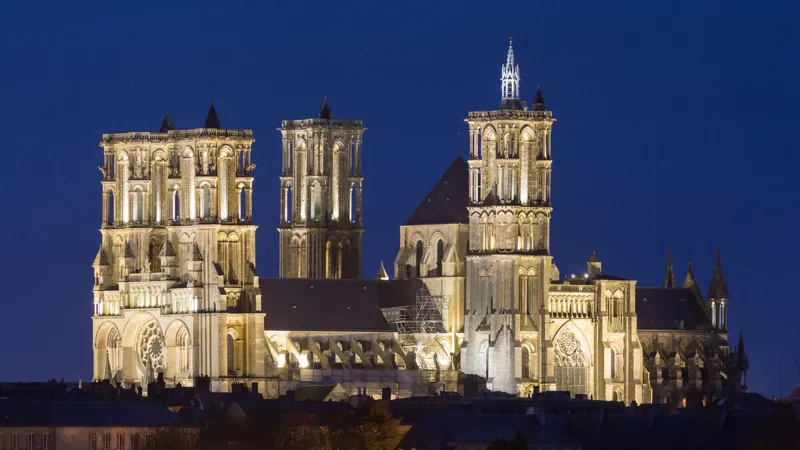
Aisne: Laon's Medieval Citadel and the Chemin des Dames
Discover the Aisne département: Laon's hilltop medieval city, the Chemin des Dames battlefields, Soissons, the Familistère de Guise and Champagne vineyards. Complete travel guide.