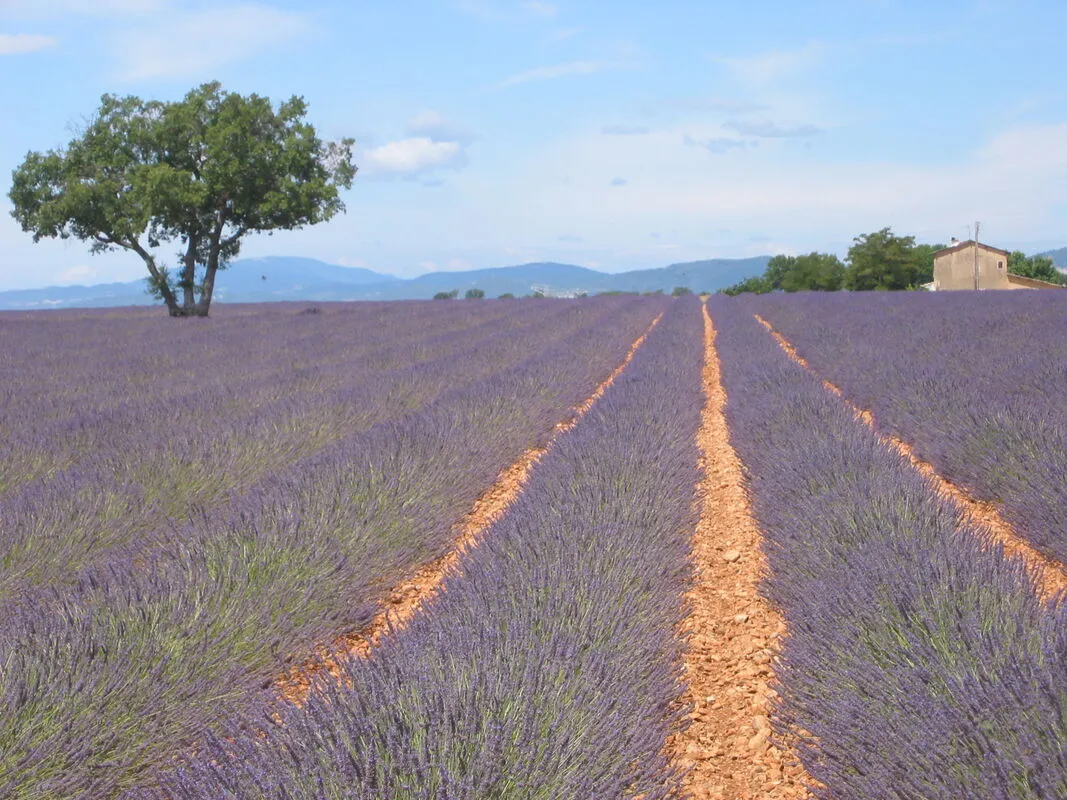
Close your eyes and picture a violet ocean rippling under the June sun: you are on the Valensole Plateau, in the heart of the Alpes-de-Haute-Provence. This wildest corner of Provence marries Mediterranean light with alpine relief in a way that feels almost otherworldly. The citadel of Sisteron clinging to its cliff, Digne-les-Bains nestled in its fragrant valley, the largest geological reserve in Europe -- everything here breathes space and serenity.
The Valensole Plateau: A Sea of Lavender
The Lavender Fields
The Valensole plateau is the largest lavender and lavandin growing territory in Provence. From mid-June to mid-July, its 800 square kilometers are draped in a violet mantle striped with parallel rows stretching to the horizon. The spectacle is hypnotic, especially at sunrise and sunset, when the raking light deepens the contrast between the purple flowers, the green of almond trees and the intense blue of the Provençal sky.
The départementale roads crisscrossing the plateau — notably the D6, D8 and D56 — provide spectacular viewpoints. Distilleries open their doors to explain the process of transforming lavender into essential oil (free visits or about 3 to 5 euros, with shop). The harvest usually takes place in July: watching the machines sweep through the fields is a unique moment.
Valensole Village
The village of Valensole, perched at the edge of the plateau, retains authentic Provençal charm. Its sloping lanes, old fountains and large square shaded by plane trees invite leisurely exploration. The Sunday morning market, small but flavorful, offers lavender honey, artisanal soaps, almonds and olive oil. In summer, lavender festivals with distillation demonstrations enliven the village.
Lake Sainte-Croix and the Gorges du Verdon
At the southern edge of the plateau, Lake Sainte-Croix spreads its turquoise waters in a setting of limestone cliffs. It is the meeting point between the Valensole plateau and the famous Gorges du Verdon. Renting a pedalo or canoe (about 15 to 25 euros per hour) allows you to venture to the entrance of the gorges, where the cliffs soar 700 meters high. The pebble and sand beaches around the lake offer refreshing swimming with Alpine views. Access to the lake is free; parking costs about 5 to 8 euros in summer.
Sisteron: Gateway to Provence
The Citadel
Sisteron is a spectacular town, squeezed between the Durance and a rocky spur crowned by its famous citadel. Known as the "gateway to Provence," it marks the transition between the Dauphiné to the north and Provence to the south, a geographical bottleneck exploited since antiquity. The Citadelle (admission about 7 euros), perched at 500 meters above sea level, is visited along a path that climbs through successive fortifications — medieval, Renaissance and Vauban. The panorama from the uppermost terraces is absolutely breathtaking: the Durance far below, the Rocher de la Baume striated like the pages of a giant book, and the mountains of the Dauphiné on the horizon.
In summer, the Nuits de la Citadelle, a festival of music, theater and dance, takes over the fortress's open-air theater. Tickets range from 15 to 45 euros depending on the performance.
The Old Town
The old town of Sisteron, at the foot of the citadel, is a pleasure to wander. Its andrones (covered alleyways typical of Provence), medieval towers and the Cathédrale Notre-Dame-des-Pommiers, a former twelfth-century Romanesque building, merit a stroll of about 1 hour. The Saturday morning market, colorful and fragrant, is one of the most pleasant in the département.
Sisteron Lamb
Sisteron lamb, raised in the open air on alpine meadows, holds an IGP label and is considered among the finest in France. Its tender meat, scented with mountain herbs, can be enjoyed in the town's restaurants for about 18 to 28 euros per dish. Do not miss it.
Digne-les-Bains: Scented Prefecture
The Town and Its Lavender
Digne-les-Bains, prefecture of the département, is a quiet little town nestled in a valley surrounded by mountains. On the first weekend of August, the Corso de la Lavande, a parade of floats decorated entirely with lavender, perfumes the streets. The Jardin des Papillons (admission about 7 euros), a tropical greenhouse in the heart of town, shelters hundreds of exotic butterflies in free flight.
The heritage of Digne includes the Cathédrale Notre-Dame-du-Bourg, a thirteenth-century Romanesque church built of golden stone, and the Musée Gassendi (admission about 6 euros), which brings together fine art, natural history and contemporary art in an original dialogue.
The Thermal Baths
The Thermes de Digne-les-Bains draw on chloride-sodium water at 50 degrees Celsius, effective in treating rheumatic and ear-nose-throat conditions. Beyond medical cures, a wellness center offers discovery packages starting from 30 to 50 euros for 2 hours of treatments.
The Geological Reserve of Haute-Provence
The Réserve naturelle nationale géologique de Haute-Provence, created in 1984, is the largest geological reserve in Europe at 2,300 square kilometers. It protects exceptional fossil sites dating back 300 million years. The dalle aux ammonites (ammonite slab) at Digne, the flagship site accessible free of charge, displays more than 1,500 fossilized ammonites embedded in a single limestone slab of 320 square meters. The spectacle of these petrified spirals, 200 million years old, is striking.
The Musée Promenade (admission about 6 euros), set in a wooded park on the outskirts of Digne, offers an outdoor trail punctuated with contemporary artworks and geological explanations. Free waymarked geological hiking trails allow visitors to discover the most remarkable sites in the territory, including the fossil ichthyosaurs of La Robine and the colorful strata of the Terres Noires.
Forcalquier and the Montagne de Lure
Forcalquier: Town of Character
Forcalquier, former capital of the county of Haute-Provence, is a charming small town perched on a hill crowned by an octagonal chapel. Its Monday market, one of the most renowned in Provence, draws connoisseurs of goat cheese, olive oil, honey and artisanal products. The stalls overflow with color and fragrance on the Place du Bourguet and the surrounding lanes.
The Couvent des Cordeliers (admission about 5 euros), with its cloister and reconstructed medicinal garden, and the Observatoire de Haute-Provence (guided tours about 8 euros), an astronomical research center on the plateau of Saint-Michel-l'Observatoire, are two visits of distinction.
The Montagne de Lure
The Montagne de Lure, twin sister of Mont Ventoux, rises to 1,826 meters and offers magnificent hiking through oak and beech forests and alpine meadows. Its south-facing slope is studded with Provençal villages clinging to the hillside — Lurs, Ganagobie (whose Benedictine priory holds superb twelfth-century mosaics, free admission) and Saint-Étienne-les-Orgues. The summit, reachable by car or on foot, provides an exceptional panorama stretching from the Mediterranean to the Alps on a clear day.
Practical Tips
- When to go: Mid-June to mid-July for the lavender in bloom, July and August for festivals, September for hiking and tranquility
- Getting around: A car is essential. Digne is connected to Nice by the scenic Train des Pignes (about 4 hours, ticket around 25 euros), a spectacular railway journey. Sisteron is accessible via the A51 motorway
- Accommodation budget: Expect 60 to 120 euros per night in a chambre d'hôtes or small hotel. Rural gîtes are plentiful and affordable
- How long: 4 to 6 days. 1 to 2 days for Valensole and Lake Sainte-Croix, 1 day for Sisteron, 1 day for Digne and the Geological Reserve, 1 day for Forcalquier and Lure
- Do not miss: A sunrise over the lavender fields of Valensole, the view from the citadel of Sisteron, the ammonite slab at Digne, and the Monday market in Forcalquier
Explore on the map
Map →📚 Related collections
Related guides
 Regions
Ain: Bresse, Dombes and Pays de Gex
Discover the Ain: world-famous Bresse poultry, the thousand ponds of the Dombes, Pays de Gex facing Mont Blanc and the emerald gorges of Nantua. Complete guide.
 Regions
Aisne: Laon's Medieval Citadel and the Chemin des Dames
Discover the Aisne département: Laon's hilltop medieval city, the Chemin des Dames battlefields, Soissons, the Familistère de Guise and Champagne vineyards. Complete travel guide.