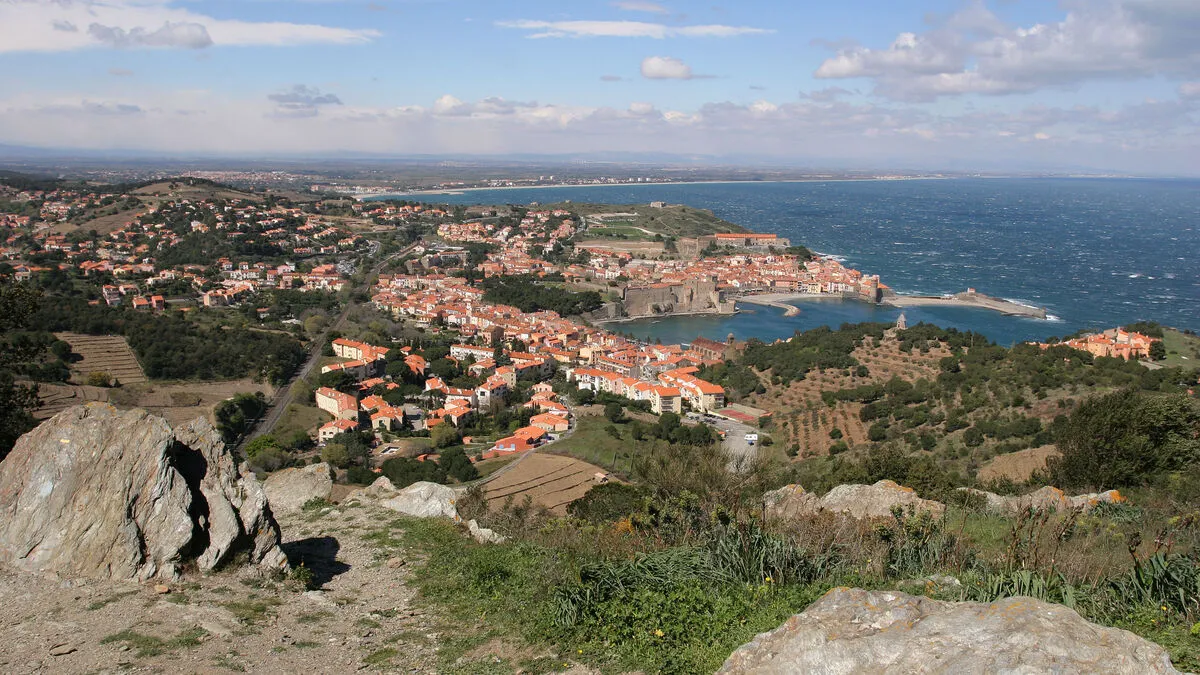
Salvador Dali once declared that Perpignan held 'the centre of the universe'. Surrealist exaggeration, no doubt, but the Pyrenees-Orientales department does possess something almost cosmic: a Catalan territory where Pyrenean peaks plunge into the Mediterranean, where the vertiginous terraced vineyards of Banyuls produce inimitable naturally sweet wines, and where the Cote Vermeille offers a coastline as beautiful as the Riviera but far wilder.
Perpignan: Catalan Capital
Perpignan wears its Catalan identity with pride, a blend of Spanish and French traditions expressed in its architecture, food and language.
The Palace of the Kings of Majorca
The Palais des Rois de Majorque, a thirteenth-century fortress-palace on a hilltop in the centre of town, is Perpignan's landmark monument. Home to the Kings of Majorca for nearly a century, it blends military architecture with palatial refinement. The inner courtyard, framed by wings and superimposed Romanesque and Gothic chapels, is striking. Entry costs about 4 euros, a remarkably affordable price for a monument of this stature. Allow 1 hour. From the ramparts, the panorama sweeps across the city, the Roussillon plain and the snow-capped Canigou.
The Castillet and the Old Town
The Castillet, a red-brick tower and fourteenth-century fortified gate, is the symbol of Perpignan. It houses the Casa Pairal, a museum of Catalan folk arts and traditions. The surrounding old town unfolds its shopping streets and terrace-lined squares, notably the Place de la Loge, the historic heart bordered by the Loge de Mer (a former mercantile exchange) and the town hall. The daily market on the Place de la République overflows with Catalan produce: Collioure anchovies, sheep's cheese, turrón and sun-gorged fruit.
Collioure: Village of Painters
Collioure is the jewel of the Vermilion Coast, a fishing port of vivid colours nestled between terraced vineyards and turquoise water. In 1905, Henri Matisse and André Derain invented Fauvism here, overwhelmed by the intensity of the light.
The Port and the Royal Castle
The Royal Castle, a medieval fortress remodelled by the Kings of Aragon and later by Vauban, commands the harbour and the beach. A visit (about 5 euros) traces the turbulent history of this border stronghold. Below it, the bell tower of the Church of Notre-Dame-des-Anges, a former medieval lighthouse standing with its feet in the water, is the most famous image of Collioure. The Fort Saint-Elme, perched above the village (about 6 euros), offers an outstanding panorama of the coast and the Albères mountains.
Anchovies and the Fauvism Trail
Collioure anchovies are a celebrated speciality, traditionally salt-cured for centuries. The Roque workshop, the last artisan anchovy producer in the village, offers tours and tastings. A signposted Fauvism trail marked with reproductions of paintings lets you find the viewpoints that Matisse and Derain captured on canvas, a walk of about 1 hour through the village and the neighbouring coves.
The Vermilion Coast
The Côte Vermeille stretches from Collioure to the Spanish border, a succession of rocky coves, terraced vineyards dropping into the sea and fishing villages with colourful facades.
Banyuls-sur-Mer and Cerbère
Banyuls-sur-Mer is famous for its fortified sweet wine, made from Grenache grapes grown on vertiginous schist terraces. The Terres des Templiers cellar offers free tastings. The central beach is pleasant, and the Cerbère-Banyuls marine reserve, the first marine reserve in France, features a marked snorkelling trail (fins and mask hire for about 8 euros). The village of Cerbère, the last French railway station before Spain, retains an untouched end-of-the-world charm. The coastal path links Banyuls to Cerbère in 3 to 4 hours of spectacular walking through coves, vineyards and maquis scrub.
Villefranche-de-Conflent and the Vauban Heritage
Villefranche-de-Conflent, a fortified village inscribed on the UNESCO World Heritage List as part of the Vauban fortification network, occupies a glacial bottleneck at the confluence of the Têt and Cady rivers, about 50 minutes from Perpignan.
The Ramparts and Fort Libéria
The medieval ramparts, reinforced by Vauban in the seventeenth century, encircle a pink-marble village of artisan shops and workshops. Fort Libéria, perched 150 metres above the village, is connected by an underground staircase of 734 steps cut into the rock (about 8 euros for the fort, 30 minutes to climb). The view from the fort terraces looks down the Conflent valley and across the surrounding peaks. Villefranche is also the departure station for the famous Train Jaune.
The Train Jaune
The Train Jaune de Cerdagne, nicknamed "the canary," is one of the most spectacular railway lines in France. Linking Villefranche-de-Conflent to Latour-de-Carol over 63 kilometres, it climbs through the Pyrenees via gorges, vertiginous bridges and tunnels, reaching 1,593 metres at Bolquère station, the highest in France. The full journey takes about 3 hours. Fares range from 10 to 30 euros depending on the section and season. In summer, open-air carriages offer an unforgettable experience. The train serves the Cerdagne, a sunny high plateau shared between France and Spain, dotted with Romanesque villages and golden meadows.
Font-Romeu and the Mountains
Font-Romeu, at 1,800 metres in the Cerdagne, is the sunniest mountain resort in the Pyrenees, enjoying more than 300 days of sunshine a year.
Skiing and the Solar Furnace
The resort offers a ski area of 43 runs suited to families (day pass about 35 euros). In summer, hiking trails open towards altitude lakes and high pastures. The most singular attraction is the Odeillo solar furnace, an immense 54-metre-high parabola that concentrates sunlight to reach temperatures of 3,500 degrees Celsius. The Héliodyssée visitor centre (about 6 euros) explains solar research through interactive experiments.
Mount Canigou
Canigou (2,784 metres) is the sacred mountain of the Catalans, visible from Perpignan and even from Barcelona on a clear day. Its ascent is a classic Pyrenean hike, accessible by several routes of varying difficulty. The most popular starts from the Cortalets refuge (reachable by 4x4 from Prades) and reaches the summit in 2 to 3 hours of walking. On the eve of Saint John's Day (June 23), fires are lit on the summit as part of the Flama del Canigó, an ancient Catalan tradition.
Practical Tips
Getting Around
Perpignan-Rivesaltes airport serves several French and European destinations. Perpignan station is on the Barcelona-Montpellier-Paris TGV line. A car is essential for the Vermilion Coast and the mountains. The Train Jaune is as much a means of transport as it is an attraction.
Best Time to Visit
April to June and September to October for the coast and hinterland. Summer is hot and beaches are crowded, but the seaside evenings are delightful. December to March for skiing at Font-Romeu. The Saint John's Day celebration (June 23) is a highlight of Catalan culture.
Budget
Accommodation ranges from 50 to 80 euros per night for a budget hotel, 80 to 130 euros for a B&B or charming hotel, and 130 to 220 euros for upscale options. A restaurant lunch runs 14 to 22 euros, dinner 25 to 40 euros. Local farmers' markets provide excellent produce for picnics at reasonable prices. Hiking, village exploration and most churches are free. Paid sites and museums cost 6 to 15 euros per person. To keep costs in check, look for weekday set-lunch menus, stay in rural gites or quality campsites, and enjoy the free tastings many local producers offer.
Explore on the map
Map →📚 Related collections
Related guides
 Road trips
The Alsace Wine Route: Vineyards and Charming Villages
Explore the Alsace Wine Route from Marlenheim to Thann. Picturesque villages, wine tastings and tips for an unforgettable road trip.
 Road trips
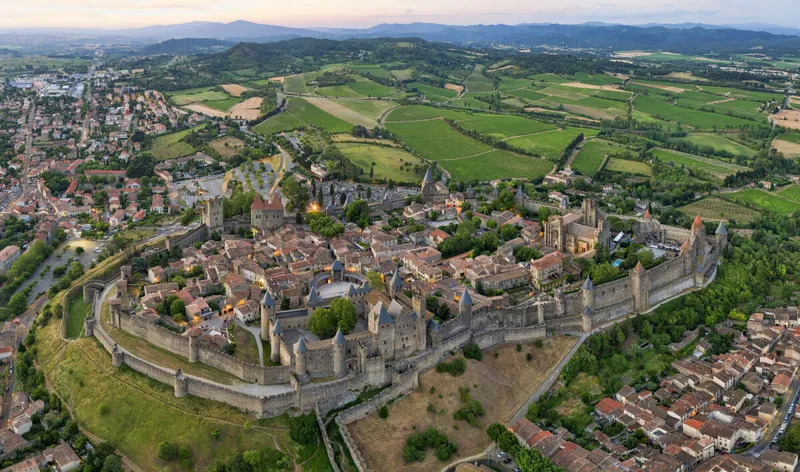
Aude: Carcassonne and Cathar Country
Guide to the Aude: Carcassonne citadel, Cathar castles, Canal du Midi, Narbonne, Fontfroide Abbey. Vertiginous fortresses and Languedoc vineyards.