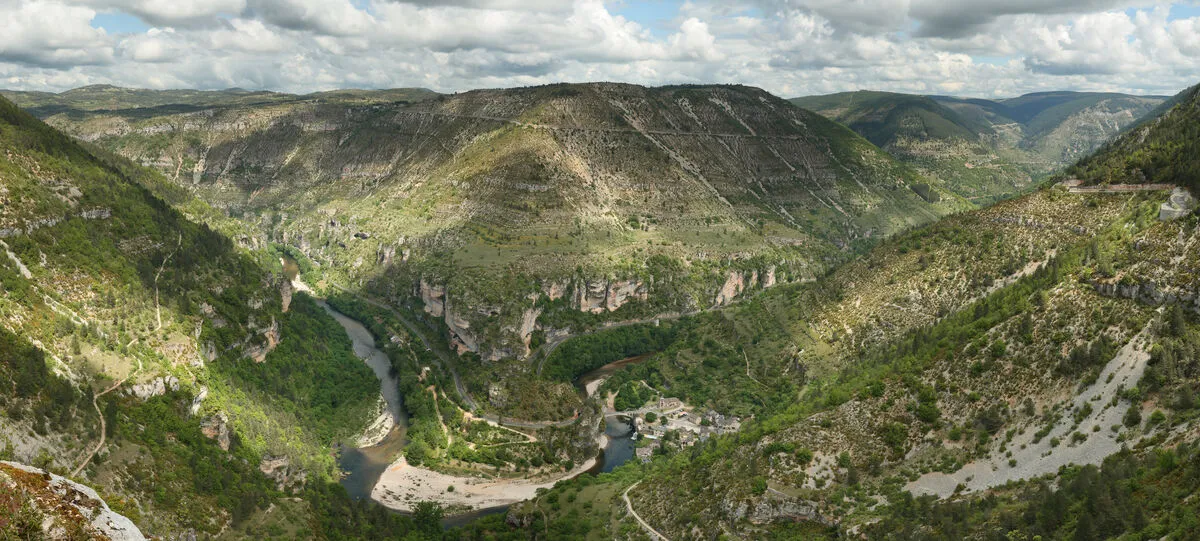
France's least populated department is also one of its most magnificent. In Lozere there are no crowds, no concrete sprawl, no compromises with modernity -- just limestone plateaux, the vertiginous gorges of the Tarn, and the vast Aubrac uplands where dark-eyed cattle graze in near-total silence.
The Tarn Gorges
A Canyon of Emerald Water
The Gorges du Tarn rank among the finest canyons in Europe. For roughly 50 kilometers between Ispagnac and Le Rozier, the Tarn River has carved a breathtaking trench between the Causse Méjean and the Causse de Sauveterre, with limestone cliffs rising up to 500 meters on either side. The road that follows the gorge floor is spectacular but narrow and winding -- in summer, drive it early in the morning to avoid traffic.
The best way to experience the gorges is by canoe. From La Malène, several outfitters offer descents ranging from 8 to 30 kilometers, suitable for all skill levels. The classic La Malène to Les Vignes run (8 km, about 2.5 hours) passes through the most dramatic stretch, the Détroits, where the cliffs close in and the water turns a deep emerald green. Expect to pay around 25 euros per person for a two-seat canoe. Traditional flat-bottomed boat trips guided by local boatmen are also available from La Malène (about 20 euros).
Sainte-Enimie
Listed among the Plus Beaux Villages de France, Sainte-Enimie tumbles steeply from the causse plateau down to the Tarn. Its cobbled medieval lanes, grey stone houses and the remains of a Benedictine monastery tell the story of the Merovingian princess Enimie, said to have been cured of leprosy by a miraculous spring. The village takes about an hour to explore and makes an excellent base for the gorges.
Cévennes National Park
An International Dark Sky Reserve
The Cévennes National Park, the only permanently inhabited national park in mainland France, covers a large part of southern Lozère. Its landscapes range from deep valleys thick with chestnut trees to the bare granite ridges of Mont Lozère, which tops out at 1,699 meters. Since 2018, the core zone of the park has been designated an International Dark Sky Reserve by the International Dark-Sky Association, one of the largest in Europe. On moonless nights, the Milky Way unfurls with extraordinary clarity. Several guesthouses and campsites organize astronomy evenings in summer.
Mont Lozère
Mont Lozère is a granite massif with a tundra-like character, swept by wind, blanketed in peat bogs and blueberry heaths. The discovery trail at the Ferme de Troubat (free) explains traditional mountain pastoralism. The summit of Finiels (1,699 m) can be reached on a manageable three-hour return hike from the Col de Finiels, rewarding walkers with a 360-degree panorama stretching from the Alps to the Cantal volcanoes.
The Aubrac Plateau
A Landscape of Infinite Grassland
The Aubrac plateau, in the western reaches of Lozère, is a high-altitude territory (1,000 to 1,400 meters) of austere, haunting beauty. Endless pastures, punctuated by dry-stone walls of black basalt, traditional stone burons (shepherd huts) and herds of tawny Aubrac cattle, create a landscape of profound stillness. In spring, the meadows erupt with wild daffodils and narcissi.
Transhumance and Aligot
Each year in late May, the transhumance festival marks the departure of the herds for their summer pastures. The cows, decorated with flowers and bells, parade through the villages in a spirit of joyful celebration. This is the time to taste aligot, the signature dish of the Aubrac: mashed potatoes stretched with fresh Laguiole tome cheese until they form long, elastic ribbons. You will find aligot served in converted burons and at village fêtes throughout the plateau. Nasbinals, with its basalt houses and eleventh-century Romanesque church, is the main settlement of the Lozère Aubrac.
Aven Armand
The Stalagmite Forest
Aven Armand, set on the Causse Méjean, contains one of the largest underground chambers in Europe and a forest of over 400 stalagmites, some reaching 30 meters in height. The tallest, known simply as the Grande Stalagmite, is one of the largest in the world. The guided tour lasts about 45 minutes and includes a funicular descent into the chasm. Entry costs approximately 12 euros. The site is open from April to November.
Mende: The Quiet Capital
Cathedral and Market
Mende, the only prefecture in Lozère, is a small, peaceful town nestled in the valley of the infant Lot River. Its Cathédrale Notre-Dame-et-Saint-Privat, rebuilt after the Wars of Religion, raises two asymmetric bell towers above the slate rooftops. The clapper of its former great bell, the Non-Pareille -- the largest bell in Christendom in the sixteenth century -- is preserved inside. The Saturday morning market on Place Urbain-V is the place to discover local products: charcuterie, cheeses, chestnut honey and wild mushrooms in season.
The Margeride and the Beast of Gévaudan
Lands of Legend
The Margeride, a granite range cloaked in pine and beech forests north of Mende, is inseparable from the legend of the Beast of Gévaudan. Between 1764 and 1767, an unidentified animal reportedly killed over a hundred people across the region, terrorizing the entire kingdom. The Musée de la Bête du Gévaudan in Saugues (Haute-Loire, on the Lozère border) chronicles this dark mystery. At the Loups du Gévaudan wildlife park near Sainte-Lucie, visitors can observe wolf packs in semi-freedom within a large forested enclosure (about 10 euros).
The GR 70: Stevenson Trail
Following the Writer's Footsteps
In 1878, Scottish writer Robert Louis Stevenson walked across the Cévennes with a donkey named Modestine, recording his journey in Travels with a Donkey in the Cévennes. The GR 70 long-distance path retraces his 272-kilometer route from Le Puy-en-Velay to Saint-Jean-du-Gard, crossing the Margeride, Mont Lozère and the Cévennes valleys. The Lozère section is the wildest. Many hikers still adopt a pack donkey to carry their bags, keeping Stevenson's tradition alive. The full trail takes about 12 days; shorter sections of two to four days through Lozère are perfectly feasible.
Practical Tips
Getting Around
A car is essential in Lozère. Mende is about 2.5 hours from Montpellier and 3 hours from Clermont-Ferrand by road. The scenery is beautiful but the roads are slow. Bus services are very limited. For hikers on the GR 70, luggage transfer services operate along the trail.
Suggested Itinerary: 5 to 7 Days
- Day 1: Mende -- cathedral, market, local cuisine.
- Day 2: Tarn Gorges -- Sainte-Enimie, canoeing from La Malène.
- Day 3: Aven Armand and the Causse Méjean.
- Day 4: Mont Lozère -- hike to Finiels summit, stargazing in the evening.
- Day 5: Cévennes valleys -- Mimente or Tarnon.
- Days 6-7: Aubrac -- Nasbinals, transhumance in season, aligot.
Best Time to Visit
June and September are the most comfortable months. July and August bring warm weather but the Tarn Gorges become very busy. Winter is harsh on the plateaux (frequent snow), but magical for those who crave solitude and pristine stargazing.
Budget
Accommodation ranges from 40 to 70 euros per night for a budget hotel or quality campsite, 70 to 120 euros for a B&B or boutique hotel, and 120 to 200 euros for high-end establishments. A restaurant lunch costs 12 to 20 euros, dinner 20 to 35 euros. Local markets and picnics are an excellent way to eat well while keeping costs down. Many activities are free: hiking, village strolls, markets, churches. Paid museums and sites average 5 to 12 euros per person. To save money, book rural gites by the week, opt for weekday lunch menus, and take advantage of free tastings at local producers.
Explore on the map
Map →📚 Related collections
Related guides
 Road trips
The Alsace Wine Route: Vineyards and Charming Villages
Explore the Alsace Wine Route from Marlenheim to Thann. Picturesque villages, wine tastings and tips for an unforgettable road trip.
 Road trips
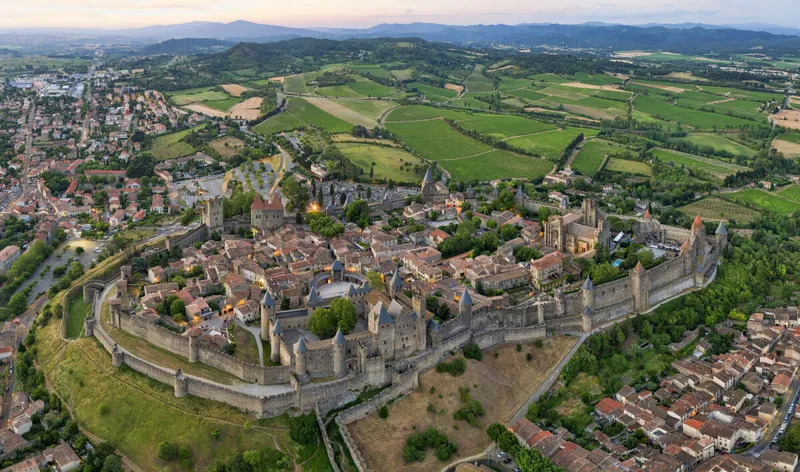
Aude: Carcassonne and Cathar Country
Guide to the Aude: Carcassonne citadel, Cathar castles, Canal du Midi, Narbonne, Fontfroide Abbey. Vertiginous fortresses and Languedoc vineyards.