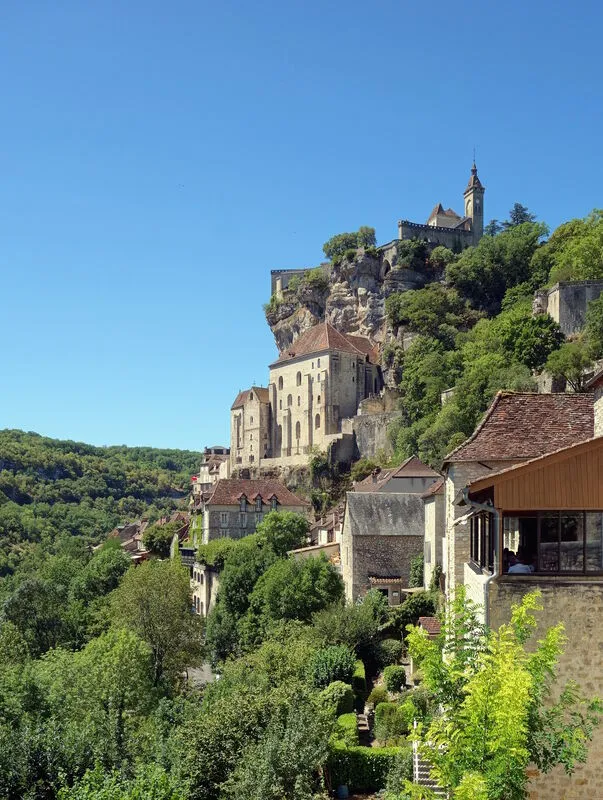
Rocamadour, clinging to a cliff above a canyon, seems to defy both gravity and time. Nearby, the Gouffre de Padirac invites an underground boat ride on a river 103 metres below the surface. The Lot is one of those southwestern departments where rivers have carved limestone plateaux into spectacular cliffs, medieval villages drift through the centuries unhurried, and the dark Cahors wine has been flowing since antiquity.
Rocamadour: The Sacred City
A Village Built Upward
Rocamadour is one of France's most dramatic sights. Clinging to a 150-meter cliff above the Alzou canyon, this thousand-year-old pilgrimage site is arranged on three tiers: the commercial village at the bottom, the religious sanctuary in the middle, and the ramparts at the top. Since the Middle Ages, pilgrims have climbed the 216 steps of the Grand Stairway on their knees to reach the Chapel of Notre-Dame and its miraculous Black Madonna, a twelfth-century walnut carving. Access to the sanctuary and its seven chapels is free. A lift connects the village to the sanctuary for those who prefer to save their knees (about 4 euros return).
The View from L'Hospitalet
To grasp the full scale of Rocamadour, head to the hamlet of L'Hospitalet on the plateau above. The viewpoint there offers a plunging panorama over the entire village and canyon, especially breathtaking at sunset when the golden stone catches fire. Nearby, the Rocher des Aigles bird of prey park stages free-flight displays of eagles, vultures and falcons over the void (about 12 euros; March to November).
Cahors: Capital of Malbec
The Pont Valentré
Cahors, the departmental capital, sits within a near-perfect loop of the Lot River. Its defining landmark is the Pont Valentré, a fourteenth-century fortified bridge with three crenellated towers, inscribed on the UNESCO World Heritage list as part of the Routes of Santiago de Compostela. Legend has it that the master builder, frustrated by slow progress, struck a deal with the Devil to complete the bridge. Look for the small carved devil perched at the top of the central tower. Walking across the bridge is free and offers fine views over the river and the town's rooftops.
The Cathedral and the Vineyards
The Cathédrale Saint-Étienne, with its massive Romanesque cupolas and a twelfth-century sculpted tympanum depicting the Ascension, deserves a careful look inside. The adjoining Gothic cloister is a pocket of calm. Entry is free.
The Cahors wine region stretches along both sides of the Lot Valley, producing deep, powerful red wines from the Malbec grape (known locally as Auxerrois or Côt). Estates lining the road between Cahors and Puy-l'Evêque welcome visitors for tastings, usually free or at minimal cost. The views over the Lot's sweeping meanders from the heights of Luzech and Puy-l'Evêque are among the finest in the department.
Saint-Cirq-Lapopie: The Jewel of the Lot
André Breton's Village
Classified among the Plus Beaux Villages de France (Most Beautiful Villages), Saint-Cirq-Lapopie crowns a sheer cliff 100 meters above the Lot River. Its timber-framed houses from the thirteenth and sixteenth centuries, cobbled lanes and cascading brown-tiled roofs compose a scene of almost unreal perfection. André Breton, founder of Surrealism, lived here and declared that he had ceased to wish himself elsewhere. The village can be explored on foot in about an hour. The panorama from the castle ruins at the highest point sweeps across the valley for kilometers.
Below the village, a towpath runs alongside the Lot, ideal for a peaceful walk or a bike ride. Traditional flat-bottomed boat trips on the river are available from the quay (about 10 euros, 50 minutes).
The Gouffre de Padirac
An Underground River Voyage
The Gouffre de Padirac is one of the most spectacular underground experiences in Europe. A gaping chasm 35 meters across opens in the limestone causse, plunging 75 meters down. After descending by staircase or lift, visitors board flat-bottomed boats that glide along a crystal-clear subterranean river 103 meters below the surface. The boat ride leads to the Salle du Grand Dôme, a natural cathedral 94 meters high decorated with monumental rock formations. Allow about 90 minutes for the full visit. Tickets cost approximately 16 euros for adults. In summer, queues can exceed two hours: book online and aim for early morning slots.
The Pech Merle Cave
Authentic Prehistoric Art
About 20 kilometers from Saint-Cirq-Lapopie, the Grotte de Pech Merle is one of the few prehistoric sites in France where visitors can still see original cave paintings in their natural setting. The famous Spotted Horses, painted around 25,000 years ago, are strikingly modern in their abstraction. The cave also contains negative hand prints, mammoths and bison. The guided tour lasts about an hour, followed by a visit to the adjoining prehistory museum. Entry is approximately 14 euros. Visitor numbers are strictly limited to 700 per day: booking ahead in season is essential.
Figeac and the Célé Valley
In Champollion's Footsteps
Figeac, a lively market town on the eastern edge of the Lot, is the birthplace of Jean-François Champollion, the man who cracked the code of Egyptian hieroglyphics. The Musée Champollion -- Les Écritures du Monde (Museum of Writing), housed in his childhood home, traces the history of written communication across civilizations (entry about 5 euros). In the square outside, a giant reproduction of the Rosetta Stone is set into the ground, a work by American artist Joseph Kosuth. Figeac also has an appealing medieval center with half-timbered houses and soleilhos, the open-air attic galleries typical of Quercy architecture.
The Célé Valley
Less visited than the Lot Valley, the Célé Valley offers wild, unspoiled scenery of ochre cliffs and emerald water. The GR 651 long-distance path follows the valley from end to end, passing painted caves, old mills and sleepy hamlets like Espagnac-Sainte-Eulalie with its Augustinian priory. It is prime territory for hiking and canoeing for those seeking solitude.
The Dordogne Valley in the Lot
Carennac and Martel
The stretch of the Dordogne that passes through the northern Lot contains some outstanding villages. Carennac, a Plus Beaux Villages member, charms with its Cluniac priory featuring a finely carved Romanesque portal and riverside houses with turrets. Martel, known as the "town of seven towers," is a prosperous medieval market town whose covered grain hall still hosts a busy market. Autoire and Loubressac, two more Plus Beaux Villages, perch on promontories with exceptional views over the valley below.
Practical Tips
Getting Around
The Lot is a rural department where a car is essential. Cahors is connected to Toulouse by train in about 1 hour 15 minutes (regional TER service). Departmental roads are scenic but narrow and winding, so allow generous driving times.
Suggested Itinerary: 5 to 7 Days
- Day 1: Cahors -- Pont Valentré, cathedral, wine estates.
- Day 2: Saint-Cirq-Lapopie and Grotte de Pech Merle.
- Day 3: Figeac and the Célé Valley.
- Day 4: Rocamadour (arrive in late afternoon for the best light).
- Day 5: Gouffre de Padirac and Martel.
- Days 6-7: Dordogne Valley -- Carennac, Autoire, Loubressac, canoeing.
Best Time to Visit
May, June and September are ideal, with pleasant weather and manageable visitor numbers. July and August bring crowds, especially to Rocamadour and Padirac. Autumn is beautiful for fall colors and the grape harvest.
Budget
Accommodation ranges from 50 to 80 euros per night for a budget hotel, 80 to 130 euros for a B&B or charming hotel, and 130 to 220 euros for upscale options. A restaurant lunch runs 14 to 22 euros, dinner 25 to 40 euros. Local farmers' markets provide excellent produce for picnics at reasonable prices. Hiking, village exploration and most churches are free. Paid sites and museums cost 6 to 15 euros per person. To keep costs in check, look for weekday set-lunch menus, stay in rural gites or quality campsites, and enjoy the free tastings many local producers offer.
Explore on the map
Map →📚 Related collections
Related guides
 Road trips
The Alsace Wine Route: Vineyards and Charming Villages
Explore the Alsace Wine Route from Marlenheim to Thann. Picturesque villages, wine tastings and tips for an unforgettable road trip.
 Road trips
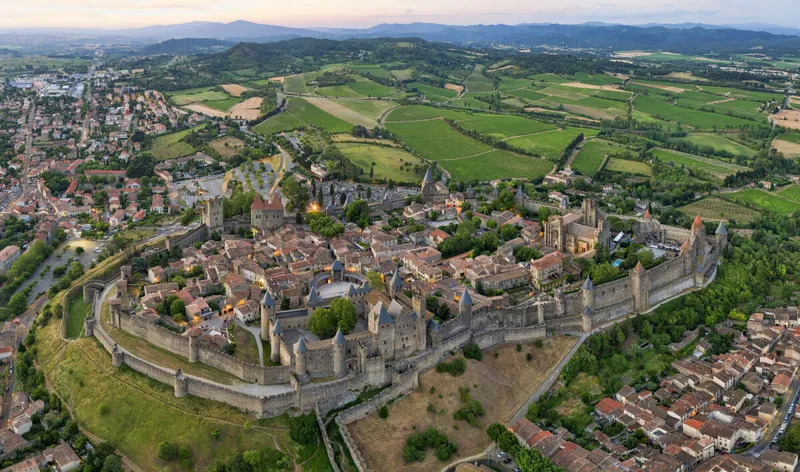
Aude: Carcassonne and Cathar Country
Guide to the Aude: Carcassonne citadel, Cathar castles, Canal du Midi, Narbonne, Fontfroide Abbey. Vertiginous fortresses and Languedoc vineyards.