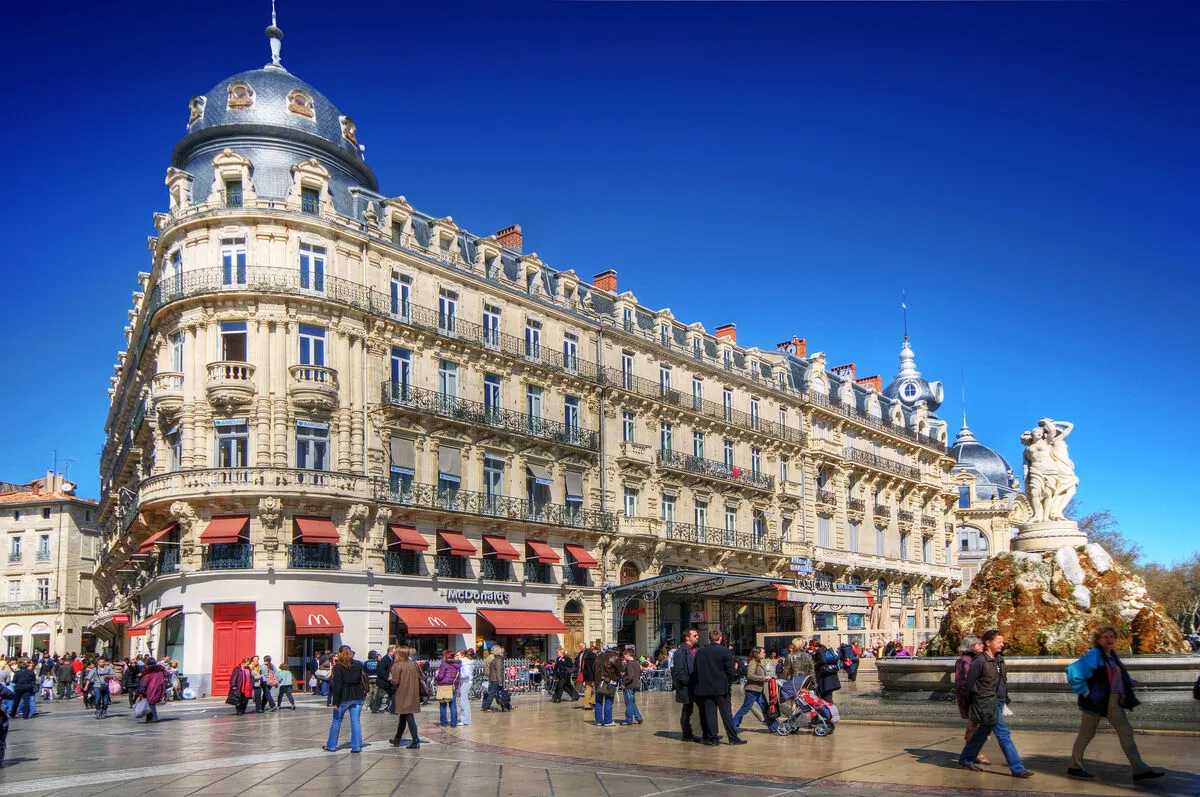
Montpellier has grown faster than any other French city over the past thirty years, and you can feel the energy on every corner. But the Herault department stretches far beyond its vibrant capital. From the limestone garrigues of the hinterland to the long sandy beaches of the Mediterranean, via the Languedoc vineyards, the Canal du Midi and the hilltop villages of the Orb valley, this territory offers a thousand faces under near-permanent sunshine.
Montpellier: A Mediterranean Capital
Montpellier is one of the most dynamic cities in southern France, driven by a young population and neighbourhoods that blend medieval architecture with bold contemporary design.
Place de la Comédie and the Écusson
Everything begins at the Place de la Comédie, a sweeping oval esplanade nicknamed "the Egg" by locals, anchored by the opera house and the Fountain of the Three Graces. It is the beating heart of the city, lively day and night with café terraces and buskers. From here, plunge into the Écusson, the medieval old town where pedestrianised lanes wind between seventeenth- and eighteenth-century mansions. Look for the Rue de l'Ancien Courrier, one of the oldest streets in the city, and Place Saint-Roch with its shaded terraces. The quarter is best explored on foot over 2 to 3 hours, with your gaze lifted to catch carved facades and hidden courtyards behind heavy stone doorways.
The Fabre Museum and Antigone
The Musée Fabre, housed in a fully renovated historic mansion, is one of the finest fine-arts museums in France. Its collections span six centuries of painting, from Raphael to Soulages, with strong holdings in Courbet and local son Frédéric Bazille. Entry costs about 8 euros. Allow 2 hours for a thorough visit. On leaving, cross the Lez river towards the Antigone quarter, a neoclassical housing complex designed by Ricardo Bofill in the 1980s whose monumental perspectives lead all the way to the regional government building on the riverbank.
Sète: The Singular Island
Sète is a port with character, built between the Mediterranean and the Thau lagoon, threaded with canals that earn it the nickname "Venice of the Languedoc."
Canal Royal and Mont Saint-Clair
The Canal Royal is the heart of Sète: its colourful quays lined with seafood restaurants and fishing boats offer one of the most photogenic strolls on the Languedoc coast. Then climb to the summit of Mont Saint-Clair (183 metres) for a spectacular 360-degree panorama sweeping across sea, lagoon, vineyards and the Gardiole hills. The walk up takes about 30 minutes from the town centre. Sète is also the birthplace of Georges Brassens and Paul Valéry, each honoured with a museum that explores their deep ties to this singular town.
Tielle and Bouzigues Oysters
The culinary signature of Sète is the tielle, a savoury pie filled with octopus in a spiced tomato sauce, inherited from Italian fishermen who settled here in the nineteenth century. You will find it in every bakery and at the covered market. Across the Thau lagoon, the village of Bouzigues is the cradle of Languedoc shellfish farming: sit down at one of the waterside restaurants to enjoy oysters and mussels straight from the water, from about 12 euros for a dozen oysters.
The Canal du Midi
The Canal du Midi, a UNESCO World Heritage Site since 1996, crosses the Hérault from west to east for over 100 kilometres. A seventeenth-century engineering masterpiece conceived by Pierre-Paul Riquet, it links Toulouse to the Mediterranean through a landscape of ancient plane trees, hand-operated locks and stone bridges.
The best way to experience it is to hire a licence-free boat for a day or more. Several hire bases operate between Béziers and Agde, with rates starting at roughly 150 euros for a half-day for a small boat (4 to 6 people). Cyclists can follow the towpath for dozens of kilometres through vineyards and sleepy villages. The stretch between the Fonseranes locks (a staircase of nine locks on the edge of Béziers) and the Malpas tunnel is particularly impressive.
Saint-Guilhem-le-Désert and the Hérault Gorges
The Village and Gellone Abbey
Saint-Guilhem-le-Désert is listed among the Most Beautiful Villages in France, and the title is well earned. Tucked into the depths of the Hérault gorges, this medieval village is built around the Abbey of Gellone, founded in 804 by William of Orange, a cousin of Charlemagne, and inscribed on the World Heritage List as part of the Routes of Santiago de Compostela. The Romanesque cloister, part of which is displayed at The Cloisters museum in New York, is strikingly beautiful. Entry to the abbey is free. Allow 2 to 3 hours to wander the lanes, admire the medieval houses and settle into a terrace on the tiny village square. Tip: arrive early in the morning or visit out of season to avoid the summer crowds.
The Devil's Bridge and Swimming
Upstream from the village, the Pont du Diable, an eleventh-century Romanesque bridge listed as a World Heritage Site, spans the Hérault above pools of turquoise water. It is one of the most popular swimming spots in the département during summer. Access is free, though parking costs about 5 euros in high season.
The Cirque de Navacelles
The Cirque de Navacelles, designated a Grand Site de France, is a spectacular natural amphitheatre carved by the Vis river into the limestone causses on the border between the Hérault and the Gard. The abandoned meander forms a cirque 300 metres deep, with a tiny village at the bottom. Several viewpoints offer dizzying perspectives, notably from Baume Auriol on the northern rim. Access is free. Allow half a day to enjoy the different vantage points and descend to the floor of the cirque.
Cap d'Agde and the Coast
The Hérault coastline alternates between lively seaside resorts and unspoilt beaches. Cap d'Agde is the largest resort in the département, with its marina, volcanic black-sand beaches and Musée de l'Éphèbe (underwater archaeology, about 6 euros). For quieter shores, head to the Maguelone lagoons near Villeneuve-lès-Maguelone, where an ancient Romanesque cathedral sits on a sand bar between sea and lagoon, or to the wild, pine-fringed Plage des Aresquiers.
Pic Saint-Loup and the Wines of the Hérault
The Hérault is the largest wine-producing département in France, and the quality of its wines has risen dramatically in recent decades. The Pic Saint-Loup appellation north of Montpellier produces powerful yet elegant reds based on Syrah, Mourvèdre and Grenache. The mountain itself (658 metres) can be hiked in about 90 minutes from the car park at Cazevieille village, rewarding walkers with an exceptional panorama from the Cévennes to the sea.
Wine estates around Pic Saint-Loup offer tastings, usually free or for a few euros. Also seek out the wines of Faugères and Saint-Chinian in the Béziers hinterland, and the golden Muscats of Frontignan and Mireval, perfect as an apéritif.
Practical Tips
Getting Around
Montpellier-Méditerranée airport serves many French and European destinations. Montpellier-Saint-Roch TGV station connects to Paris in 3 hours 20 minutes. The Montpellier tramway covers the city efficiently, but a car is essential for the hinterland, the gorges and the vineyards.
Best Time to Visit
May to June and September are ideal: pleasant warmth, swimmable sea temperatures and moderate crowds. July and August deliver full beach season but inland highlights such as Saint-Guilhem become very busy. Autumn (October to November) is perfect for hiking and wine tasting.
Budget
Accommodation ranges from 50 to 80 euros per night for a budget hotel, 80 to 130 euros for a B&B or charming hotel, and 130 to 220 euros for upscale options. A restaurant lunch runs 14 to 22 euros, dinner 25 to 40 euros. Local farmers' markets provide excellent produce for picnics at reasonable prices. Hiking, village exploration and most churches are free. Paid sites and museums cost 6 to 15 euros per person. To keep costs in check, look for weekday set-lunch menus, stay in rural gites or quality campsites, and enjoy the free tastings many local producers offer.
Explore on the map
Map →📚 Related collections
Related guides
 Road trips
The Alsace Wine Route: Vineyards and Charming Villages
Explore the Alsace Wine Route from Marlenheim to Thann. Picturesque villages, wine tastings and tips for an unforgettable road trip.
 Road trips
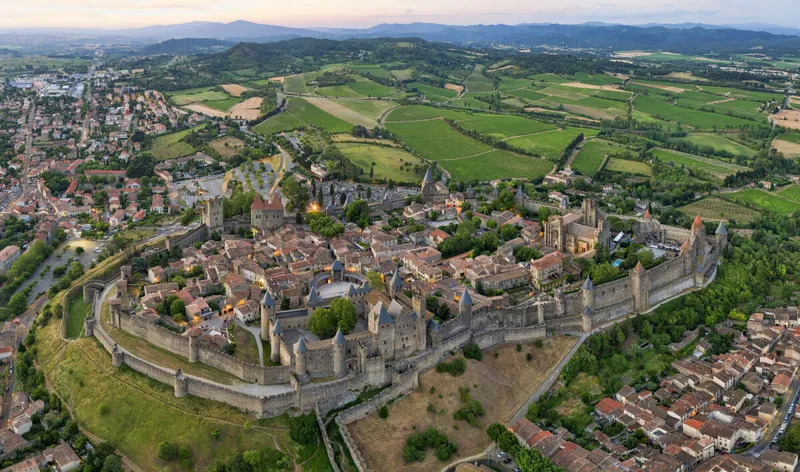
Aude: Carcassonne and Cathar Country
Guide to the Aude: Carcassonne citadel, Cathar castles, Canal du Midi, Narbonne, Fontfroide Abbey. Vertiginous fortresses and Languedoc vineyards.