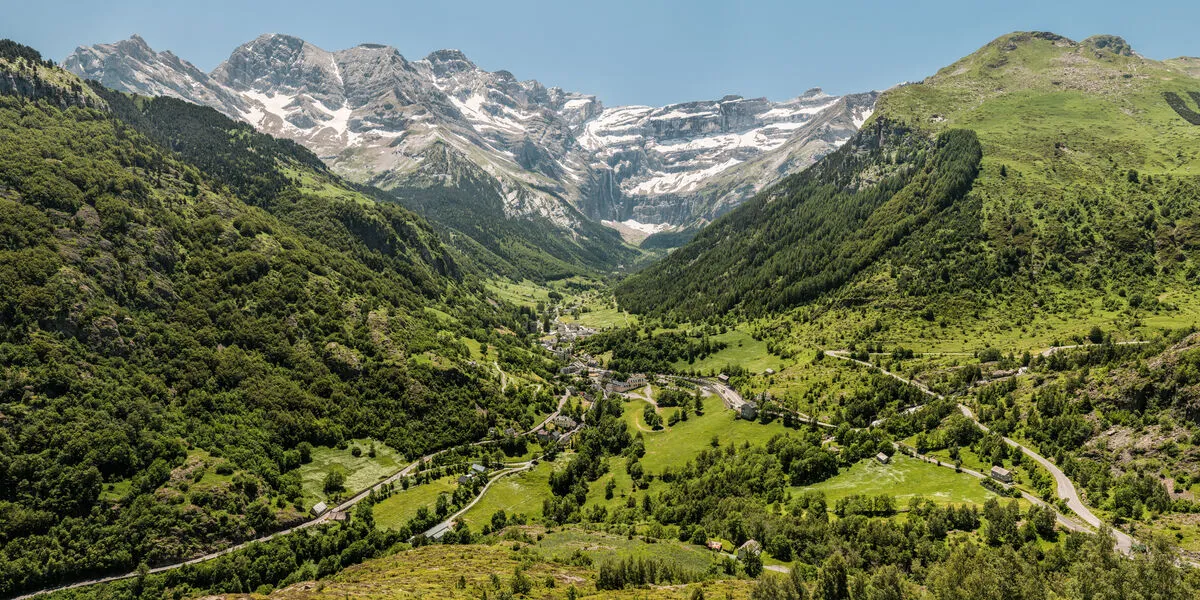
When Victor Hugo first set eyes on the Cirque de Gavarnie, he called it 'nature's Colosseum'. The Hautes-Pyrenees still deserve that superlative. This is where the Pyrenean chain reaches its highest French summits, where France's most vertiginous waterfalls plunge into the void, and where Lourdes, the world's second-largest Christian pilgrimage site, draws millions of visitors every year.
The Cirque de Gavarnie
An Amphitheatre of Rock and Ice
The Cirque de Gavarnie, a UNESCO World Heritage Site, is one of the most awe-inspiring natural spectacles in Europe. This semicircular limestone wall measures nearly 1,700 meters in height and stretches 4 kilometers across. At its center, the Grande Cascade drops 423 meters, making it one of the tallest waterfalls in Europe. Victor Hugo described the cirque as "the Colosseum of nature."
The approach from the village of Gavarnie is a gentle, well-marked trail of 3.5 kilometers (roughly 75 minutes one way), accessible to families with children. The path follows the infant Gave de Pau and rises gradually to the base of the rock walls. Access is free. For those who prefer not to walk, donkeys and horses can be rented in the village (about 25 euros return). In summer, the Festival de Gavarnie stages open-air theatre performances at the foot of the cirque, a setting unlike any other.
The Cirque de Troumouse
Less famous but equally grand, the Cirque de Troumouse can be reached by car along a winding road that climbs to 2,100 meters (parking about 7 euros in season). Far wider than Gavarnie at 10 kilometers across, it offers an overwhelming sense of solitude and scale. Cattle and horses graze freely inside this natural amphitheatre. A one-hour walk around the flat base of the cirque gives the full measure of its immensity.
The Pic du Midi de Bigorre
An Observatory Above the Clouds
The Pic du Midi de Bigorre (2,877 m) is one of the most iconic sites in the Pyrenees. Reached by a spectacular cable car from La Mongie (about 40 euros return), it houses a historic astronomical observatory founded in 1878, now converted into a unique science and visitor center. On a clear day, the 360-degree panorama spans the entire Pyrenean chain from the Basque Country to Andorra, and on the clearest days reaches as far as the Massif Central.
The viewing terraces, cantilevered over the void, are breathtaking. A museum traces the observatory's history and its contributions to astronomy and cosmic ray research. For an unforgettable experience, overnight stays at the summit are available (advance booking essential, from about 400 euros for two), with after-dark stargazing sessions from the dome.
Lourdes: A Global Sanctuary
The Sanctuaries of Our Lady
Lourdes is the second-most-visited Catholic pilgrimage site in the world, drawing roughly six million visitors each year. It all began in 1858, when Bernadette Soubirous, a fourteen-year-old local girl, reported eighteen visions of the Virgin Mary in the Grotto of Massabielle. Today, the Sanctuaries of Our Lady of Lourdes form a vast precinct containing the Grotto, the Basilica of the Immaculate Conception, the Basilica of the Rosary and the monumental underground Basilica of Saint Pius X, which can hold 25,000 people. The entire complex is free to enter.
The evening candlelight processions, which gather thousands of pilgrims along the Avenue de la Grotte, are a powerful sight regardless of personal belief. The Château Fort de Lourdes, a medieval fortress overlooking the town, houses the Musée Pyrénéen, dedicated to mountain ethnography and art (entry about 7 euros).
Cauterets and the Pont d'Espagne
Thermal Springs and Waterfalls
The spa town of Cauterets, set in a wooded valley at 930 meters, blends centuries-old thermal traditions with mountain activities. Its sulfurous waters, known since antiquity, attracted Victor Hugo, George Sand and Chateaubriand. The modern Bains du Rocher spa complex offers indoor and outdoor pools facing the peaks (about 20 euros for a two-hour session).
Above Cauterets, the Pont d'Espagne site (1,496 m) is a major gateway to the Pyrenees National Park. A 20-minute walk from the car park (parking about 8 euros) leads to the stone bridge spanning a torrent amid cascading waterfalls and ancient pines. From there, a chairlift rises to the Lac de Gaube (about 7 euros), an altitude jewel ringed by snow-capped summits including the Vignemale (3,298 m), the highest peak in the French Pyrenees.
The Col du Tourmalet
A Tour de France Legend
The Col du Tourmalet (2,115 m) is the most frequently used mountain pass in Tour de France history, crossed more than 80 times since 1910. The climb from Luz-Saint-Sauveur (18 km, 1,404 m elevation gain) is a pilgrimage for cyclists from around the world. At the summit, the sculpture of the Géant du Tourmalet -- an iron cyclist rearing against the gradient -- has become an icon of professional cycling. The road is open from June to October depending on snow conditions and offers spectacular views over the surrounding valleys and peaks.
On the eastern descent, the thermal village of Barèges, the highest thermal spa in the Pyrenees at 1,250 meters, retains authentic mountain character with its slate-roofed houses and sulfurous springs.
The Néouvielle Nature Reserve
Lakes and Ancient Pines
The Réserve Naturelle de Néouvielle, established in 1936, is one of the oldest nature reserves in France. This granite massif, accessible by road from Saint-Lary-Soulan or the Col du Tourmalet side, shelters around sixty altitude lakes of translucent water and one of the finest mountain pine forests in Europe, with some trees more than 500 years old. The Lac d'Aubert (2,148 m) and Lac d'Aumar (2,192 m) can be linked on a manageable two-hour loop hike through a mineral landscape dotted with glacial erratics and, in early summer, blooming rhododendrons. Access is free, but parking is regulated in summer (mandatory shuttle from certain car parks, about 3 euros).
Practical Tips
Getting Around
Lourdes is 1 hour 45 minutes from Toulouse by car and has a TGV station (6 hours from Paris). A vehicle is essential for exploring the valleys and mountain passes. High-altitude roads are closed in winter (Tourmalet, parts of Pont d'Espagne).
Suggested Itinerary: 5 to 7 Days
- Day 1: Lourdes -- Sanctuaries, Château Fort.
- Day 2: Cauterets -- Thermal baths, Pont d'Espagne, Lac de Gaube.
- Day 3: Col du Tourmalet and Barèges.
- Day 4: Cirque de Gavarnie -- Hike to the base of the cirque.
- Day 5: Cirque de Troumouse.
- Days 6-7: Néouvielle Reserve -- Lacs d'Aubert and Aumar, Pic du Midi.
Best Time to Visit
June to September for hiking and open mountain passes. July and August are warmest but also busiest. Winter (December to March) is ski season at Cauterets, La Mongie, Barèges and Saint-Lary.
Budget
Accommodation ranges from 50 to 80 euros per night for a budget hotel, 80 to 130 euros for a B&B or charming hotel, and 130 to 220 euros for upscale options. A restaurant lunch runs 14 to 22 euros, dinner 25 to 40 euros. Local farmers' markets provide excellent produce for picnics at reasonable prices. Hiking, village exploration and most churches are free. Paid sites and museums cost 6 to 15 euros per person. To keep costs in check, look for weekday set-lunch menus, stay in rural gites or quality campsites, and enjoy the free tastings many local producers offer.
Explore on the map
Map →📚 Related collections
Related guides
 Road trips
The Alsace Wine Route: Vineyards and Charming Villages
Explore the Alsace Wine Route from Marlenheim to Thann. Picturesque villages, wine tastings and tips for an unforgettable road trip.
 Road trips
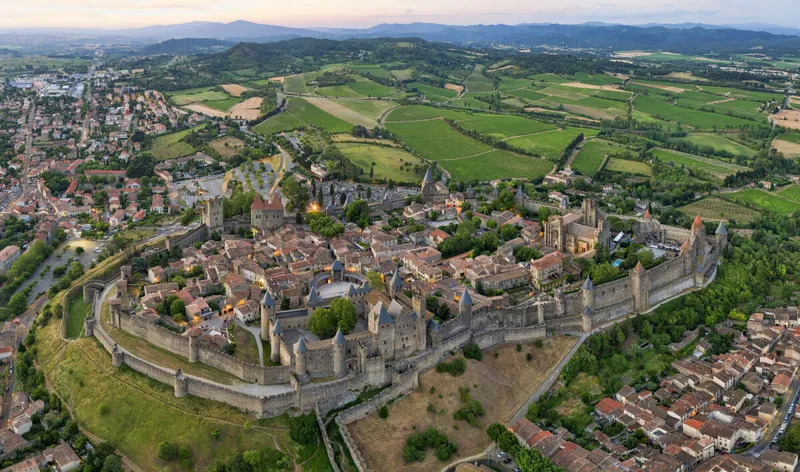
Aude: Carcassonne and Cathar Country
Guide to the Aude: Carcassonne citadel, Cathar castles, Canal du Midi, Narbonne, Fontfroide Abbey. Vertiginous fortresses and Languedoc vineyards.