From the flower-lined canals of Colmar, which rival Venice for the title of Petite Venise, to the windswept summit of the Grand Ballon, the highest point in the Vosges, the Haut-Rhin is the Alsace of storybook imagination made real. Circular villages ranked among the most beautiful in France, vine-covered terraces gilded by autumn, and Christmas markets whose magic draws millions of visitors every year create a department where beauty is a way of life.
Colmar: Half-Timbered Elegance
Petite Venise
Colmar looks as though it was designed specifically to delight. The Petite Venise (Little Venice) quarter, where pastel-colored half-timbered houses line the banks of the Lauch canal, is almost impossibly photogenic. Flat-bottomed boats carry visitors along the waterways for about 7 euros per person (roughly 20 minutes). Just above, the Tanners' Quarter features tall, narrow houses whose open-air attics were once used to dry hides. Set aside half a day to explore old Colmar on foot: every street holds an architectural detail worth pausing for, whether a carved oriel window, a wrought-iron shop sign or a Renaissance fountain.
Musée Unterlinden and the Isenheim Altarpiece
The Musée Unterlinden is one of the most visited museums in France outside Paris, and its centerpiece alone is worth the journey. The Isenheim Altarpiece, a masterwork by Matthias Grünewald completed around 1516, is a polyptych of shattering emotional power. The central crucifixion panel, with its unflinchingly realistic tortured Christ, and the golden-lit resurrection panel rank among the greatest achievements in Western painting. The museum, housed in a former Dominican convent extended by architects Herzog & de Meuron, also holds collections of Rhenish art, archaeology and contemporary work. Entry is approximately 13 euros; allow two hours.
Christmas Markets
Colmar's Christmas markets rival those of Strasbourg for sheer atmosphere. Six distinct markets are spread across the historic center, with special attention given to the children's market on Place des Six Montagnes Noires and the gourmet market on Place de l'Ancienne Douane. The illuminated Petite Venise quarter during the holiday season is an unforgettable sight.
Wine Route Villages
Éguisheim: The Circular Village
Éguisheim, voted France's favorite village in 2013, is a jewel of medieval planning arranged in concentric circles around its octagonal castle. Its lanes, lined with geranium-decked half-timbered houses, trace perfect rings that can be walked in about an hour. The village is also the birthplace of Alsatian viticulture: Pope Leo IX, born here in 1002, helped spread its reputation across medieval Europe. Tasting cellars are plentiful and the welcome is warm.
Riquewihr and Kaysersberg
Riquewihr, often called the "pearl of the Alsatian vineyard," has survived the centuries virtually intact. Its thirteenth-century ramparts, its Thieves' Tower and its main street lined with Renaissance houses create a storybook setting. The downside is heavy visitor traffic in peak season: arrive early in the morning for the most pleasant experience.
Kaysersberg, voted France's favorite village in 2017, adds a fortified bridge over the River Weiss and a hilltop castle ruin with magnificent valley views to its considerable architectural appeal. It is also the birthplace of Albert Schweitzer, and a small museum traces the life of the Nobel Peace Prize laureate (entry about 2 euros).
The Vosges Peaks
Grand Ballon
The Grand Ballon, at 1,424 meters the highest point in the Vosges mountains, is reached via the spectacular Route des Crêtes, a ridge road built during World War I to link the Vosges summits out of sight of German positions in the Rhine valley. On a clear day the summit delivers a full 360-degree panorama stretching from the Black Forest to the Swiss Alps. The walk from the car park to the top takes about 20 minutes. In winter the area offers modest downhill skiing; the rest of the year it is prime hiking territory.
The Route des Crêtes
The Route des Crêtes (D431) winds for nearly 80 kilometers between the Col du Bonhomme and Cernay, crossing the chaumes, the high-altitude pastures where Vosges cattle graze against a backdrop of rolling summits. It is one of the most beautiful mountain roads in France. Plan stops at the Markstein, the Col de la Schlucht and the Hohneck (1,363 meters), another outstanding viewpoint. Parts of the road are closed in winter.
Mulhouse: World-Class Industrial Museums
Cité de l'Automobile
Mulhouse looks and feels nothing like the rest of Alsace. A former industrial powerhouse, it has transformed its factory heritage into museums of genuinely international stature. The Cité de l'Automobile — Schlumpf Collection brings together more than 400 vehicles, including the largest Bugatti collection in the world, inside a converted wool mill. From Rolls-Royces to Formula One racing cars, the display is stunning even for people with no particular interest in automobiles. Entry is approximately 18 euros; allow two to three hours.
Cité du Train
The Cité du Train, the largest railway museum in Europe, traces the history of French railways through a spectacular collection of locomotives and carriages spanning the nineteenth century to the TGV era. Theatrical staging and sound effects make the visit engaging and accessible for families. Entry is about 15 euros; allow two hours.
Écomusée d'Alsace
At Ungersheim, between Colmar and Mulhouse, the Écomusée d'Alsace is the largest open-air museum in France. More than 80 authentic Alsatian houses, dismantled stone by stone from villages facing demolition, have been reassembled on a 100-hectare site to form a living village. Craftspeople demonstrate traditional trades, farm animals roam freely, vegetable gardens are tended by season, and traditional festivals mark the calendar. Entry is approximately 16 euros; plan at least half a day.
Wines of Haut-Rhin
Haut-Rhin produces the most celebrated wines in Alsace, blessed by exceptional terroir and generous sunshine. Gewurztraminer, opulent and aromatic with notes of lychee and rose, is the signature grape of the region. Riesling, more mineral and taut, is widely regarded as the noblest Alsatian variety. Pinot Gris, rich and full-bodied, and Muscat d'Alsace, dry and intensely aromatic, complete the main lineup.
Of the 51 grand cru vineyards in Alsace, the majority are located in the Haut-Rhin. Visiting the cellars in Éguisheim, Riquewihr or Kaysersberg allows you to taste these wines at the source, often for a few euros or even free. Late-harvest wines (vendanges tardives) and selection of noble berries (sélection de grains nobles), picked deep into autumn, produce dessert wines of remarkable complexity.
Practical Tips
Getting There and Around
Colmar is approximately two hours and 30 minutes from Paris by TGV (via Strasbourg). The city center is best explored on foot. A car is essential for the Wine Route, the Route des Crêtes and the Mulhouse museums. The excellent network of cycling paths links several wine villages and makes for a delightful alternative to driving.
Suggested Itinerary: 5 to 7 Days
- Days 1-2: Colmar — Petite Venise, Musée Unterlinden, old town.
- Day 3: Éguisheim, Riquewihr, Kaysersberg and wine tastings.
- Day 4: Route des Crêtes, Grand Ballon, Hohneck.
- Day 5: Mulhouse — Cité de l'Automobile and Cité du Train.
- Day 6: Écomusée d'Alsace.
- Day 7: Remaining wine villages and tasting cellars.
Best Time to Visit
May to October for the villages and the Route des Crêtes. September and October for the grape harvest and wine festivals. December for Christmas markets. The Route des Crêtes is partially closed from November to April.
Budget
Accommodation ranges from 50 to 80 euros per night for a budget hotel, 80 to 130 euros for a B&B or charming hotel, and 130 to 220 euros for upscale options. A restaurant lunch runs 14 to 22 euros, dinner 25 to 40 euros. Local farmers' markets provide excellent produce for picnics at reasonable prices. Hiking, village exploration and most churches are free. Paid sites and museums cost 6 to 15 euros per person. To keep costs in check, look for weekday set-lunch menus, stay in rural gites or quality campsites, and enjoy the free tastings many local producers offer.
Explore on the map
Map →📚 Related collections
Related guides
 Road trips
The Alsace Wine Route: Vineyards and Charming Villages
Explore the Alsace Wine Route from Marlenheim to Thann. Picturesque villages, wine tastings and tips for an unforgettable road trip.
 Road trips
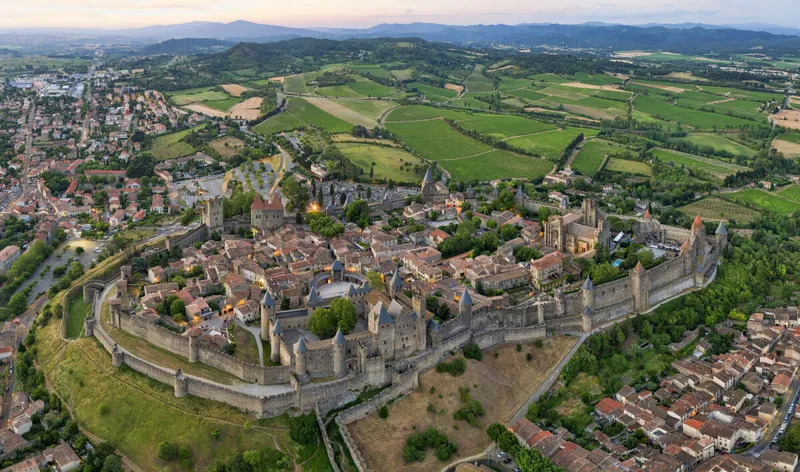
Aude: Carcassonne and Cathar Country
Guide to the Aude: Carcassonne citadel, Cathar castles, Canal du Midi, Narbonne, Fontfroide Abbey. Vertiginous fortresses and Languedoc vineyards.