Few regions can claim to excel simultaneously in the art of wine, the art of the table and the art of stone. Burgundy-Franche-Comte manages it with disarming ease. From the Route des Grands Crus between Dijon and Beaune to the Cistercian abbeys hidden in the forests of the Morvan, via a culinary tradition that has circled the globe, this region offers a density of pleasures found nowhere else in France.
Dijon: Capital of the Dukes
Any journey through Burgundy begins naturally with Dijon. Once the seat of the powerful Duchy of Burgundy, whose medieval dukes rivalled the kings of France in wealth and ambition, the city retains a historic centre of remarkable depth. The Ducal Palace (Palais des Ducs et des Etats de Bourgogne), an imposing complex now housing the town hall and the Museum of Fine Arts, presides over the Place de la Liberation -- one of France's most elegant squares, with its sweeping crescent of 17th-century arcades.
The best way to discover old Dijon is to follow the Owl Trail (Parcours de la Chouette), a self-guided walking circuit of 22 stops marked by arrows set into the pavement. It takes its name from a small owl carved into a buttress of the Church of Notre-Dame, polished smooth by generations of passers-by who rub it for good luck. The trail winds past turreted townhouses, Renaissance courtyards and narrow medieval lanes that open suddenly onto sunlit squares.
Do not miss the Halles de Dijon, a covered market designed by a student of Gustave Eiffel. On Tuesday, Friday and Saturday mornings, the stalls overflow with local treasures: artisan mustard, pain d'epices (spiced honey bread), blackcurrant liqueur, aged cheeses. It is the perfect place to assemble a Burgundian picnic before heading south into the vineyards. Allow a solid half-day for the city centre, longer if you visit the Museum of Fine Arts (free admission, well worth the time).
The Route des Grands Crus: The World's Most Prestigious Vineyard Road
South of Dijon, the Route des Grands Crus (D122) unfurls over roughly 60 kilometres through what the Burgundians call the "Champs-Elysees of Burgundy". This wine road traverses some of the most celebrated appellations on Earth, recognised as a UNESCO World Heritage Site since 2015 under the designation "Climats of the Burgundy vineyards" -- the term climat referring to the precisely delimited vineyard plots that give each wine its identity.
Gevrey-Chambertin to Nuits-Saint-Georges
The journey begins at Gevrey-Chambertin, whose vineyards alone hold nine grands crus. The village is crowned by a 10th-century castle surrounded by vines, an image that captures the essence of Burgundy in a single frame. Further south, the Clos de Vougeot deserves an extended stop. This 50-hectare walled vineyard encloses a chateau that serves as headquarters for the Confrerie des Chevaliers du Tastevin, a wine brotherhood that hosts lavish ceremonial banquets. Visiting the chateau and its 12th-century wine presses costs around 9 euros and takes about an hour.
Nuits-Saint-Georges, the commercial heart of the Cote de Nuits, is a lively small town packed with negociant houses and tasting rooms. It makes an excellent base for exploring the surrounding vineyards on foot or by bicycle.
Pommard to Meursault: The Cote de Beaune
Beyond Beaune, the route enters white-wine country. Pommard and Volnay produce powerful, silky reds, while Meursault and its famed vineyard plots -- Charmes, Perrieres, Genevrieres -- rank among the most sought-after Chardonnays in the world. The village of Meursault itself, with its church spire covered in glazed polychrome tiles and its deep stone cellars, is worth lingering in.
Wine Tasting Tips
Most estates open to the public offer guided tastings with explanations of the terroir. Expect to pay 10 to 15 euros per tasting for a flight of four to six wines. A few pointers: book ahead at the most popular domaines, start with whites before moving on to reds, and do not hesitate to use the spittoon -- it will keep your palate sharp across several stops. For a more structured experience, the Ecole des Vins de Bourgogne in Beaune runs introductory workshops starting at 35 euros.
Beaune and the Hospices
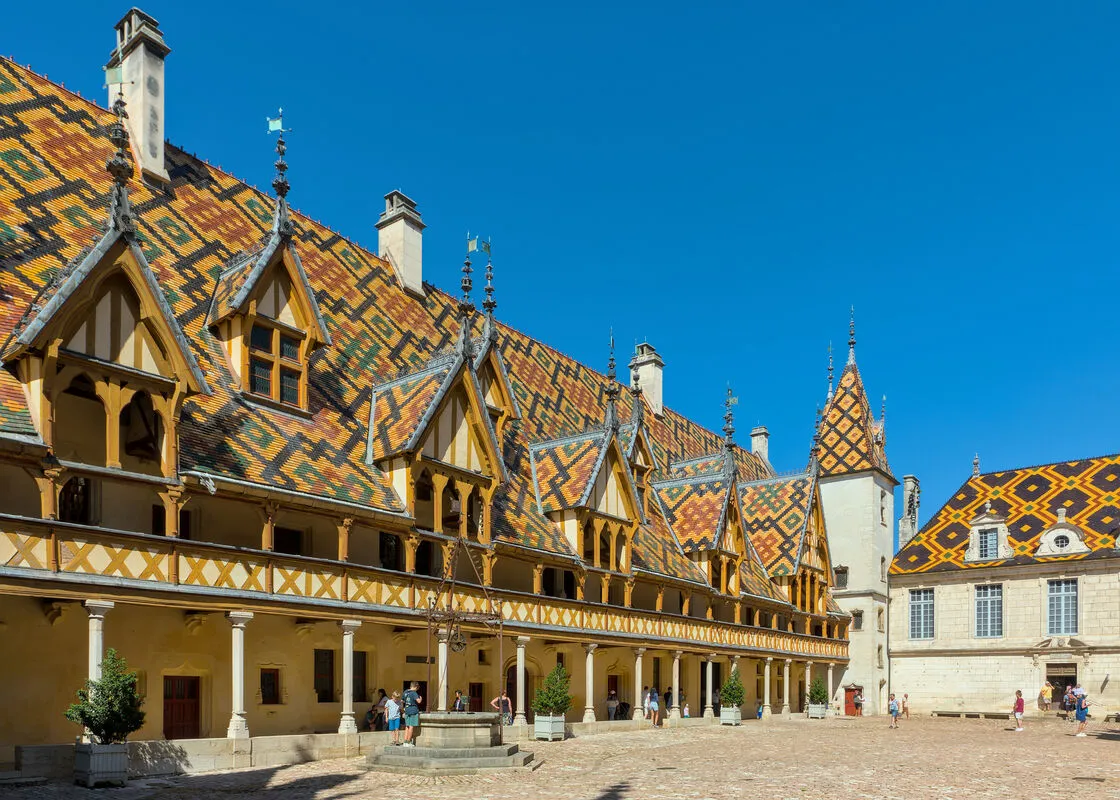
Beaune is the beating heart of Burgundy's wine country. Behind its circular ramparts, the town unfolds as a maze of cobbled streets, vaulted cellars and half-timbered houses. But it is the Hotel-Dieu des Hospices de Beaune that draws every eye.
Founded in 1443 by Chancellor Nicolas Rolin to care for the sick and the poor, this medieval hospital is a masterpiece of Flamboyant Gothic architecture. Its inner courtyard, with roofs clad in glazed polychrome tiles arranged in geometric patterns of red, green, yellow and black, is one of the most instantly recognisable sights in France. Inside, the Great Hall of the Poor, with its canopied beds and soaring ship's-hull ceiling, is both beautiful and profoundly moving. Admission costs around 10 euros, and you should allow a good hour for the visit.
Every third Sunday of November, the Hospices de Beaune Wine Auction, the most famous charity wine sale in the world, brings the town alive for an entire weekend. The prices reached at this auction serve as a barometer for the Burgundy market as a whole, and the surrounding festivities -- parades, open cellars, street banquets -- make it one of the great wine events.
After the Hospices, walk the circuit of the town ramparts (about 30 minutes, free) for a peaceful perspective over the rooftops and the vineyards stretching to the horizon.
Vezelay: The Eternal Hill
About a hundred kilometres west of Dijon, Vezelay rises on its hilltop like a vision from another age. This tiny village of a few hundred inhabitants, classified among France's Most Beautiful Villages, is crowned by the Basilica of Sainte-Marie-Madeleine, a masterpiece of Romanesque art and a UNESCO World Heritage Site.
The climb up the main street, flanked by golden-stone houses, art galleries and artisan workshops, is a pleasure in itself. The basilica's narthex holds a carved tympanum of extraordinary finesse depicting the Pentecost. Inside, the luminous nave with its storied capitals -- each one a miniature sculpture -- invites quiet contemplation. Vezelay is also one of the four historic starting points of the Way of Saint James (Camino de Santiago) pilgrimage route in France.
From the basilica's terrace and the village lookout points, the panorama sweeps across the rolling, wooded hills of the Morvan natural park. Allow half a day for the visit, more if you want to hike the surrounding trails.
Fontenay Abbey: Cistercian Silence
Tucked into a wooded valley in northern Burgundy, the Abbey of Fontenay is one of the oldest surviving Cistercian monasteries in Europe. Founded in 1118 by Saint Bernard of Clairvaux, it embodies the Cistercian ideal of austerity and harmony with breathtaking clarity. The abbey church, cloister, chapter house, forge and gardens form an ensemble of striking coherence, inscribed on the UNESCO World Heritage list.
The visit (around 11 euros, allow 1 to 1.5 hours) unfolds in deep stillness. Light filtering through the church's plain windows, reflections in the cloister's washbasin, the murmur of the stream running through the grounds -- everything here invites contemplation. An essential detour for anyone with an interest in medieval architecture or simply in the restorative power of quiet, beautiful spaces.
Franche-Comte and the Jura: The Region's Wild Side
The eastern half of the Bourgogne-Franche-Comte region, often overshadowed by Burgundy's vineyards, holds treasures that merit a journey of their own.
Arbois and Jura Wines
Arbois, a handsome small town nestled at the foot of the Jura foothills, is the capital of vin jaune (yellow wine), a singular wine aged under a veil of yeast for a minimum of six years and three months. The result is an intensely nutty, oxidative wine unlike anything else in the world -- an acquired taste that, once acquired, becomes an obsession. The house where Louis Pasteur conducted his early experiments on fermentation is open to visitors and sheds fascinating light on the link between science and winemaking. Also seek out Macvin (a fortified wine aperitif) and vin de paille (straw wine), rarities found nowhere else.
The Reculees and Herisson Waterfalls
The Reculees are dramatic dead-end valleys carved into the Jura plateau, with sheer limestone cliffs rising on three sides. The Reculee de Baume-les-Messieurs, with its imperial abbey and a cave filled with spectacular formations, is the most impressive.
The Cascades du Herisson (Herisson Waterfalls) offer one of the finest walks in the region. The trail (roughly 7 km return, about 3 hours, moderate difficulty) follows a succession of 31 falls and rapids dropping 280 metres through forest. The Saut de l'Eventail (65 m) and the Grand Saut (60 m) are the most dramatic, especially in spring when snowmelt swells the waters into thundering curtains of white.
The Royal Saltworks of Arc-et-Senans
Designed in the 18th century by the visionary architect Claude-Nicolas Ledoux, the Saline Royale d'Arc-et-Senans is a unique architectural ensemble inscribed on the UNESCO World Heritage list. Its semicircular plan, conceived as an "ideal city", stands as a monument to Enlightenment utopianism. Admission costs around 11 euros and the visit, enhanced by temporary exhibitions, takes 1.5 to 2 hours.
Gastronomy: The Flavours of Burgundy and the Jura
No trip through this region is complete without paying homage at the table. Boeuf bourguignon, slow-braised in red wine with lardons, mushrooms and pearl onions, is one of the most iconic dishes in French cuisine -- and it tastes incomparably better here, made with local Charolais beef and a bottle of village Pinot Noir. Escargots de Bourgogne, served sizzling in their shells with garlic-parsley butter, are a rite of passage for every visitor.
On the cheese board, Epoisses is a pungent, washed-rind cheese bathed in marc de Bourgogne that Napoleon reportedly adored. Comte, produced in the Jura's cooperative dairies (fruitieres) and aged anywhere from 4 to 24 months, is the most popular AOP cheese in France -- nutty, complex and endlessly versatile. Try also the gougeres, light cheese-flavoured choux pastry puffs that accompany every cellar tasting in Burgundy.
For an aperitif, the kir -- white Aligote wine with a dash of Dijon blackcurrant liqueur (creme de cassis) -- was born here, popularised by Canon Kir, the former mayor of Dijon. In its deluxe form, known as kir royal, Cremant de Bourgogne replaces the still wine.
Practical Tips
When to Go
The ideal window is September to October, during the grape harvest. The vines turn gold and copper, cellars open wide, and the air carries the scent of ripe fruit. Spring (April-May) is also lovely, with fewer crowds and lush green landscapes. Winter has its own rewards: the Hospices de Beaune dusted with snow, warm cellars lit by log fires, and Burgundy truffle season.
Getting Around
A car is essential for the Route des Grands Crus and for exploring the Jura. Wine villages are poorly served by public transport. From Paris, Dijon is just 1 hour 40 minutes by TGV high-speed train; from there, a rental car gives you complete freedom. If you plan to taste, designate a driver or use one of the private chauffeur services that are growing in the region.
Budget
Accommodation ranges from 50 to 80 euros per night for a budget hotel, 80 to 130 euros for a B&B or charming hotel, and 130 to 220 euros for upscale options. A restaurant lunch runs 14 to 22 euros, dinner 25 to 40 euros. Local farmers' markets provide excellent produce for picnics at reasonable prices. Hiking, village exploration and most churches are free. Paid sites and museums cost 6 to 15 euros per person. To keep costs in check, look for weekday set-lunch menus, stay in rural gites or quality campsites, and enjoy the free tastings many local producers offer.
Explore on the map
Map →📚 Related collections
Related guides
 Road trips
The Alsace Wine Route: Vineyards and Charming Villages
Explore the Alsace Wine Route from Marlenheim to Thann. Picturesque villages, wine tastings and tips for an unforgettable road trip.
 Road trips
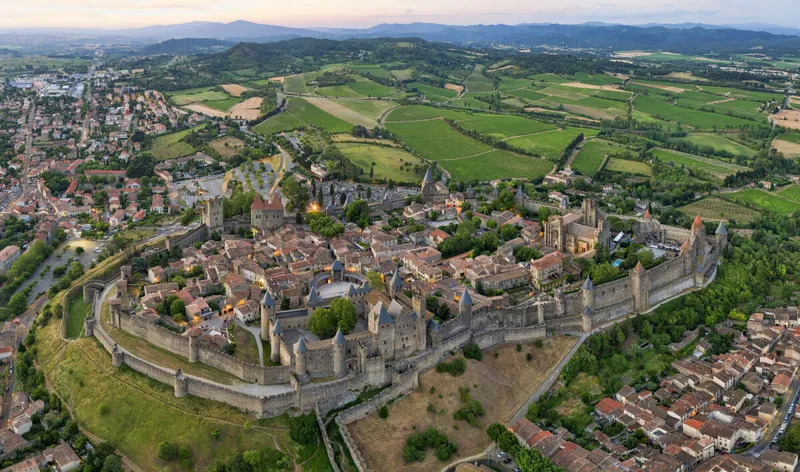
Aude: Carcassonne and Cathar Country
Guide to the Aude: Carcassonne citadel, Cathar castles, Canal du Midi, Narbonne, Fontfroide Abbey. Vertiginous fortresses and Languedoc vineyards.