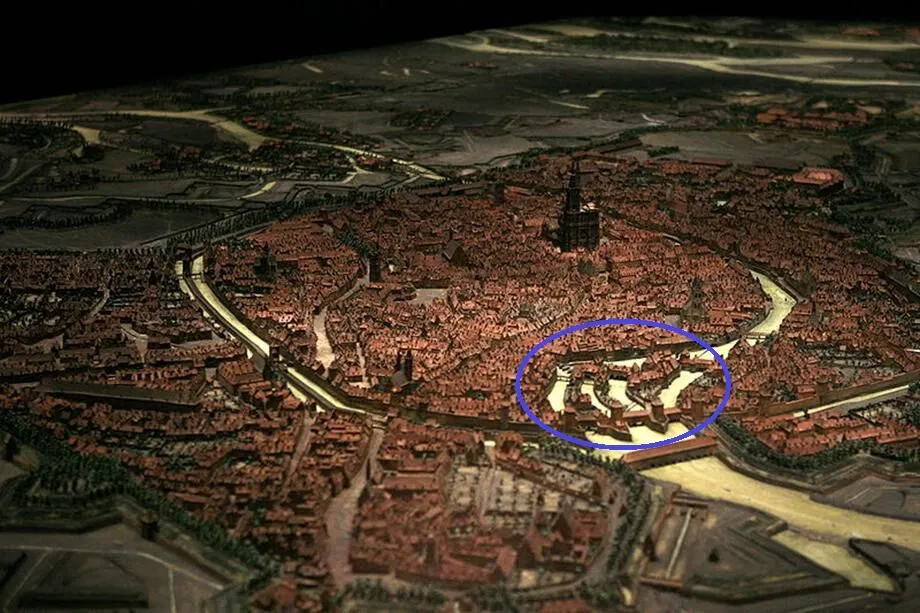
Strasbourg is one of the few French cities where you can visit a Gothic cathedral in the morning, lunch in a European parliament and dine in a half-timbered winstub in the evening. The Bas-Rhin department, of which it is capital, delivers postcard after postcard: vine-covered slopes along the Wine Route, hilltop fortresses in the Northern Vosges, and villages so immaculately kept they look like illustrations from a fairy tale.
Strasbourg: European Capital, Alsatian Soul
Notre-Dame Cathedral
Strasbourg's Notre-Dame Cathedral held the title of tallest building in the world for over two centuries. Its single spire, built from pink Vosges sandstone, reaches 142 meters and is covered in an almost hallucinatory profusion of Gothic sculpture. Inside, the sixteenth-century astronomical clock performs its mechanical show every day at 12:30 (ticketed access from 12:00, approximately 3 euros). For those willing to climb 332 steps, the panoramic platform at 66 meters delivers sweeping views over the old town rooftops, the Black Forest across the Rhine, and on clear days, the distant Alps. Entry costs about 8 euros.
La Petite France
La Petite France is the most photographed quarter in Strasbourg, and for good reason. Sixteenth- and seventeenth-century half-timbered houses lean over the canals of the River Ill, their window boxes spilling geraniums in summer. The neighborhood was originally home to tanners and fishermen, and the restored houses now shelter restaurants and tea rooms. Walk along the Ponts Couverts, three medieval bridge towers that once guarded the city, and climb the terrace of the Barrage Vauban for the best overhead view of the quarter. Free and open at all times.
The European Parliament and Institutions
Strasbourg serves as the official seat of the European Parliament, alongside the Council of Europe and the European Court of Human Rights. The Parlamentarium Simone Veil visitor center offers a free interactive experience explaining how European institutions work. Free guided tours are also available during parliamentary sessions. Online booking is recommended.
Christmas Market
The Christkindelsmärik, founded in 1570, is the oldest Christmas market in France and one of the most celebrated in Europe. From late November to late December, more than 300 wooden chalets spread across ten sites throughout the city center. Place Kléber hosts the towering Christmas tree, Place Broglie features traditional crafts, and Place du Château houses the more contemporary OFF market. Visit on a weekday morning to avoid the weekend crush.
Mont Sainte-Odile and Obernai
The Monastery and the Pagan Wall
Rising to 760 meters above the Rhine plain, Mont Sainte-Odile is the spiritual heart of Alsace. The monastery, founded in the seventh century by Saint Odile, patron saint of Alsace, commands a vast panorama stretching from the Vosges to the Black Forest. Access to the site is free. Encircling the summit, the enigmatic Pagan Wall runs for more than 10 kilometers, a rampart of massive stone blocks whose exact origin and purpose remain debated by archaeologists. A marked trail follows a scenic section in about two hours of easy walking.
Obernai: A Perfect Wine Town
At the foot of Mont Sainte-Odile, Obernai is one of the most appealing towns on the Wine Route. Its market square, framed by polychrome half-timbered houses and overlooked by the Kapellturm belfry, is a concentrated dose of Alsatian charm. The Thursday morning market is especially lively. Take time to see the old corn exchange and the medieval ramparts, which survive intact along part of their original circuit.
Haut-Koenigsbourg Castle
Perched at 757 meters on a rocky spur with commanding views over the Alsace plain, Haut-Koenigsbourg is the most visited castle in the region. Rebuilt in the early twentieth century by Kaiser Wilhelm II on medieval foundations, it offers a thorough immersion in fortress architecture: keep, drawbridge, armory, and a wall-walk with dramatic views over vineyards, villages and the Rhine valley toward Germany. Entry costs approximately 9 euros. Allow ninety minutes to two hours for the visit. The site draws large crowds in summer; arrive early in the morning or late in the afternoon for a quieter experience.
The Wine Route: Barr, Andlau and Dambach
Barr and Andlau
The Alsace Wine Route threads through the Bas-Rhin from north to south, linking a chain of vine-draped villages between the foothills and the plain. Barr is an essential stop, with its tasting cellars and a celebrated grape harvest festival every October. A few kilometers south, Andlau charms with a Romanesque abbey church bearing unique animal carvings on its facade and with two prestigious grand cru vineyards, Kastelberg and Wiebelsberg. Cellar tastings are usually free for three to six wines, with no obligation to purchase.
Dambach-la-Ville
Dambach-la-Ville is one of the largest wine-producing villages in Alsace, still encircled by fourteenth-century ramparts pierced by three monumental gates. Its vineyards are planted predominantly with Riesling, the noblest grape of the region. The chapel of Saint-Sébastien, set among the vines on the Bernstein hillside, offers a fine view over the plain and the ruins of Bernstein castle above.
The Maginot Line: Fort Schoenenbourg
Near the northern border of the department, the Fort de Schoenenbourg is one of the most important Maginot Line structures open to visitors. This underground bunker, constructed in the 1930s, descends several levels and could accommodate over 600 soldiers. The guided tour lasts about two hours and takes you through combat blocks, galleries, barracks and the power plant. Entry is approximately 8 euros per adult. The temperature underground remains a constant 12 degrees Celsius year-round, so bring a warm layer even in summer.
Saverne and Wissembourg
Saverne: Gateway to the Vosges
Saverne sits at the foot of the Saverne pass, the historic crossing point between Alsace and Lorraine. The Château des Rohan, an enormous red sandstone palace sometimes called the "little Alsatian Versailles," houses an archaeology and local history museum. The municipal rose garden is one of the finest in France, with more than 8,500 rose bushes of 550 varieties. Free entry from June to September.
Wissembourg: Border Charm
At the far north of the department, right on the German border, Wissembourg is a small town with a calm, unhurried appeal. Its half-timbered houses line the banks of the Lauter, its abbey church of Saints Peter and Paul contains one of the largest Romanesque wall paintings in France, and its streets invite leisurely wandering without the crowds of the more famous wine villages. The Saturday morning market draws locals from both sides of the border.
Food and Drink
Eating in Northern Alsace is a hearty, satisfying affair rooted in centuries of Franco-Germanic tradition. The choucroute garnie, sauerkraut topped with a generous assortment of smoked sausages and cured meats, is the signature dish, best enjoyed in a wood-paneled winstub. Baeckeoffe is a slow-cooked casserole of three meats marinated overnight in white wine and layered with potatoes, traditionally prepared on washday when the oven was already hot. Tarte flambée (flammekueche), a paper-thin dough spread with crème fraîche, onions and smoked bacon, is eaten with the fingers and shared among friends. For dessert, the kougelhopf, a yeast cake studded with raisins and almonds and baked in a distinctive fluted mold, is a Sunday morning ritual.
Practical Tips
Getting There and Around
Strasbourg is one hour and 46 minutes from Paris by TGV. The city center is easily explored on foot or by the excellent tramway. A car is necessary for the Wine Route, Haut-Koenigsbourg and the Maginot Line. Roads are excellent, and the network of cycling paths is among the best in France.
Suggested Itinerary: 4 to 6 Days
- Days 1-2: Strasbourg — cathedral, Petite France, museums, European institutions.
- Day 3: Mont Sainte-Odile and Obernai. Wine Route: Barr, Andlau, Dambach.
- Day 4: Haut-Koenigsbourg castle. Wine village exploration in the afternoon.
- Day 5: Maginot Line (Schoenenbourg) in the morning, Wissembourg in the afternoon.
- Day 6: Saverne and return via the Northern Vosges.
Best Time to Visit
May and June bring flowering vineyards and mild temperatures. September and October are harvest months with wine festivals across the region. December is magical with the Christmas markets in full swing. Winter, despite the cold, holds a special charm in snow-dusted villages.
Budget
Accommodation ranges from 50 to 80 euros per night for a budget hotel, 80 to 130 euros for a B&B or charming hotel, and 130 to 220 euros for upscale options. A restaurant lunch runs 14 to 22 euros, dinner 25 to 40 euros. Local farmers' markets provide excellent produce for picnics at reasonable prices. Hiking, village exploration and most churches are free. Paid sites and museums cost 6 to 15 euros per person. To keep costs in check, look for weekday set-lunch menus, stay in rural gites or quality campsites, and enjoy the free tastings many local producers offer.
Explore on the map
Map →📚 Related collections
Related guides
 Road trips
The Alsace Wine Route: Vineyards and Charming Villages
Explore the Alsace Wine Route from Marlenheim to Thann. Picturesque villages, wine tastings and tips for an unforgettable road trip.
 Road trips
Aude: Carcassonne and Cathar Country
Guide to the Aude: Carcassonne citadel, Cathar castles, Canal du Midi, Narbonne, Fontfroide Abbey. Vertiginous fortresses and Languedoc vineyards.