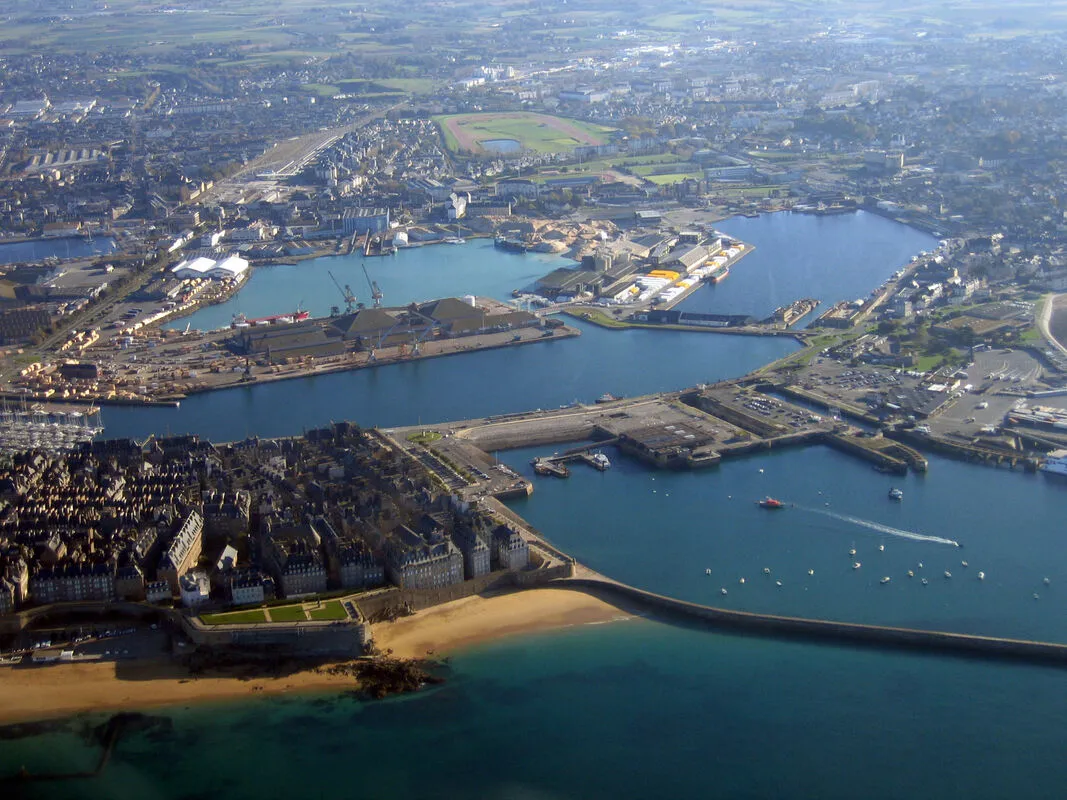
When the tide comes in beneath the ramparts of Saint-Malo, the corsair city becomes an island once more. That image, one of the most striking in Brittany, is merely the opening act of Ille-et-Vilaine. From Rennes, the reinvented Breton capital with its half-timbered houses and buzzing bars, to the forests of Broceliande where Arthurian legend still feels alive, this department opens the door to a Brittany far richer than most suspect.
Saint-Malo: The Corsair City
Saint-Malo hits you immediately. The old walled city rises from a rocky promontory, its granite ramparts facing the English Channel with an attitude that is equal parts defiance and beauty. Start with a full circuit of the ramparts (about 1.7 kilometres, free), which deliver sweeping views of the sea, the offshore islands, the harbour, and the slate-roofed townhouses below. The panorama changes dramatically with the tide: at low water, you can walk across the sand to the Grand Bé, a small island where the writer Chateaubriand is buried in a tomb that faces nothing but open ocean.
Inside the walls, the streets are filled with restaurants, crêperies, and shops. The Demeure de Corsaire (around 8 euros) offers a fascinating guided visit of an 18th-century privateer's mansion, complete with hidden passages and vaulted cellars. For a broader sweep of the city's seafaring past, the History Museum in the château provides an excellent overview (about 6 euros).
The tides of Saint-Malo
Saint-Malo experiences some of Europe's largest tidal ranges -- up to 13 metres during spring tides. Watching a big tide from the ramparts, with waves crashing against the walls and spray soaking the walkways, is a thrilling spectacle. Check tide tables in advance and aim for coefficients above 100 for the most dramatic show.
Rennes: A Living Capital
Rennes confounds expectations. Far from being a grey administrative centre, it pulses with youthful energy (60,000 students) and a cultural scene that punches well above its weight. The historic quarter north of the river, miraculously spared when a great fire destroyed much of the city in 1720, is a beautiful tangle of half-timbered houses and medieval lanes.
The Parlement de Bretagne, a 17th-century masterpiece painstakingly restored after a fire in 1994, can be visited on a guided tour (around 7 euros; reservation required). The Jardin du Thabor -- ten hectares of formal French gardens, English-style parkland, and a rose garden -- is one of the loveliest urban green spaces in France, and entry is free.
The Marché des Lices, held every Saturday morning, is the second-largest market in France after the wholesale Halles de Rungis near Paris. The atmosphere is electric: farmers from across the département sell cheeses, charcuterie, fish, galettes, and cider under the market halls and in the surrounding streets. Arrive before 9 in the morning for the best selection and the liveliest crowds. This is the unmissable ritual of Rennes life.
Nightlife in Rennes
Rennes has a well-earned reputation for its nightlife, concentrated around the famous Rue de la Soif (Rue Saint-Michel) and the Place Sainte-Anne. Bars and pubs are packed side by side, and the atmosphere is lively every evening during term time. It is one of the best cities in France for a relaxed pub crawl.
Dinard: Belle Epoque Elegance
Across the Rance estuary from Saint-Malo, Dinard offers a completely different mood. This seaside resort boomed in the late 19th century when wealthy British and American families built extravagant villas along its shores -- neo-Gothic, Moorish, neo-Norman, and every revival style in between. The Promenade du Clair de Lune, a 2-kilometre waterfront path passing beneath these grand houses, is best walked at sunset when the light turns the facades gold and the reflections shimmer across the water.
In summer, Dinard hosts the British Film Festival, screening films in gorgeous settings. The Plage de l'Ecluse, with its iconic blue-and-white striped beach tents, is the postcard image of the town. A water bus connects Dinard to Saint-Malo in 10 minutes (about 8 euros return), making it easy to combine both towns in a single day.
Cancale: Oyster Capital
Fifteen kilometres east of Saint-Malo, Cancale is a pilgrimage site for oyster lovers. The harbour of La Houle, lined with oyster shacks, is where you sample the renowned Cancale flat oysters directly from the producers, practically at the water's edge. Expect to pay around 8 euros per dozen for oysters of unbeatable freshness, served with rye bread and salted butter.
The open-air oyster market at the bottom of the slipway operates daily. Buy your oysters, perch on the sea wall overlooking the Bay of Mont-Saint-Michel, and eat them with nothing but lemon, the breeze, and one of the best views in Brittany. For those curious about the process, the Ferme Marine runs guided tours (about 11 euros) that explain the full lifecycle of an oyster from spat to plate.
Fougeres: Europe's Largest Medieval Fortress
Fougères is home to what is genuinely the largest medieval castle in Europe -- and the claim stands up to scrutiny. The fortress (around 8 euros), built and expanded between the 11th and 15th centuries, spreads across more than 2 hectares at the bottom of a loop in the Nançon River, bristling with 13 towers. Victor Hugo, upon seeing it, called it "the Carcassonne of the North."
Allow 1.5 to 2 hours for the castle visit. From the public garden above, you get a commanding view of the entire fortification -- one of the most photogenic castle panoramas in France. The upper town is also worth exploring, with its half-timbered houses and 14th-century belfry. Fougères is 45 minutes from Rennes by car and remains surprisingly under-visited: even in high summer, you may find yourself wandering the ramparts in near solitude.
Vitre: A Medieval Time Capsule
Forty minutes east of Rennes, Vitre is one of Brittany's most perfectly preserved medieval towns. Its castle, bristling with pointed towers, overlooks a maze of streets where 15th- and 16th-century half-timbered houses look as though the intervening five centuries never happened. The Rue de la Baudrairie and Rue d'Embas are particularly photogenic. The castle itself is free to enter (occasional paid exhibitions). Vitre pairs naturally with Fougeres for a day dedicated to the great border fortresses of the Breton Marches.
The Emerald Coast
The northern coastline of Ille-et-Vilaine is part of the Cote d'Emeraude (Emerald Coast), named for the jade-green colour of its waters. East of Saint-Malo, the coastal path offers views across the Bay of Mont-Saint-Michel. To the west, the beaches of Saint-Lunaire, Saint-Briac, and Saint-Cast-le-Guildo alternate fine sand with rocky headlands in unspoiled settings. These resorts are quieter and more family-oriented than Saint-Malo, perfect for laying out a towel and swimming in the emerald waters that gave the coast its name.
Practical Information
- Getting there: TGV from Paris to Rennes in just 1 hour 25 minutes, one of the fastest long-distance rail links in France. Paris to Saint-Malo takes about 2 hours 30 minutes (change at Rennes). Rennes Bretagne Airport offers connections to several French and European cities.
- Best time to visit: May through September. Spring tides (mainly March and September) are a must-see spectacle in Saint-Malo. Check a tide calendar before planning your trip.
- Getting around: the regional bus and train network (BreizhGo) provides decent connections between Rennes, Saint-Malo, Dinard, and Cancale. A car is recommended for Fougeres and Vitre.
- Food budget: a buckwheat galette runs 8 to 13 euros; a dozen oysters in Cancale start at about 8 euros; a gastronomic restaurant menu in Rennes costs 30 to 50 euros.
- Don't miss: sunset from the Saint-Malo ramparts, the Saturday morning market in Rennes, and eating oysters by the water in Cancale.
Explore on the map
Map →